Sieber Tim, Ducke Jana, Rietig Anja, Langner Thomas, Acker Jörg
Department of Physical Chemistry, Brandenburg Technical University Cottbus-Senftenberg, Universitätsplatz 1, D-01968 Senftenberg, Germany.
Nanomaterials (Basel). 2019 Feb 12;9(2):246. doi: 10.3390/nano9020246.
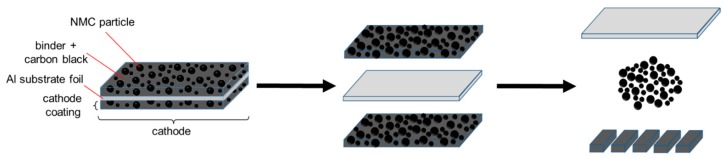
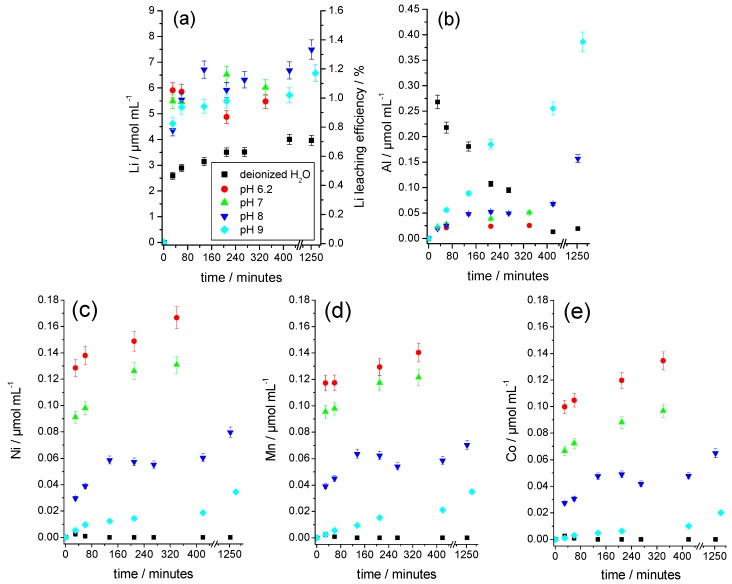
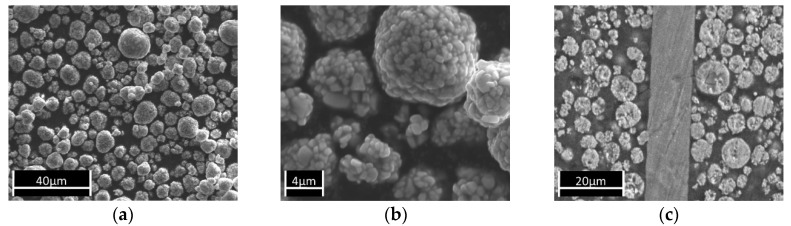
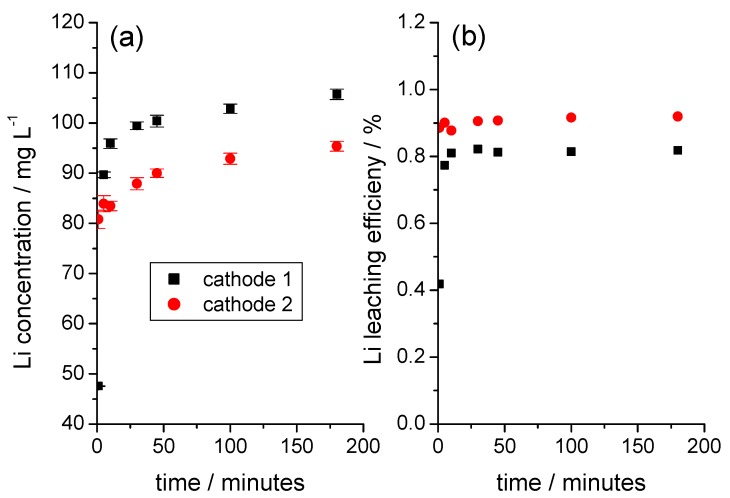
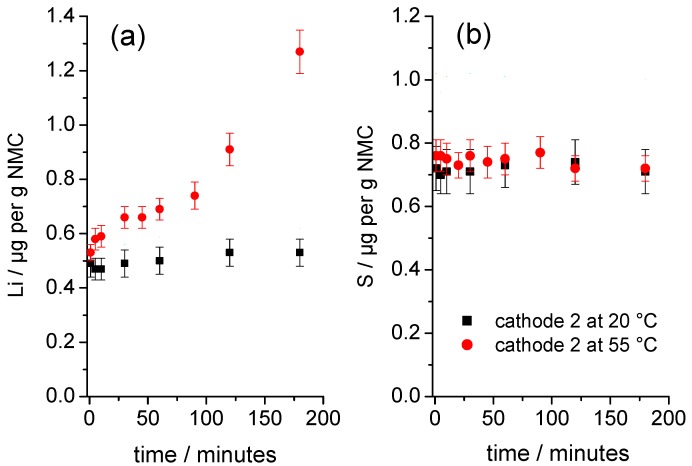
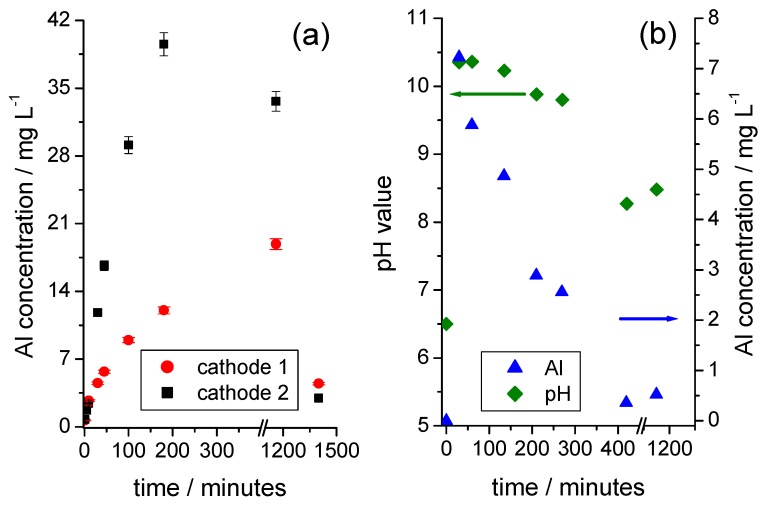
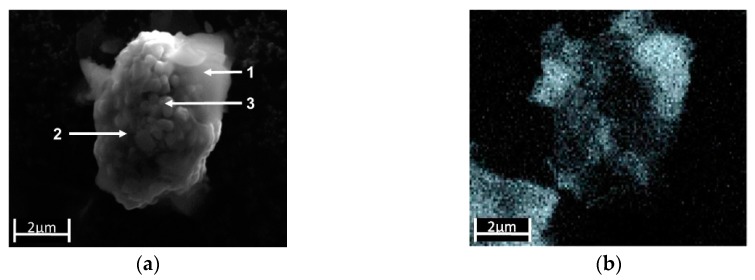
Nickel⁻manganese⁻cobalt oxides, with LiNiMnCoO₂ (NMC) as the most prominent compound, are state-of-the-art cathode materials for lithium-ion batteries in electric vehicles. The growing market for electro mobility has led to a growing global demand for Li, Co, Ni, and Mn, making spent lithium-ion batteries a valuable secondary resource. Going forward, energy- and resource-inefficient pyrometallurgical and hydrometallurgical recycling strategies must be avoided. We presented an approach to recover NMC particles from spent lithium-ion battery cathodes while preserving their chemical and morphological properties, with a minimal use of chemicals. The key task was the separation of the cathode coating layer consisting of NMC, an organic binder, and carbon black, from the Al substrate foil. This can be performed in water under strong agitation to support the slow detachment process. However, the contact of the NMC cathode with water leads to a release of Li⁺ ions and a fast increase in the pH. Unwanted side reactions may occur as the Al substrate foil starts to dissolve and Al(OH)₃ precipitates on the NMC. These side reactions are avoided using pH-adjusted solutions with sufficiently high buffer capacities to separate the coating layer from the Al substrate, without precipitations and without degradation of the NMC particles.
镍锰钴氧化物,其中最典型的化合物是LiNiMnCoO₂(NMC),是电动汽车锂离子电池的先进阴极材料。电动出行市场的不断增长导致全球对锂、钴、镍和锰的需求不断增加,使废旧锂离子电池成为一种有价值的二次资源。展望未来,必须避免能源和资源效率低下的火法冶金和湿法冶金回收策略。我们提出了一种从废旧锂离子电池阴极中回收NMC颗粒的方法,同时保留其化学和形态特性,且化学品用量最少。关键任务是将由NMC、有机粘合剂和炭黑组成的阴极涂层与铝基箔分离。这可以在强烈搅拌的水中进行,以支持缓慢的分离过程。然而,NMC阴极与水接触会导致Li⁺离子释放和pH值快速升高。随着铝基箔开始溶解且Al(OH)₃在NMC上沉淀,可能会发生不必要的副反应。使用具有足够高缓冲容量的pH调节溶液来将涂层与铝基分离,可避免这些副反应,不会产生沉淀且不会使NMC颗粒降解。