Clinical Epidemiology Unit, National Clinical Research Centre, Ministry of Health Malaysia, Level 2, Block B4, National Institute of Health, Jalan Setia Murni U13/52, Seksyen U13, 40170, Shah Alam, Selangor Darul Ehsan, Malaysia.
Healthcare Statistics Unit, National Clinical Research Centre, Ministry of Health Malaysia, Level 4, Block B4, National Institute of Health, Jalan Setia Murni U13/52, Seksyen U13, 40170, Shah Alam, Selangor Darul Ehsan, Malaysia.
BMC Infect Dis. 2019 Feb 13;19(1):152. doi: 10.1186/s12879-019-3786-9.
A major outbreak of the Zika virus (ZIKV) has been reported in Brazil in 2015. Since then, it spread further to other countries in the Americas and resulted in declaration of the Public Health Emergency of International Concern (PHEIC) by World Health Organization. In 2016, Singapore reported its first minor ZIKV epidemic. Malaysia shares similar ecological environment as Brazil and Singapore which may also favor ZIKV transmission. However, no ZIKV outbreak has been reported in Malaysia to date. This study aimed to discuss all confirmed ZIKV cases captured under Malaysia ZIKV surveillance system after declaration of the PHEIC; and explore why Malaysia did not suffer a similar ZIKV outbreak as the other two countries.
This was an observational study reviewing all confirmed ZIKV cases detected in Malaysia through the ZIKV clinical surveillance and Flavivirus laboratory surveillance between June 2015 and December 2017. All basic demographic characteristics, co-morbidities, clinical, laboratory and outcome data of the confirmed ZIKV cases were collected from the source documents.
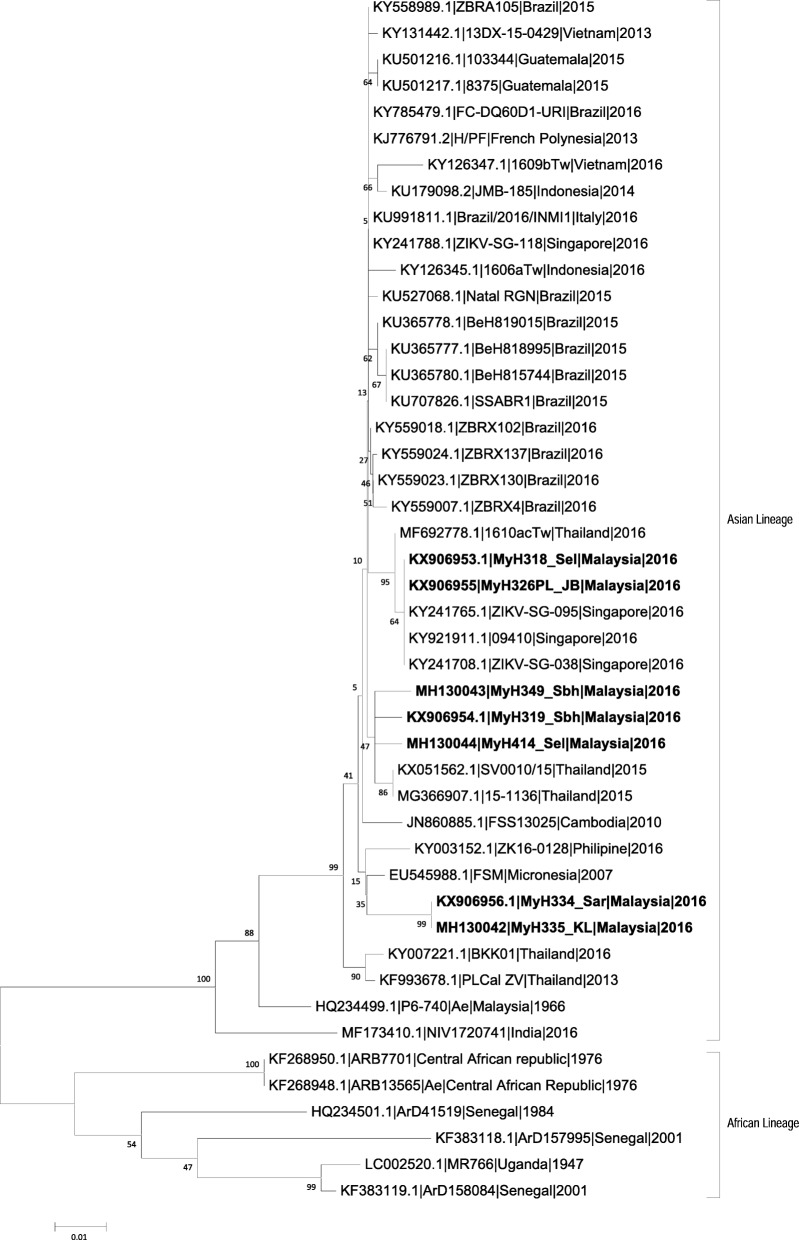
Only eight out of 4043 cases tested positive for ZIKV infection during that period. The median age of infected patients was 48.6 years and majority was Chinese. Two of the subjects were pregnant. The median interval between the onset of disease and the first detection of ZIKV Ribonucleic Acid (RNA) in body fluid was 3 days. Six cases had ZIKV RNA detected in both serum and urine samples. Phylogenetic analysis suggests that isolates from the 7 cases of ZIKV infection came from two clusters, both of which were local circulating strains.
Despite similar ecological background characteristics, Malaysia was not as affected by the recent ZIKV outbreak compared to Brazil and Singapore. This could be related to pre-existing immunity against ZIKV in this population, which developed after the first introduction of the ZIKV in Malaysia decades ago. A serosurvey to determine the seroprevalence of ZIKV in Malaysia was carried out in 2017. The differences in circulating ZIKV strains could be another reason as to why Malaysia seemed to be protected from an outbreak.
2015 年,巴西爆发了大规模的 Zika 病毒(ZIKV)疫情。此后,该病毒进一步传播到美洲其他国家,并导致世界卫生组织宣布国际关注的突发公共卫生事件(PHEIC)。2016 年,新加坡报告了首例轻微的 ZIKV 疫情。马来西亚与巴西和新加坡具有相似的生态环境,这可能也有利于 ZIKV 的传播。然而,截至目前,马来西亚尚未报告 ZIKV 疫情。本研究旨在讨论在宣布 PHEIC 后,马来西亚 ZIKV 监测系统中捕获的所有确诊 ZIKV 病例,并探讨为什么马来西亚没有像其他两个国家那样爆发类似的 ZIKV 疫情。
这是一项观察性研究,回顾了 2015 年 6 月至 2017 年 12 月期间,通过 ZIKV 临床监测和黄病毒实验室监测在马来西亚发现的所有确诊 ZIKV 病例。从原始文件中收集了所有确诊 ZIKV 病例的基本人口统计学特征、合并症、临床、实验室和结局数据。
在这段时间内,4043 例检测样本中只有 8 例呈 ZIKV 感染阳性。感染患者的中位年龄为 48.6 岁,多数为华人。其中 2 例为孕妇。疾病发作与首次检测到体液中 ZIKV 核糖核酸(RNA)之间的中位间隔为 3 天。6 例血清和尿液样本均检测到 ZIKV RNA。系统发育分析表明,7 例 ZIKV 感染分离株来自两个聚类,均为当地循环株。
尽管具有相似的生态背景特征,但与巴西和新加坡相比,马来西亚受近期 ZIKV 疫情的影响较小。这可能与该人群中存在针对 ZIKV 的固有免疫力有关,这种免疫力是在几十年前马来西亚首次引入 ZIKV 时产生的。2017 年在马来西亚进行了一项血清学调查,以确定 ZIKV 的血清流行率。循环 ZIKV 株的差异可能是马来西亚似乎免受疫情爆发影响的另一个原因。