Programa de Pós-Graduação em Saúde Coletiva (UFJF), Laboratório de Informações Geo-referenciadas (UFJF), Juiz de Fora, Brazil.
Pós-Graduação Stricto Senso em Educação Física (PPGEFIUFV), Universidade Federal de Viçosa, Viçosa, Brazil.
BMC Public Health. 2019 Feb 13;19(1):184. doi: 10.1186/s12889-019-6488-8.
Lack of regular physical activity, high sedentary behavior and presence of unbalanced alimentary practices are attitudes associated with an inadequate lifestyle among female adolescents.
to assess the lifestyle of female adolescents based on measurements of behavioral variables.
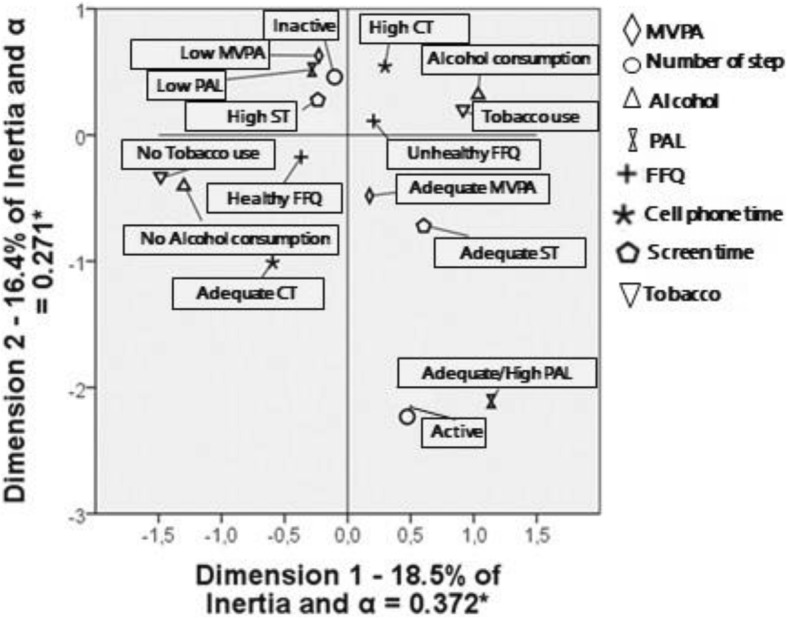
Cross-sectional study with 405 female adolescents between 14 and 19 years old, resident and attending public schools in Viçosa (state of Minas Gerais). Their lifestyle was analyzed by the Physical Activity Recall, number of steps, screen time (ST), cellphone time (CT), sitting time, food frequency questionnaire (FFQ), and alcohol and tobacco consumption. With multiple correspondence analysis it was possible to observe dispersion and approximation of the variables' categories. Latent class analysis (LCA) was used for modeling the "lifestyle" variable, having been conducted in the poLCA (Polychromous Variable Latent Class Analysis) package of the R statistical software.
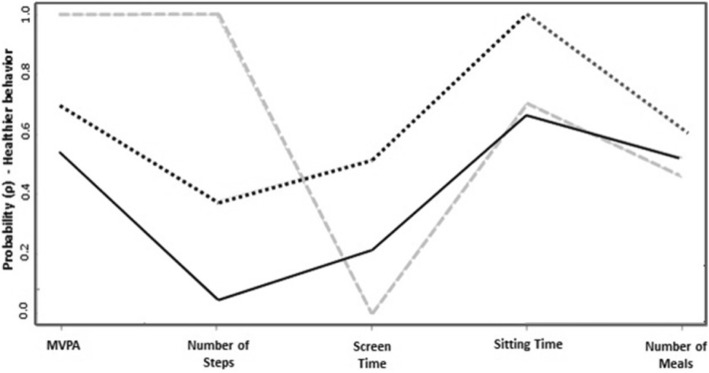
The mean age was 15.92 ± 1.27 years. Most of the adolescents were considered physically inactive (78%) and with low number of steps (82.57%); 41.45% reported not performing Moderate to Vigorous Physical Activities (MVPA) adequately. Sedentary behavior was found high when assessing ST (72.90%) and CT (65.31%). It was found the best fitted latent class model for the lifestyle (p-G = 0.055, p-χ = 0.066) featured three latent classes and one covariate (alcohol): Class 1, 'Inactive and Sedentary' (γ = 77.5%); Class 2, 'Inactive and Non-sedentary lifestyle (γ=16.31%); and Class 3, 'Active and sedentary' (γ=6.19%). Female adolescents that had 'never consumed alcohol' were 2.26 times as likely (log OR = 0.8174; p = 0.033) to belong to class 3 (Active & Sedentary lifestyle) than to class 1 (Inactive & Sedentary lifestyle).
Latent class analysis model with five manifest variable (MVPA, number of steps, ST, sitting time and number of meals) and alcohol consumption like covariate showed itself to be an accurate and objective method in the assessment of female adolescents' lifestyle. Female adolescents that had 'never consumed alcohol' were more as likely to belong to class 'Active & Sedentary lifestyle' than to class Inactive & Sedentary lifestyle. An inactive and sedentary lifestyle is coupled to other unhealthy behaviors during adolescence, possibly carrying over into adult life.
缺乏规律的体育锻炼、久坐行为较多以及饮食不均衡,这些都是女性青少年生活方式不恰当的表现。
根据行为变量的测量结果,评估女性青少年的生活方式。
本横断面研究于 2019 年在米纳斯吉拉斯州维索萨市选取了 405 名 14 至 19 岁的女性青少年为研究对象,这些青少年均为在校居民。通过体力活动回顾、步数、屏幕时间(ST)、手机时间(CT)、久坐时间、食物频率问卷(FFQ)以及酒精和烟草使用情况来评估其生活方式。采用多元对应分析可以观察变量类别之间的离散和接近程度。潜在类别分析(LCA)用于对“生活方式”变量进行建模,该分析是在 R 统计软件的 poLCA(多色变量潜在类别分析)包中进行的。
研究对象的平均年龄为 15.92±1.27 岁。大多数青少年被认为是不活跃的(78%),且步数较少(82.57%);41.45%的人报告没有进行足够的中等到剧烈强度的身体活动(MVPA)。评估 ST(72.90%)和 CT(65.31%)时,发现久坐行为较高。对于生活方式,发现拟合最优的潜在类别模型(p-G=0.055,p-χ=0.066),有三个潜在类别和一个协变量(酒精):第 1 类,“不活跃且久坐”(γ=77.5%);第 2 类,“不活跃但非久坐生活方式”(γ=16.31%);第 3 类,“活跃且久坐”(γ=6.19%)。从不饮酒的女性青少年属于第 3 类(活跃和久坐生活方式)的可能性是属于第 1 类(不活跃和久坐生活方式)的 2.26 倍(log OR=0.8174;p=0.033)。
使用包含 MVPA、步数、ST、久坐时间和用餐次数等 5 个显变量和酒精摄入作为协变量的潜在类别分析模型,在评估女性青少年的生活方式方面表现出准确性和客观性。从不饮酒的女性青少年更有可能属于“活跃和久坐”的生活方式,而不是“不活跃和久坐”的生活方式。青少年时期不活跃和久坐的生活方式与其他不健康的行为有关,这种生活方式可能会延续到成年期。