Service d'Information Promotion Éducation Santé (SIPES), Research Center in Epidemiology, Biostatistics and Clinical Research, School of Public Health, Université libre de Bruxelles (ULB), Postal address: ULB CP598, Route de Lennik 808, B-1070, Brussels, Belgium.
Research Center in Social Approaches to Health, School of Public Health, Université libre de Bruxelles (ULB), Brussels, Belgium.
BMC Public Health. 2019 Feb 13;19(1):187. doi: 10.1186/s12889-019-6509-7.
In Belgium, as in many other countries, the juvenile practice of physical activity is insufficient. A growing attention has been paid to environmental factors that may influence physical activity but with inconsistent findings. This study aims to estimate the association between daily life environment characteristics and physical activity among children 10 to 13 years old in Wallonia (Belgium).
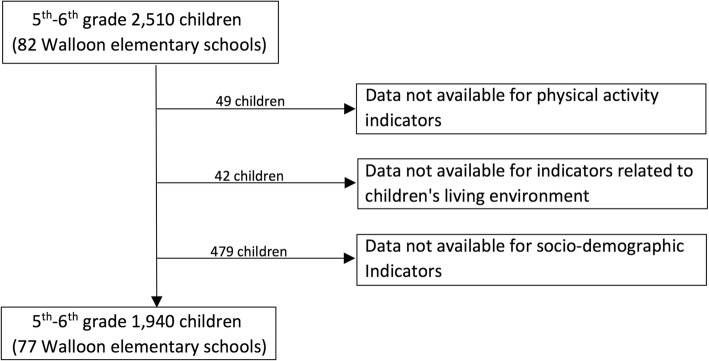
Data were collected using a self-administered questionnaire among 1940 children (HBSC survey). Associations between factors related to the children's living environment and physical activity (vigorous physical activity (VPA) ≥ twice a week; global physical activity (GPA) defined as VPA ≥ twice a week and moderate-to-vigorous physical activity ≥1 h/day) were estimated using logistic regressions adjusted for potential confounders.
Nearly three-quarters of the children practiced VPA ≥ twice a week, but only one in five practiced GPA consistent with recommendations. After adjustment, children living in a neighborhood with playgrounds or parks were more likely to achieve a recommended level of GPA (OR: 1.34 [1.04-1.73]), as were children who reported that other youngsters were present in their neighborhood with whom they could play outside (OR: 1.50 [1.12-1.99]). The presence of neighborhood children was also positively associated with VPA (OR: 1.80 [1.42-2.29]); in stratified analyses, the association was significant only among boys (OR: 1.95 [1.34-2.82]). Moreover, and only in girls (OR: 1.66 [1.10-2.49]), a feeling of safety in one's neighborhood was positively associated with VPA. No association was found between VPA and the existence of a yard or a garden at home to go playing outside.
Our results argue for developing actions aimed at creating living environments more favorable to children's daily physical activity. More specifically, they help better understand the environment of Belgian children and thus contribute to better identify their needs.
在比利时和许多其他国家一样,青少年的身体活动量不足。人们越来越关注可能影响身体活动的环境因素,但研究结果并不一致。本研究旨在估计瓦隆大区(比利时)儿童日常生活环境特征与身体活动之间的关联。
使用自我管理问卷在 1940 名儿童(HBSC 调查)中收集数据。使用逻辑回归调整潜在混杂因素后,估计与儿童生活环境相关的因素与身体活动之间的关联(每周至少进行两次剧烈身体活动(VPA);全球身体活动(GPA)定义为每周至少进行两次 VPA 和中度至剧烈身体活动≥1 小时/天)。
近四分之三的儿童每周至少进行两次 VPA,但只有五分之一的儿童符合建议的 GPA 水平。调整后,居住在有操场或公园的社区的儿童更有可能达到推荐的 GPA 水平(OR:1.34 [1.04-1.73]),报告社区中有其他可以一起在户外玩耍的小朋友的儿童(OR:1.50 [1.12-1.99])也是如此。社区中存在其他儿童也与 VPA 呈正相关(OR:1.80 [1.42-2.29]);在分层分析中,这种关联仅在男孩中显著(OR:1.95 [1.34-2.82])。此外,仅在女孩中(OR:1.66 [1.10-2.49]),对社区的安全感与 VPA 呈正相关。VPA 与家中有院子或花园以供户外玩耍之间没有关联。
我们的研究结果表明,应采取行动,营造更有利于儿童日常身体活动的生活环境。更具体地说,它们有助于更好地了解比利时儿童的环境,从而更好地确定他们的需求。