Brussoni Mariana, Gibbons Rebecca, Gray Casey, Ishikawa Takuro, Sandseter Ellen Beate Hansen, Bienenstock Adam, Chabot Guylaine, Fuselli Pamela, Herrington Susan, Janssen Ian, Pickett William, Power Marlene, Stanger Nick, Sampson Margaret, Tremblay Mark S
British Columbia Injury Research & Prevention Unit, Child & Family Research Institute, University of British Columbia, British Columbia Children's Hospital, F511-4480 Oak Street, Vancouver, BC V6H 3V4, Canada.
Department of Pediatrics, School of Population & Public Health, University of British Columbia, British Columbia Children's Hospital, F511-4480 Oak Street, Vancouver, BC V6H 3V4, Canada.
Int J Environ Res Public Health. 2015 Jun 8;12(6):6423-54. doi: 10.3390/ijerph120606423.
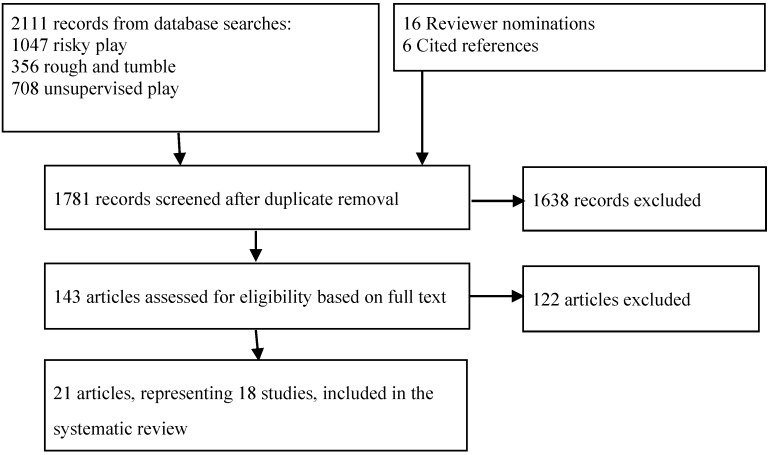
Risky outdoor play has been associated with promoting children's health and development, but also with injury and death. Risky outdoor play has diminished over time, concurrent with increasing concerns regarding child safety and emphasis on injury prevention. We sought to conduct a systematic review to examine the relationship between risky outdoor play and health in children, in order to inform the debate regarding its benefits and harms. We identified and evaluated 21 relevant papers for quality using the GRADE framework. Included articles addressed the effect on health indicators and behaviours from three types of risky play, as well as risky play supportive environments. The systematic review revealed overall positive effects of risky outdoor play on a variety of health indicators and behaviours, most commonly physical activity, but also social health and behaviours, injuries, and aggression. The review indicated the need for additional "good quality" studies; however, we note that even in the face of the generally exclusionary systematic review process, our findings support the promotion of risky outdoor play for healthy child development. These positive results with the marked reduction in risky outdoor play opportunities in recent generations indicate the need to encourage action to support children's risky outdoor play opportunities. Policy and practice precedents and recommendations for action are discussed.
危险的户外玩耍既与促进儿童健康和发展有关,也与受伤和死亡相关。随着时间的推移,危险的户外玩耍有所减少,与此同时,人们对儿童安全的担忧与日俱增,对预防伤害的重视程度也不断提高。我们试图进行一项系统综述,以研究危险的户外玩耍与儿童健康之间的关系,为有关其利弊的辩论提供参考。我们使用GRADE框架识别并评估了21篇相关论文的质量。纳入的文章探讨了三种危险玩耍类型以及支持危险玩耍的环境对健康指标和行为的影响。该系统综述揭示了危险的户外玩耍对各种健康指标和行为总体上具有积极影响,最常见的是身体活动,还有社会健康和行为、受伤情况以及攻击性。该综述表明需要更多“高质量”研究;然而,我们注意到,即使面对普遍具有排他性的系统综述过程,我们的研究结果仍支持为促进儿童健康发展而推动危险的户外玩耍。这些积极结果以及近几代人危险户外玩耍机会显著减少的情况表明,有必要鼓励采取行动支持儿童进行危险户外玩耍的机会。文中还讨论了政策和实践先例以及行动建议。