Royal Veterinary College, University of London, London NW1 0TU, United Kingdom.
Department of Biomedical Science and Engineering, Konkuk University, Seoul 05029, Korea.
Genome Res. 2019 Apr;29(4):576-589. doi: 10.1101/gr.239863.118. Epub 2019 Feb 13.
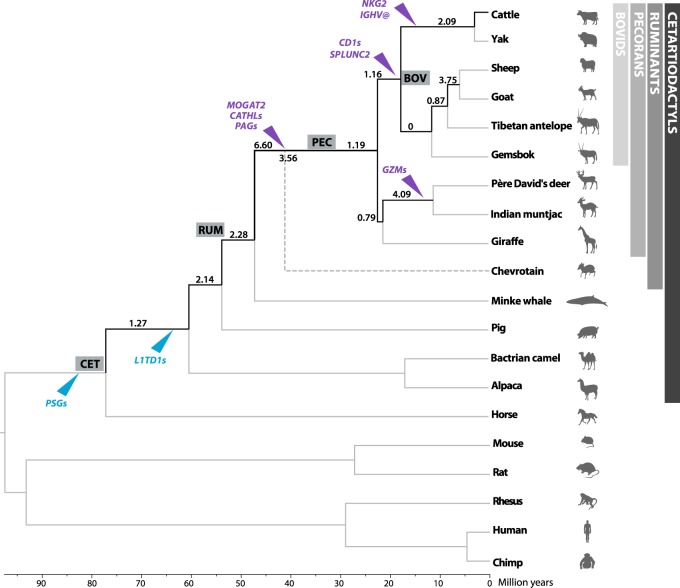
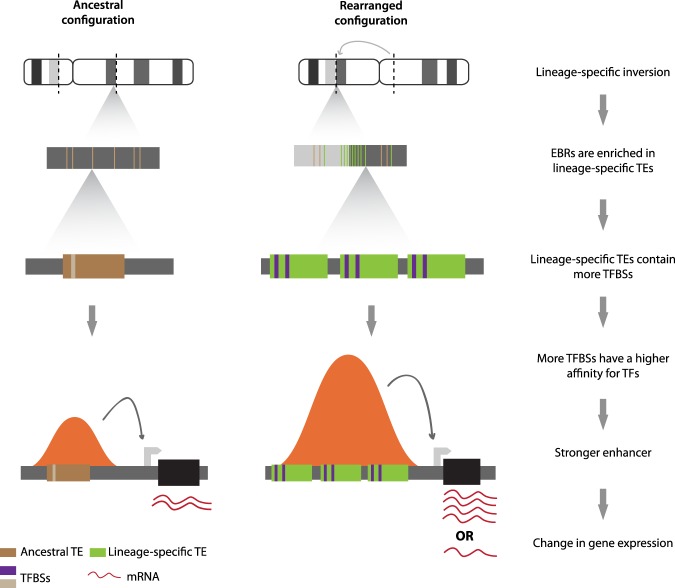
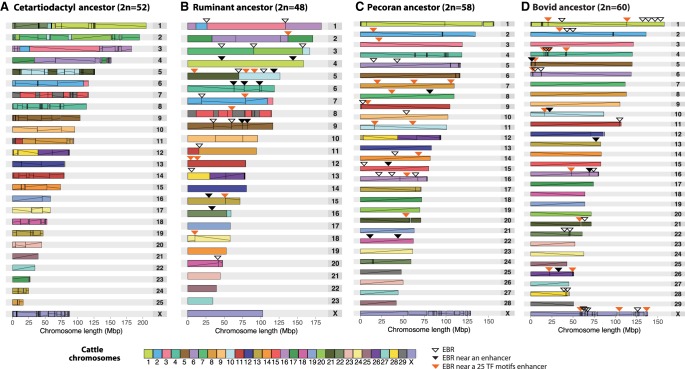
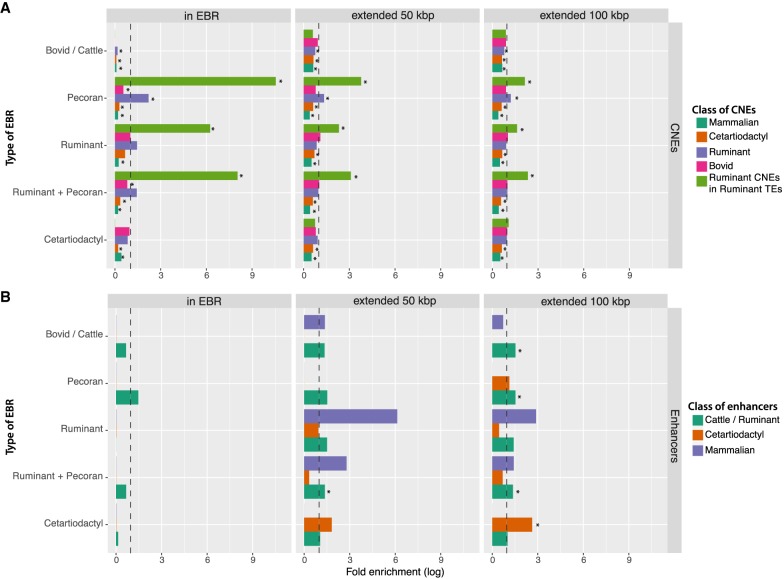
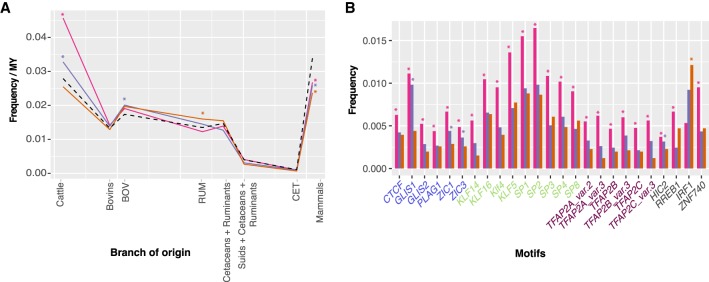
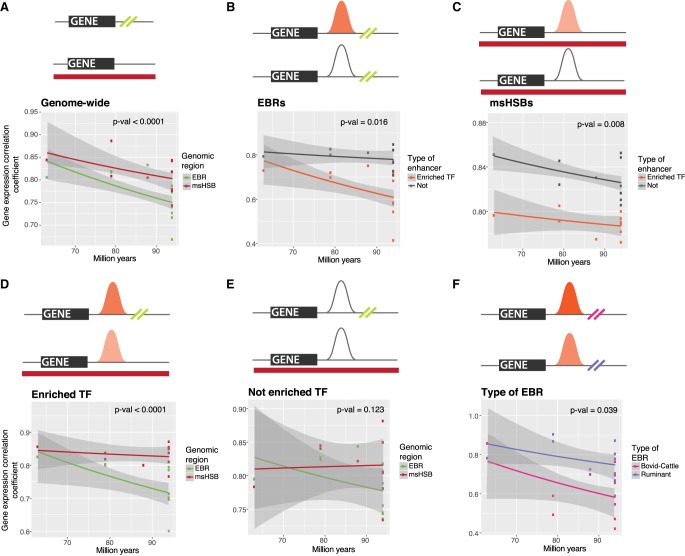
The role of chromosome rearrangements in driving evolution has been a long-standing question of evolutionary biology. Here we focused on ruminants as a model to assess how rearrangements may have contributed to the evolution of gene regulation. Using reconstructed ancestral karyotypes of Cetartiodactyls, Ruminants, Pecorans, and Bovids, we traced patterns of gross chromosome changes. We found that the lineage leading to the ruminant ancestor after the split from other cetartiodactyls was characterized by mostly intrachromosomal changes, whereas the lineage leading to the pecoran ancestor (including all livestock ruminants) included multiple interchromosomal changes. We observed that the liver cell putative enhancers in the ruminant evolutionary breakpoint regions are highly enriched for DNA sequences under selective constraint acting on lineage-specific transposable elements (TEs) and a set of 25 specific transcription factor (TF) binding motifs associated with recently active TEs. Coupled with gene expression data, we found that genes near ruminant breakpoint regions exhibit more divergent expression profiles among species, particularly in cattle, which is consistent with the phylogenetic origin of these breakpoint regions. This divergence was significantly greater in genes with enhancers that contain at least one of the 25 specific TF binding motifs and located near bovidae-to-cattle lineage breakpoint regions. Taken together, by combining ancestral karyotype reconstructions with analysis of regulatory element and gene expression evolution, our work demonstrated that lineage-specific regulatory elements colocalized with gross chromosome rearrangements may have provided valuable functional modifications that helped to shape ruminant evolution.
染色体重排在推动进化中的作用一直是进化生物学的一个长期问题。在这里,我们以反刍动物为模型,评估重排如何有助于基因调控的进化。利用偶蹄目、反刍动物、有蹄类和牛科动物的祖先染色体组型重建,我们追踪了染色体结构重排的模式。我们发现,在与其他偶蹄类动物分离后导致反刍动物祖先的谱系特征是主要的染色体内部变化,而导致有蹄类动物祖先(包括所有家畜反刍动物)的谱系则包括多个染色体间变化。我们观察到,在反刍动物进化断裂点区域的肝细胞假定增强子中,作用于谱系特异性转座元件(TEs)的选择性约束下的 DNA 序列高度富集,并且一组 25 个特定的转录因子(TF)结合基序与最近活跃的 TEs 相关联。结合基因表达数据,我们发现,在物种之间,位于反刍动物断裂点区域附近的基因表达谱更为发散,特别是在牛科动物中,这与这些断裂点区域的系统发育起源一致。在含有至少一个 25 个特定 TF 结合基序且位于牛科到牛科断裂点区域附近的增强子的基因中,这种发散更为显著。总的来说,通过将祖先染色体组型重建与调节元件和基因表达进化分析相结合,我们的工作表明,与谱系特异性调节元件共定位的染色体结构重排可能提供了有价值的功能修饰,有助于塑造反刍动物的进化。