Infectious Disease Research Institute, Seattle, Washington, United States of America.
Department of Global Health, University of Washington, Seattle, Washington, United States of America.
PLoS Negl Trop Dis. 2019 Feb 14;13(2):e0007083. doi: 10.1371/journal.pntd.0007083. eCollection 2019 Feb.
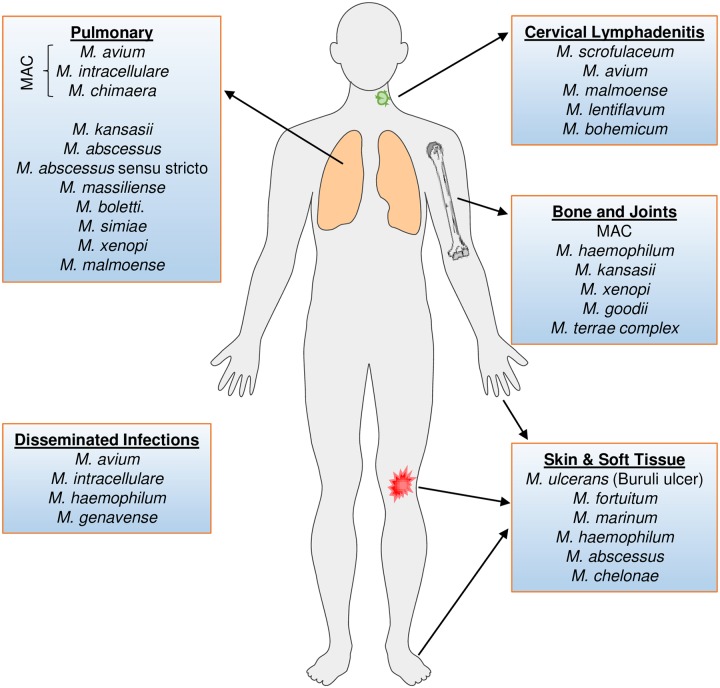
Seemingly innocuous nontuberculous mycobacteria (NTM) species, classified by their slow or rapid growth rates, can cause a wide range of illnesses, from skin ulceration to severe pulmonary and disseminated disease. Despite their worldwide prevalence and significant disease burden, NTM do not garner the same financial or research focus as Mycobacterium tuberculosis. In this review, we outline the most abundant of over 170 NTM species and inadequacies of diagnostics and treatments and weigh the advantages and disadvantages of currently available in vivo animal models of NTM. In order to effectively combat this group of mycobacteria, more research focused on appropriate animal models of infection, screening of chemotherapeutic compounds, and development of anti-NTM vaccines and diagnostics is urgently needed.
看似无害的非结核分枝杆菌(NTM)物种,根据其生长速度的快慢进行分类,可引起多种疾病,从皮肤溃疡到严重的肺部和播散性疾病。尽管 NTM 在全球范围内广泛存在且疾病负担巨大,但它们并没有像结核分枝杆菌那样获得同样的财务或研究关注。在这篇综述中,我们概述了 170 多种 NTM 物种中最丰富的物种,以及诊断和治疗方法的不足,并权衡了目前用于 NTM 的体内动物模型的优缺点。为了有效地对抗这群分枝杆菌,迫切需要更多的研究来关注感染的适当动物模型、化学治疗化合物的筛选以及抗 NTM 疫苗和诊断方法的开发。