Department of Medicine and Liver Center, University of California, San Francisco, San Francisco, California.
Department of Medicine and Liver Center, University of California, San Francisco, San Francisco, California.
Cell Mol Gastroenterol Hepatol. 2019;7(4):749-761. doi: 10.1016/j.jcmgh.2019.02.001. Epub 2019 Feb 11.
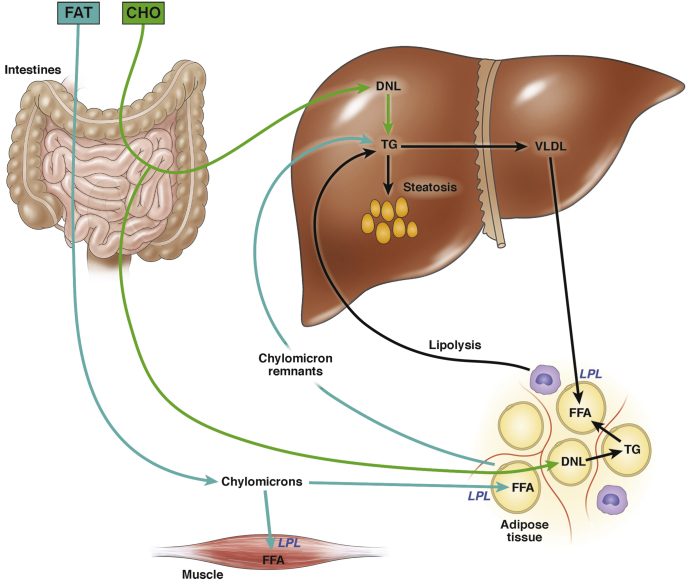
Macronutrient metabolism is a highly orchestrated process, with adipose tissue and liver each playing central roles in nutrient uptake, processing, transport, and storage. These 2 tissues form an important metabolic circuit, particularly as it relates to lipids as the primary storage form of excess energy. The function of the circuit is influenced by many factors, including the quantity and type of nutrients consumed and their impact on the overall health of the tissues. In this review we begin with a brief summary of the homeostatic disposition of lipids between adipose tissue and liver and how these processes can become dysregulated in obesity. We then explore how specific dietary nutrients and nutrient combinations can exert unique influences on the liver-adipose tissue axis.
宏量营养素代谢是一个高度协调的过程,脂肪组织和肝脏在营养物质的摄取、加工、运输和储存方面都起着核心作用。这两个组织形成了一个重要的代谢回路,特别是在脂质作为多余能量的主要储存形式方面。该回路的功能受到许多因素的影响,包括所消耗的营养物质的数量和类型及其对组织整体健康的影响。在这篇综述中,我们首先简要总结了脂肪组织和肝脏之间脂质的体内平衡分布,以及这些过程在肥胖症中如何失调。然后,我们探讨了特定的膳食营养素和营养素组合如何对肝-脂肪组织轴产生独特的影响。