Department of Medical Microbiology, University of Groningen, University Medical Center Groningen, Groningen, the Netherlands.
Department of Medical Microbiology, University of Groningen, University Medical Center Groningen, Groningen, the Netherlands.
Vaccine. 2019 Mar 14;37(12):1630-1637. doi: 10.1016/j.vaccine.2019.01.086. Epub 2019 Feb 11.
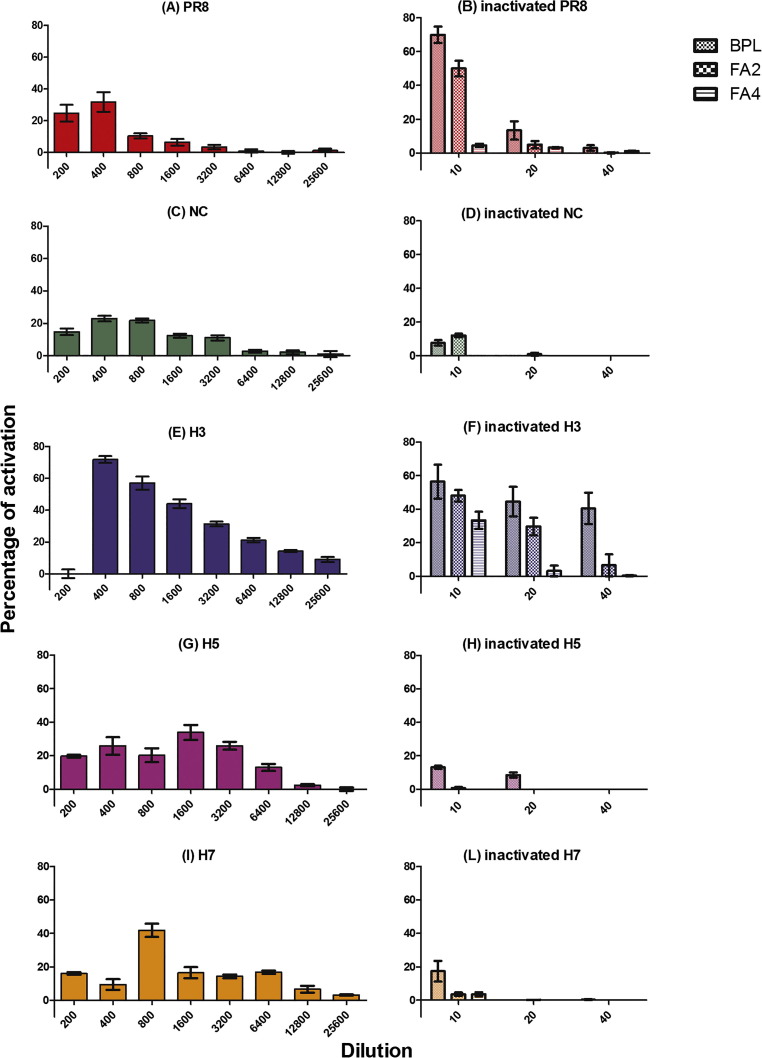
The vast majority of commercially available inactivated influenza vaccines are produced from egg-grown or cell-grown live influenza virus. The first step in the production process is virus inactivation with β-propiolactone (BPL) or formaldehyde (FA). Recommendations for production of inactivated vaccines merely define the maximal concentration for both reagents, leaving the optimization of the process to the manufacturers. We assessed the effect of inactivation with BPL and FA on 5 different influenza virus strains. The properties of the viral formulation, such as successful inactivation, preservation of hemagglutinin (HA) binding ability, fusion capacity and the potential to stimulate a Toll-like receptor 7 (TLR7) reporter cell line were then assessed and compared to the properties of the untreated virus. Inactivation with BPL resulted in undetectable infectivity levels, while FA-treated virus retained very low infectious titers. Hemagglutination and fusion ability were highly affected by those treatments that conferred higher inactivation, with BPL-treated virus binding and fusing at a lower degree compared to FA-inactivated samples. On the other hand, BPL-inactivated virus induced higher levels of activation of TLR7 than FA-inactivated virus. The alterations caused by BPL or FA treatments were virus strain dependent. This data shows that the inactivation procedures should be tailored on the virus strain, and that many other elements beside the concentration of the inactivating agent, such as incubation time and temperature, buffer and virus concentration, have to be defined to achieve a functional product.
绝大多数市售的流感灭活疫苗都是由鸡蛋或细胞培养的活流感病毒制成的。生产过程的第一步是用β-丙内酯(BPL)或甲醛(FA)进行病毒灭活。生产灭活疫苗的建议仅定义了两种试剂的最大浓度,而将该过程的优化留给制造商。我们评估了 BPL 和 FA 对 5 种不同流感病毒株的灭活效果。然后评估了病毒制剂的特性,如成功灭活、保持血凝素(HA)结合能力、融合能力以及刺激 Toll 样受体 7(TLR7)报告细胞系的潜力,并与未经处理的病毒的特性进行了比较。BPL 灭活导致可检测的感染性水平降低,而 FA 处理的病毒仍保留非常低的感染滴度。血凝和融合能力受到那些导致更高灭活的处理的高度影响,与 FA 灭活样本相比,BPL 处理的病毒结合和融合程度较低。另一方面,BPL 灭活的病毒诱导 TLR7 激活的水平高于 FA 灭活的病毒。BPL 或 FA 处理引起的变化取决于病毒株。这些数据表明,灭活程序应根据病毒株进行调整,并且除了灭活剂的浓度之外,许多其他因素,如孵育时间和温度、缓冲液和病毒浓度,都必须定义以实现功能性产品。