Follath Rolf, Koyama Takahisa, Lipp Vladimir, Medvedev Nikita, Tono Kensuke, Ohashi Haruhiko, Patthey Luc, Yabashi Makina, Ziaja Beata
Paul Scherrer Institute, 5232, Villigen PSI, Switzerland.
Japan Synchrotron Radiation Research Institute (JASRI), 1-1-1 Kouto, Sayo-cho, Sayo-gun, Hyogo, 679-5198, Japan.
Sci Rep. 2019 Feb 14;9(1):2029. doi: 10.1038/s41598-019-38556-0.
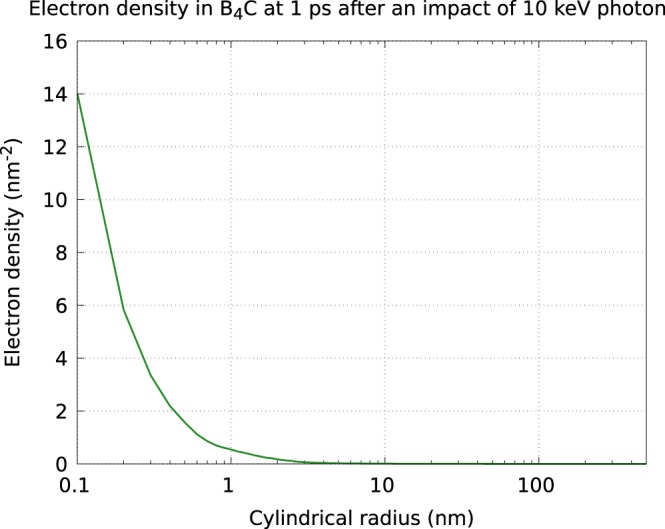
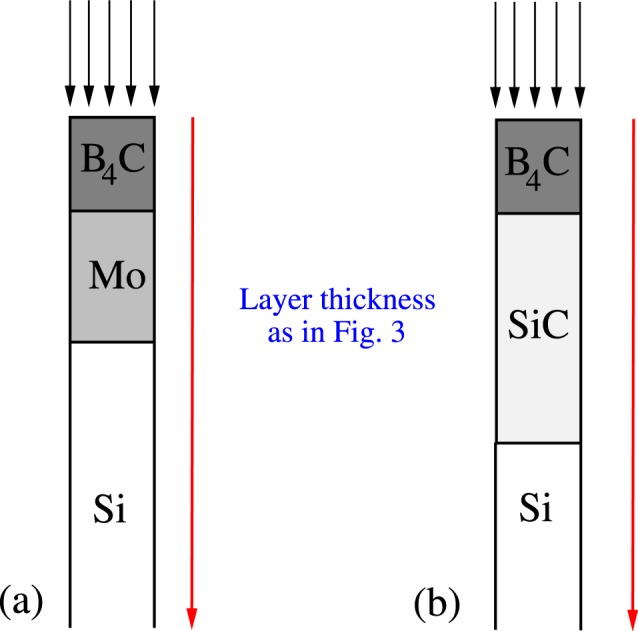
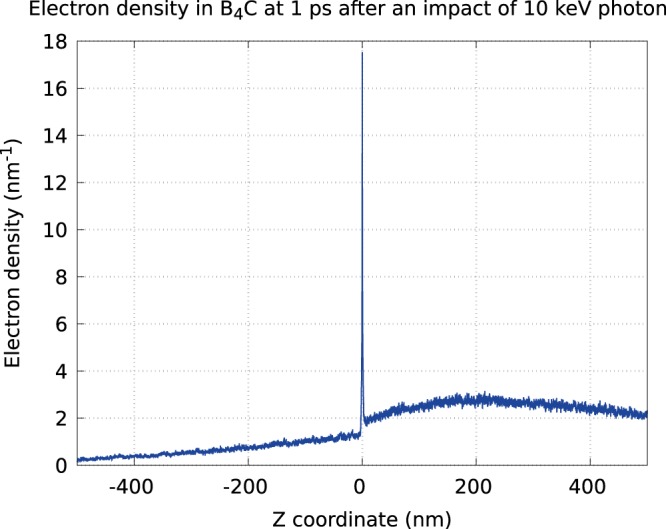
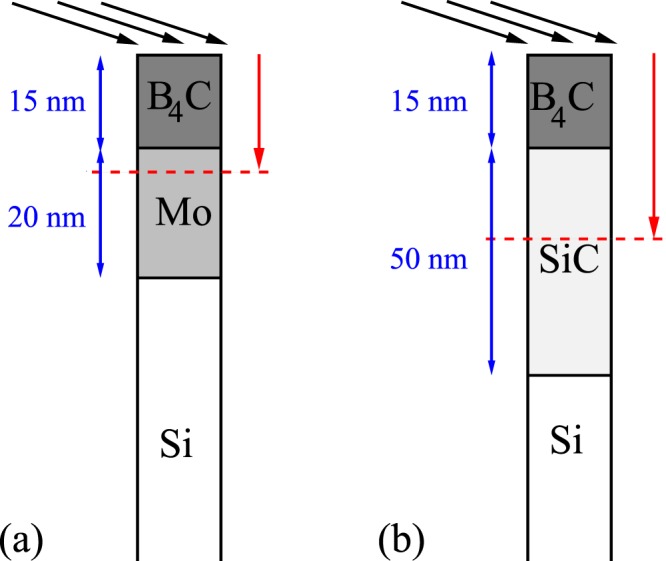
In this report, we analyse X-ray induced damage of BC-coated bilayer materials under various irradiation geometries, following the conditions of our experiment performed at the free-electron-laser facility SACLA. We start with the discussion of structural damage in solids and damage threshold doses for the experimental system components: BC, SiC, Mo and Si. Later, we analyze the irradiation of the experimentally tested coated bilayer systems under two different incidence conditions of a linearly polarized X-ray pulse: (i) grazing incidence, and (ii) normal incidence, in order to compare quantitatively the effect of the pulse incidence on the radiation tolerance of both systems. For that purpose, we propose a simple theoretical model utilizing properties of hard X-ray propagation and absorption in irradiated materials and of the following electron transport. With this model, we overcome the bottleneck problem of large spatial scales, inaccessible for any existing first-principle-based simulation tools due to their computational limitations for large systems. Predictions for damage thresholds obtained with the model agree well with the available experimental data. In particular, they confirm that two coatings tested: 15 nm BC/20 nm Mo on silicon wafer and 15 nm BC/50 nm SiC on silicon wafer can sustain X-ray irradiation at the fluences up to ~10 μJ/μm, when exposed to linearly polarized 10 keV X-ray pulse at a grazing incidence angle of 3 mrad. Below we present the corresponding theoretical analysis. Potential applications of our approach for design and radiation tolerance tests of multilayer components within X-ray free-electron-laser optics are indicated.
在本报告中,我们按照在自由电子激光设施SACLA上进行的实验条件,分析了在各种辐照几何条件下X射线对BC涂层双层材料的损伤。我们首先讨论固体中的结构损伤以及实验系统组件(BC、SiC、Mo和Si)的损伤阈值剂量。随后,我们分析了在两种不同的线性偏振X射线脉冲入射条件下对实验测试的涂层双层系统的辐照:(i)掠入射,以及(ii)正入射,以便定量比较脉冲入射对两个系统辐射耐受性的影响。为此,我们提出了一个简单的理论模型,该模型利用了硬X射线在被辐照材料中的传播和吸收特性以及随后的电子输运特性。通过这个模型,我们克服了大空间尺度的瓶颈问题,由于现有任何基于第一性原理的模拟工具对大系统的计算限制,这些大空间尺度是它们无法处理的。用该模型获得的损伤阈值预测与现有实验数据吻合良好。特别是,它们证实了测试的两种涂层:硅片上的15nm BC/20nm Mo和硅片上的15nm BC/50nm SiC,当以3mrad的掠入射角暴露于线性偏振的10keV X射线脉冲时,能够承受高达~10μJ/μm的注量的X射线辐照。以下我们给出相应的理论分析。指出了我们的方法在X射线自由电子激光光学中多层组件的设计和辐射耐受性测试方面的潜在应用。