Lakshminarayana Surendra, Augustine Dominic, Rao Roopa S, Patil Shankargouda, Awan Kamran Habib, Venkatesiah Sowmya Samudrala, Haragannavar Vanishri C, Nambiar Shwetha, Prasad Kavitha
Department of Oral Pathology and Microbiology, Faculty of Dental Sciences, Ramaiah University of Applied Sciences, Bengaluru, Karnataka, India.
Department of Maxillofacial Surgery and Diagnostic Sciences, College of Dentistry, Jazan University, Jazan, Saudi Arabia.
J Carcinog. 2018 Dec 31;17:7. doi: 10.4103/jcar.JCar_17_18. eCollection 2018.
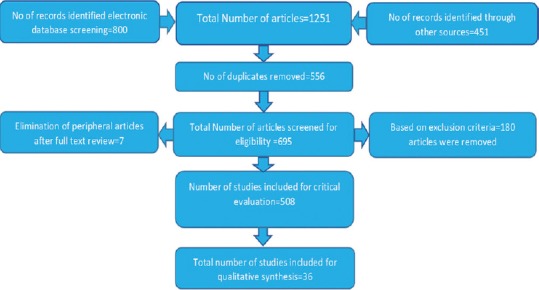
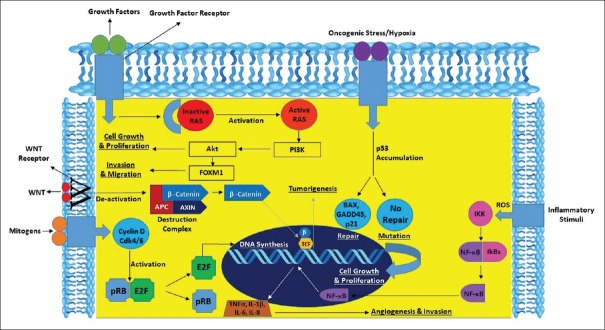
Several genes and pathways associated with oral squamous cell carcinoma (OSCC) are significant in terms of early detection and prognosis. The objective of this literature review is to evaluate the current research on molecular pathways and genes involved in oral cancer. Articles on the genes involved in oral cancer pathways were evaluated to identify potential biomarkers that can predict survival. In total, 36 articles were retrieved from internet databases, including EBSCO Host, Google Scholar, PubMed, and Science Direct, using the keywords "biomarker of oral cancer," "pathways of oral cancer," "genes involved in oral cancer," and "oral cancer pathways." A total of 36 studies related to OSCC were chosen. Most of the studies used cell lines, while others used archival tissues, few studies followed up the cases. Three major interlinked pathways found were the nuclear factor kappa B (NF-kB), PI3K-AKT, and Wnt pathways. The commonly mutated genes were cyclin D1 (CCND1), Rb, p53, FLJ10540, and TC21. The NF-kB, PI3K-AKT, and Wnt pathways are most frequently involved in the molecular pathogenesis of oral cancer. However, the CCND1, Rb, p53, FLJ10540, and TC21 genes were found to be more accurate in determining patients' overall survival. Polymerase chain reaction, immunohistochemistry, and immunoblotting were the commonly used detection methods.
与口腔鳞状细胞癌(OSCC)相关的几个基因和信号通路在早期检测和预后方面具有重要意义。本综述的目的是评估目前关于口腔癌相关分子信号通路和基因的研究。对涉及口腔癌信号通路的基因的文章进行评估,以确定可预测生存的潜在生物标志物。使用关键词“口腔癌生物标志物”“口腔癌信号通路”“口腔癌相关基因”和“口腔癌信号通路”,从互联网数据库(包括EBSCO Host、谷歌学术、PubMed和科学Direct)中总共检索到36篇文章。总共选择了36项与OSCC相关的研究。大多数研究使用细胞系,其他研究使用存档组织,很少有研究对病例进行随访。发现的三个主要相互关联的信号通路是核因子κB(NF-κB)、PI3K-AKT和Wnt信号通路。常见的突变基因有细胞周期蛋白D1(CCND1)、Rb、p53、FLJ10540和TC21。NF-κB、PI3K-AKT和Wnt信号通路最常参与口腔癌的分子发病机制。然而,发现CCND1、Rb、p53、FLJ10540和TC21基因在确定患者总生存方面更准确。聚合酶链反应、免疫组织化学和免疫印迹是常用的检测方法。