Balbinot Gustavo, Schuch Clarissa Pedrini
Brain Institute, Universidade Federal do Rio Grande do Norte, Natal, Brazil.
Graduate Program in Rehabilitation Sciences, Universidade Federal de Ciências da Saúde de Porto Alegre (UFCSPA), Porto Alegre, Brazil.
Front Neurosci. 2019 Jan 31;12:1023. doi: 10.3389/fnins.2018.01023. eCollection 2018.
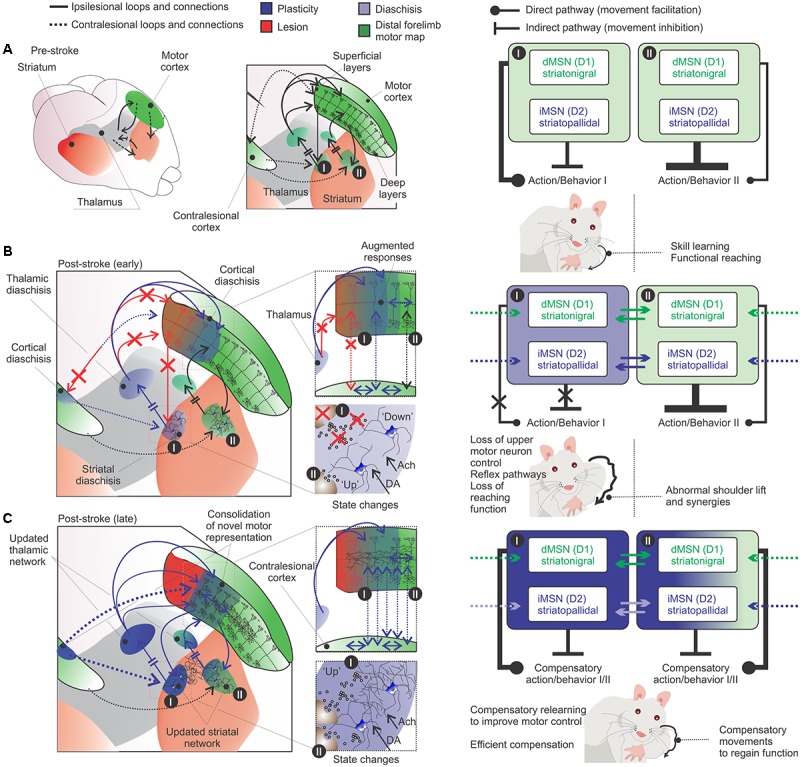
von Monakow's theory of diaschisis states the functional 'standstill' of intact brain regions that are remote from a damaged area, often implied in recovery of function. Accordingly, neural plasticity and activity patterns related to recovery are also occurring at the same regions. Recovery relies on plasticity in the periinfarct and homotopic contralesional regions and involves relearning to perform movements. Seeking evidence for a relearning mechanism following stroke, we found that rodents display many features that resemble classical learning and memory mechanisms. Compensatory relearning is likely to be accompanied by gradual shaping of these regions and pathways, with participating neurons progressively adapting cortico-striato-thalamic activity and synaptic strengths at different cortico-thalamic loops - adapting function relayed by the striatum. Motor cortex functional maps are progressively reinforced and shaped by these loops as the striatum searches for different functional actions. Several cortical and striatal cellular mechanisms that influence motor learning may also influence post-stroke compensatory relearning. Future research should focus on different neuromodulatory systems could act before, during or after rehabilitation to improve stroke recovery.
冯·莫纳科夫的去传入理论指出,远离受损区域的完整脑区会出现功能性“停滞”,这在功能恢复过程中常常有所体现。相应地,与恢复相关的神经可塑性和活动模式也在同一区域发生。恢复依赖于梗死灶周围和对侧同位区域的可塑性,并且涉及重新学习执行运动。为了寻找中风后重新学习机制的证据,我们发现啮齿动物表现出许多类似于经典学习和记忆机制的特征。代偿性重新学习可能伴随着这些区域和通路的逐渐形成,参与其中的神经元逐渐调整不同皮质 - 丘脑环路中的皮质 - 纹状体 - 丘脑活动和突触强度——调整由纹状体传递的功能。随着纹状体寻找不同的功能动作,运动皮质功能图谱会被这些环路逐渐强化和塑造。几种影响运动学习的皮质和纹状体细胞机制也可能影响中风后的代偿性重新学习。未来的研究应聚焦于不同的神经调节系统如何在康复前、康复期间或康复后发挥作用以改善中风恢复情况。