Lv Hang, Zhao Yan-Hua, Chen Jian-Guo, Wang Dong-Yan, Chen Hao
College of Psychology, Nanjing University of Chinese Medicine, Nanjing, China.
The First Medical College, Nanjing University of Chinese Medicine, Nanjing, China.
Front Psychol. 2019 Jan 31;10:64. doi: 10.3389/fpsyg.2019.00064. eCollection 2019.
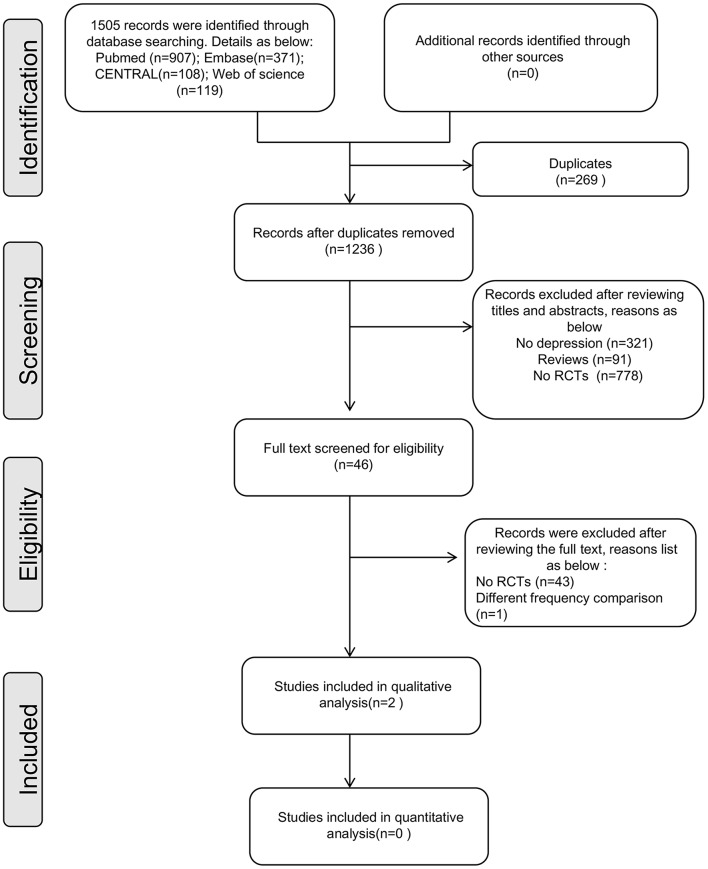
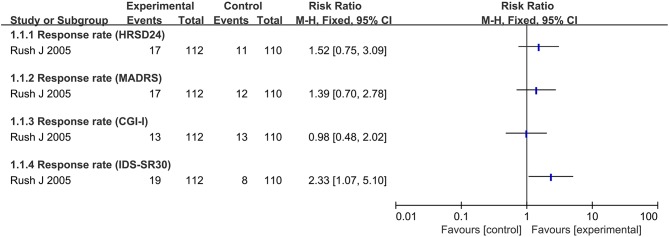
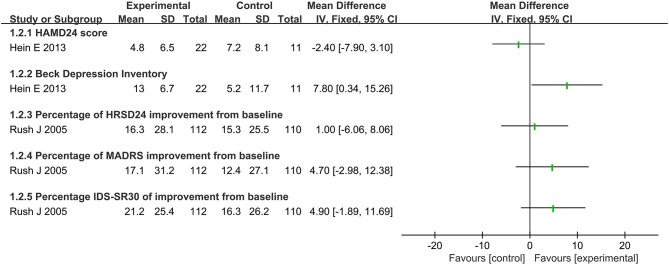
Depression is a common mental disorder worldwide. Psychological treatments and antidepressant medication are the usual treatments for depression. However, a large proportion of patients with depression do not respond to the treatments. In 2005, Vagus nerve stimulation was approved for the adjunctive long-term treatment of chronic or recurrent depression in adult patients experiencing a major depressive episode who had failed to respond to four or more adequate antidepressant treatments. However, the efficacy of VNS for treating depression remains unclear. Accordingly, we performed a systematic review to evaluate the efficacy and safety of VNS. We conducted a systematic review in accordance with the Cochrane Handbook for Systematic Reviews of Interventions. Systematic search was performed in the database of Pubmed, Embase, CENTRAL, and Web of science for identifying the suitable trials. Suicidal rate was considered as the primary outcome in this review. Only two randomized sham controlled add-on studies including 255 cases (134 with VNS treatment and 121 control cases) were included in this review. None of the studies reported suicidal rate. We performed a qualitative analysis and it is suggested that there was no significant statistic difference between VNS and sham VNS on the score of 24-item Hamilton Rating Scale for Depression (HAMD) (MD: -2.40, 95% CI: -7.90 to 3.10). Similar findings were also reported on improvement percentage of HAMD (MD: 1.00, 95%CI: -6.06 to 8.06), Montgomery-Asberg Depression Rating Scale (MADRS) (MD: 4.70, 95%CI: -2.98 to 12.38) and 30 item Inventory of Depressive Symptomalogy-Self-Report (IDS-SR) (MD: 4.9, 95%CI: -1.89 to 11.69). However, a marginal difference of Beck Depression Inventory self-rating score was detected between the real and sham treatment (MD: 7.80, 95% CI: 0.34 to 15.26). Aminor effect of IDS-SRwas also found in real VNS group (RR: 2.33, 95% CI: 1.07 to 5.10). The efficacy and safety of VNS for depression is still unclear. Further randomized controlled trials are needed to confirm the efficacy and safety of VNS.
抑郁症是一种全球常见的精神障碍。心理治疗和抗抑郁药物是治疗抑郁症的常用方法。然而,很大一部分抑郁症患者对这些治疗没有反应。2005年,迷走神经刺激被批准用于辅助长期治疗成年患者的慢性或复发性抑郁症,这些患者经历了严重抑郁发作且对四种或更多充分的抗抑郁治疗无反应。然而,迷走神经刺激治疗抑郁症的疗效仍不明确。因此,我们进行了一项系统评价以评估迷走神经刺激的疗效和安全性。我们按照《Cochrane干预措施系统评价手册》进行了系统评价。在PubMed、Embase、CENTRAL和科学网数据库中进行系统检索以确定合适的试验。自杀率被视为本次评价的主要结局。本评价仅纳入了两项随机假手术对照附加研究,共255例(134例接受迷走神经刺激治疗,121例为对照)。没有研究报告自杀率。我们进行了定性分析,结果表明迷走神经刺激组和假迷走神经刺激组在24项汉密尔顿抑郁量表(HAMD)评分上无显著统计学差异(MD:-2.40,95%CI:-7.90至3.10)。在HAMD改善百分比(MD:1.00,95%CI:-6.06至8.06)、蒙哥马利-阿斯伯格抑郁量表(MADRS)(MD:4.70,95%CI:-2.98至12.38)和30项抑郁症状自评量表(IDS-SR)(MD:4.9,95%CI:-1.89至11.69)上也有类似发现。然而,在真实治疗组和假治疗组之间检测到贝克抑郁量表自评得分有微小差异(MD:7.80,95%CI:0.34至15.26)。在真实迷走神经刺激组中也发现IDS-SR有轻微效果(RR:2.