Abu Diab Manar, Eiges Rachel
Stem Cell Research Laboratory, Medical Genetics Institute, Shaare Zedek Medical Center, Jerusalem 91031, Israel.
School of Medicine, Hebrew University of Jerusalem, Jerusalem 9112102, Israel.
Brain Sci. 2019 Feb 15;9(2):42. doi: 10.3390/brainsci9020042.
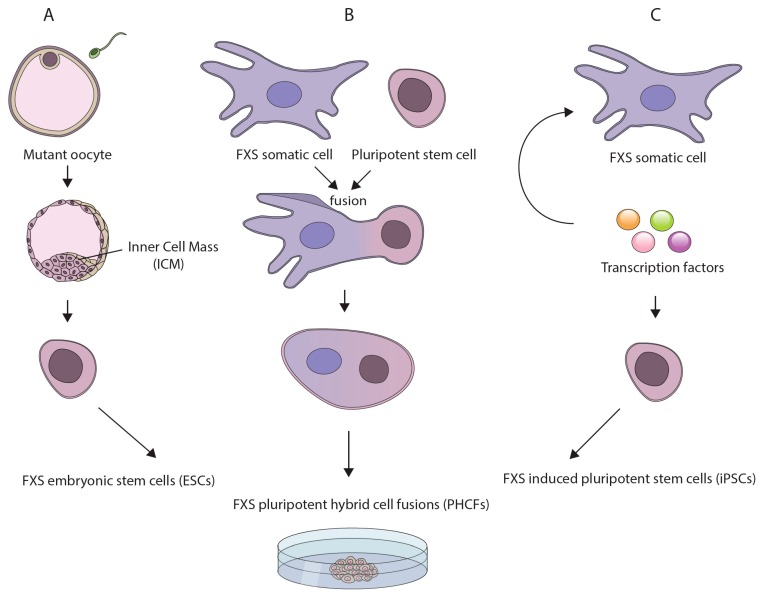
Fragile X syndrome (FXS) is the most common heritable form of cognitive impairment. It results from a deficiency in the fragile X mental retardation protein (FMRP) due to a CGG repeat expansion in the 5'-UTR of the X-linked gene. When CGGs expand beyond 200 copies, they lead to epigenetic gene silencing of the gene. In addition, the greater the allele size, the more likely it will become unstable and exhibit mosaicism for expansion size between and within tissues in affected individuals. The timing and mechanisms of epigenetic gene silencing and repeat instability are far from being understood given the lack of appropriate cellular and animal models that can fully recapitulate the molecular features characteristic of the disease pathogenesis in humans. This review summarizes the data collected to date from mutant human embryonic stem cells, induced pluripotent stem cells, and hybrid fusions, and discusses their contribution to the investigation of FXS, their key limitations, and future prospects.
脆性X综合征(FXS)是最常见的遗传性认知障碍形式。它是由于X连锁基因5'-UTR中的CGG重复序列扩增导致脆性X智力低下蛋白(FMRP)缺乏所致。当CGG重复序列扩展超过200个拷贝时,会导致该基因的表观遗传基因沉默。此外,等位基因大小越大,就越有可能变得不稳定,并在受影响个体的组织间和组织内表现出扩增大小的嵌合现象。鉴于缺乏能够完全重现人类疾病发病机制分子特征的合适细胞和动物模型,表观遗传基因沉默和重复序列不稳定性的时间和机制仍远未明确。本综述总结了迄今为止从突变人类胚胎干细胞、诱导多能干细胞和杂交融合体中收集的数据,并讨论了它们对FXS研究的贡献、关键局限性和未来前景。