a Department of Health Promotion, Economics and Policy, School of Public Health , University of Zambia , Lusaka , Zambia.
b Department of Epidemiology and Biostatistics, School of Public Health , University of Zambia , Lusaka , Zambia.
Glob Health Action. 2019;12(1):1570646. doi: 10.1080/16549716.2019.1570646.
The SAFE strategy (surgery for trichiasis, antibiotics for active infection, facial cleanliness and environmental improvement) is the World Health Organization (WHO) recommended guideline for the elimination of blindness by trachoma by the year 2020.
While evaluations on the implementation of the SAFE strategy have been done, systematic reviews on the factors that have shaped implementation are lacking. This review sought to identify these factors.
We searched PUBMED, Google Scholar, CINAHL and Cochrane Collaboration to identify studies that had implemented SAFE interventions. The Consolidated Framework for Implementation Research (CFIR) guided development of the data extraction guide and data analysis.
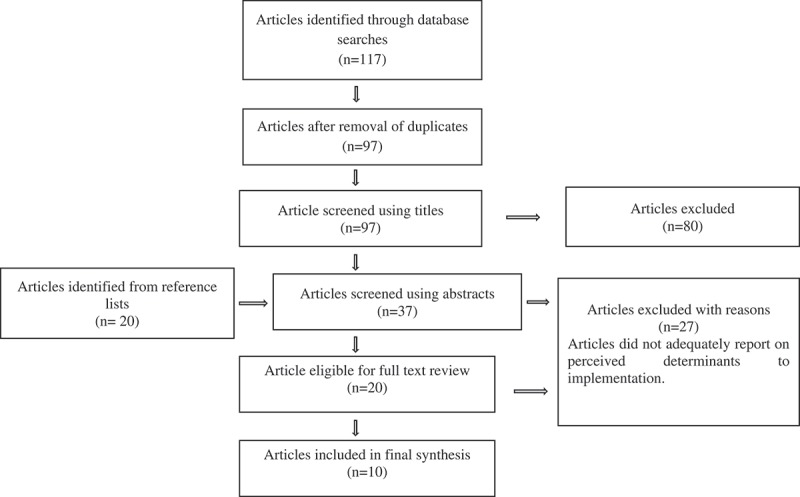
One hundred and thirty-seven studies were identified and only 10 papers fulfilled the eligibility criteria. Characteristics of the innovation - such as adaptation of the SAFE interventions to suit the setting and observability of positive health outcomes from pilots - increased local adoption. Characteristics of outer setting - which included strong multisectoral collaboration - were found to enhance implementation through the provision of resources necessary for programme activities. When community needs and resources were unaccounted for there was poor compatibility with local settings. Characteristics of the inner setting - such as poor staffing, high labour turnovers and lack of ongoing training - affected health workers' implementation behaviour. Implementation climate within provider organisations was shaped by availability of resources. Characteristics of individuals - which included low knowledge levels - affected the acceptability of SAFE programmes; however, early adopters could be used as change agents. Finally, the use of engagement strategies tailored towards promoting community participation and stakeholder involvement during the implementation process facilitated adoption process.
We found CFIR to be a robust framework capable of identifying different implementation determinants in low resource settings. However, there is a need for more research on the organisational, provider and implementation process related factors for trachoma as most studies focused on the outer setting.
SAFE 策略(针对倒睫的手术、针对活动性感染的抗生素、面部清洁和环境卫生改善)是世界卫生组织(WHO)推荐的到 2020 年消除沙眼致盲的指南。
虽然已经对 SAFE 策略的实施情况进行了评估,但缺乏对影响实施的因素进行系统评价。本综述旨在确定这些因素。
我们在 PUBMED、Google Scholar、CINAHL 和 Cochrane 协作中心搜索了实施 SAFE 干预措施的研究。实施综合框架(CFIR)指导了数据提取指南和数据分析的制定。
共确定了 137 项研究,但只有 10 篇论文符合入选标准。创新特征——例如适应 SAFE 干预措施以适应环境和从试点中观察到积极的健康结果——增加了当地的采用。外部环境特征——包括强有力的多部门合作——被发现通过提供必要的资源来增强实施,以支持项目活动。当社区需求和资源未被考虑时,与当地环境的兼容性较差。内部环境特征——例如人员配备不足、人员流动率高以及缺乏持续培训——影响卫生工作者的实施行为。提供者组织内的实施氛围受到资源可用性的影响。个体特征——包括知识水平低——影响 SAFE 计划的可接受性;然而,早期采用者可以作为变革推动者。最后,使用针对促进社区参与和利益相关者在实施过程中参与的参与策略有助于采用过程。
我们发现 CFIR 是一个强大的框架,能够在资源匮乏的环境中识别不同的实施决定因素。然而,需要对沙眼的组织、提供者和实施过程相关因素进行更多的研究,因为大多数研究都集中在外部环境上。