Kato Souichiro, Wada Kaoru, Kitagawa Wataru, Mayumi Daisuke, Ikarashi Masayuki, Sone Teruo, Asano Kozo, Kamagata Yoichi
Division of Applied Bioscience, Graduate School of Agriculture, Hokkaido University.
Bioproduction Research Institute, National Institute of Advanced Industrial Science and Technology (AIST).
Microbes Environ. 2019 Mar 30;34(1):95-98. doi: 10.1264/jsme2.ME18140. Epub 2019 Feb 15.
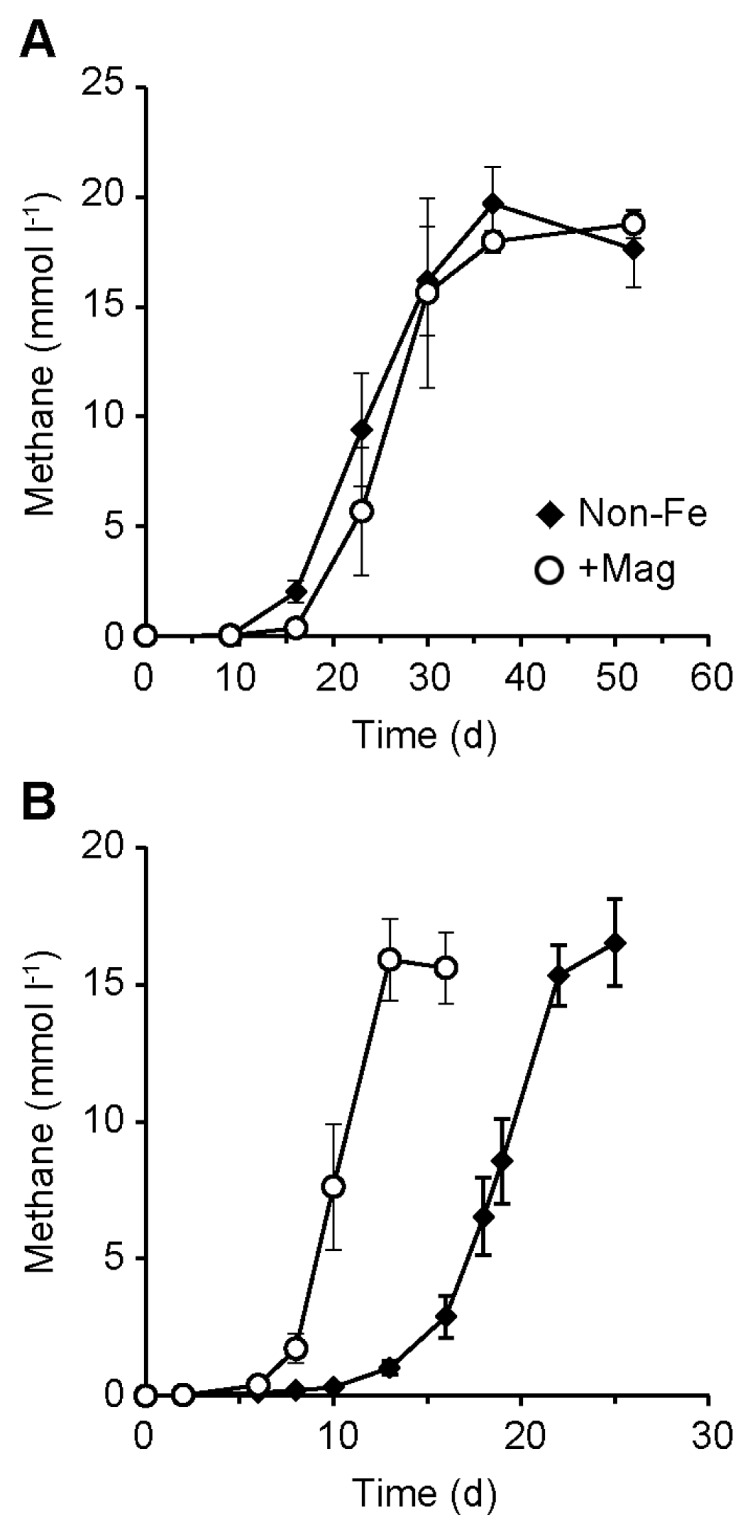
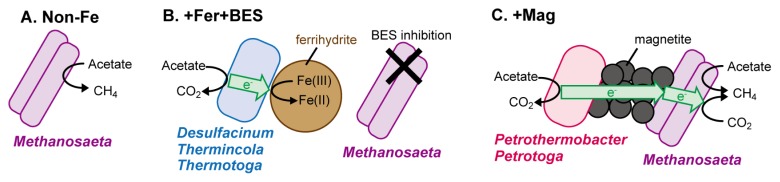
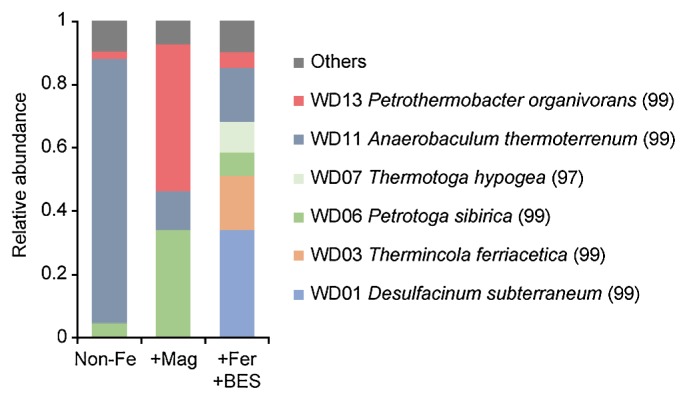
Supplementation with conductive magnetite particles promoted methanogenic acetate degradation by microbial communities enriched from the production water of a high-temperature petroleum reservoir. A microbial community analysis revealed that Petrothermobacter spp. (phylum Deferribacteres), known as thermophilic Fe(III) reducers, predominated in the magnetite-supplemented enrichment, whereas other types of Fe(III) reducers, such as Thermincola spp. and Thermotoga spp., were dominant under ferrihydrite-reducing conditions. These results suggest that magnetite induced interspecies electron transfer via electric currents through conductive particles between Petrothermobacter spp. and methanogens. This is the first evidence for possible electric syntrophy in high-temperature subsurface environments.
添加导电磁铁矿颗粒促进了从高温油藏产出水中富集的微生物群落对产甲烷乙酸盐的降解。微生物群落分析表明,作为嗜热铁(III)还原菌的石油热杆菌属(脱铁杆菌门)在添加磁铁矿的富集培养物中占主导地位,而其他类型的铁(III)还原菌,如栖热袍菌属和嗜热栖热菌属,在水铁矿还原条件下占主导地位。这些结果表明,磁铁矿通过石油热杆菌属与产甲烷菌之间的导电颗粒感应电流诱导种间电子转移。这是高温地下环境中可能存在电共生作用的首个证据。