Cheng Hui G, Augustin Dukernse, Glass Eric H, Anthony James C
Department of Epidemiology & Biostatistics, Michigan State University, East Lansing, MI, USA.
Michigan State University, East Lansing, MI, USA.
PeerJ. 2019 Feb 12;7:e6356. doi: 10.7717/peerj.6356. eCollection 2019.
There is limited evidence about the effects of United States (US) nation-level policy changes on the incidence of alcohol drinking and tobacco smoking. To investigate the potential primary prevention effects on precocious drug use and to clarify lag-time issues, we estimated incidence rates for specified intervals anticipating and lagging after drug policy enactment. Our hypotheses are (a) reductions in underage drinking or smoking onset and (b) increases of incidence at the legal age (i.e., 21 for drinking and 18 for smoking).
The study population is 12-23-year-old non-institutionalized US civilian residents. Estimates are from 30 community samples drawn to be nationally representative for the US National Surveys on Drug Use and Health 1979-2015. Estimates were year-by-year annual incidence rates for alcohol drinking and tobacco smoking by 12-23-year-olds, age by age. Meta-regressions estimate age-specific incidence over time.
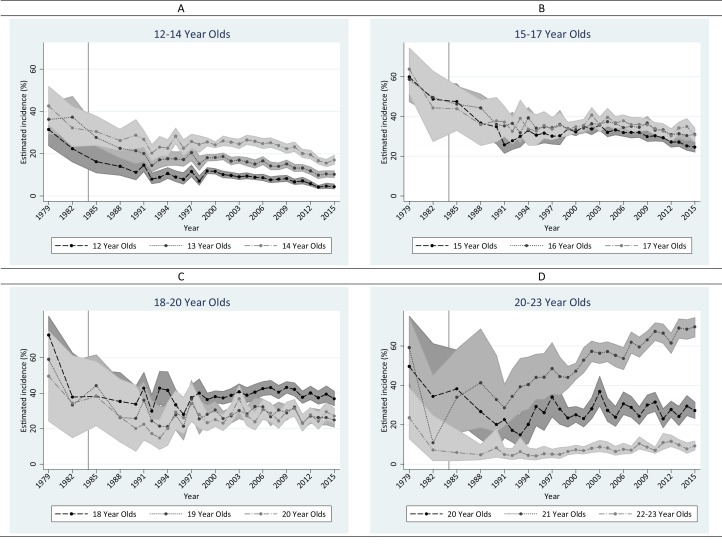
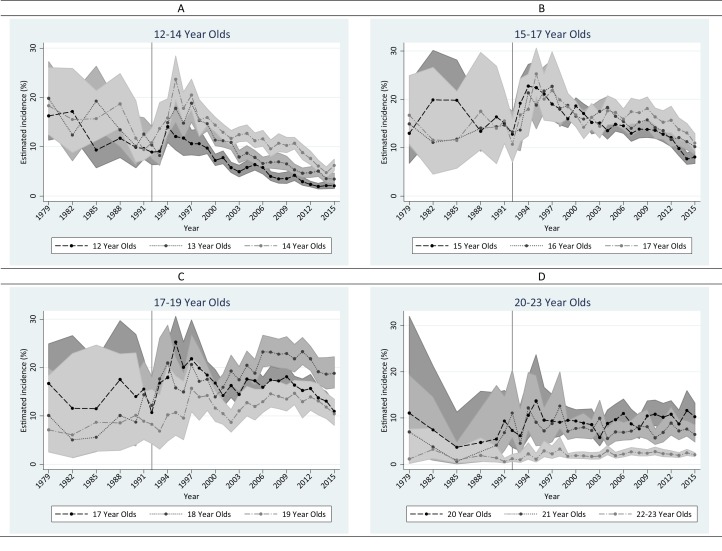
Incidence of underage alcohol drinking declined and followed a trend line that started before 1984 enactment of the National Minimum Drinking Age Act, but increased drinking incidence for 21 year olds was observed approximately 10 years after policy enactment. Eight years after the Synar amendment enactment, evidence of reduced smoking incidence started to emerge. Among 18 year olds, a slight increase in tobacco smoking incidence occurred about 10 years after the Synar amendment.
Once nation-level policies affecting drug sales to minors are enacted, one might have to wait almost a decade before seeing tangible policy effects on drug use incidence rates.
关于美国国家层面政策变化对饮酒和吸烟发生率的影响,证据有限。为了调查对过早药物使用的潜在一级预防效果并阐明滞后时间问题,我们估计了在药物政策颁布之前和之后特定时间段的发生率。我们的假设是:(a)降低未成年人饮酒或吸烟的开始率;(b)法定年龄(即饮酒为21岁,吸烟为18岁)的发生率增加。
研究人群为12至23岁的非机构化美国平民居民。估计数据来自为代表美国1979 - 2015年全国药物使用和健康调查而抽取的30个社区样本。估计值是12至23岁人群逐年的饮酒和吸烟年发生率,按年龄划分。元回归估计随时间变化的特定年龄发生率。
未成年饮酒发生率下降,且在1984年《全国最低饮酒年龄法案》颁布之前就开始遵循一种趋势线,但在政策颁布后约10年观察到21岁人群饮酒发生率增加。在《西纳尔修正案》颁布8年后,吸烟发生率降低的证据开始显现。在18岁人群中,《西纳尔修正案》颁布约10年后吸烟发生率略有增加。
一旦颁布影响向未成年人销售药物的国家层面政策,可能需要等待近十年才能看到对药物使用发生率的切实政策效果。