Øvrehus Marius A, Bruheim Per, Ju Wenjun, Zelnick Leila R, Langlo Knut A, Sharma Kumar, de Boer Ian H, Hallan Stein I
Department of Clinical and Molecular Medicine, Norwegian University of Science and Technology, Trondheim, Norway.
Department of Nephrology, St Olav Hospital, Trondheim University Hospital, Trondheim, Norway.
Kidney Int Rep. 2018 Oct 17;4(2):321-333. doi: 10.1016/j.ekir.2018.10.007. eCollection 2019 Feb.
Hypertensive nephrosclerosis is among the leading causes of end-stage renal disease, but its pathophysiology is poorly understood. We wanted to explore early metabolic changes using gene expression and targeted metabolomics analysis.
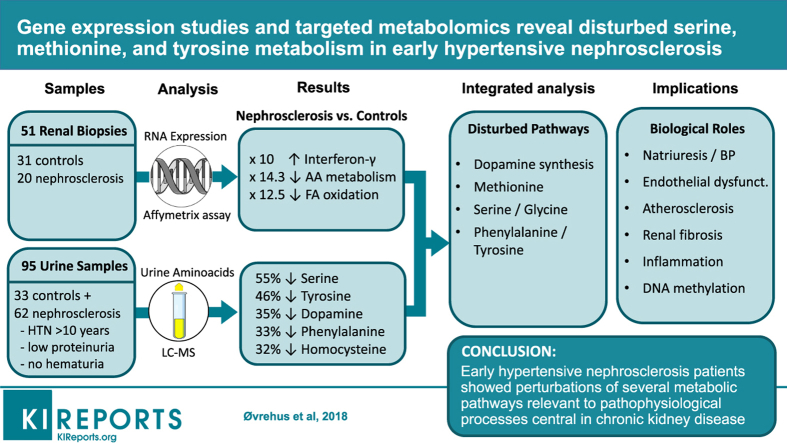
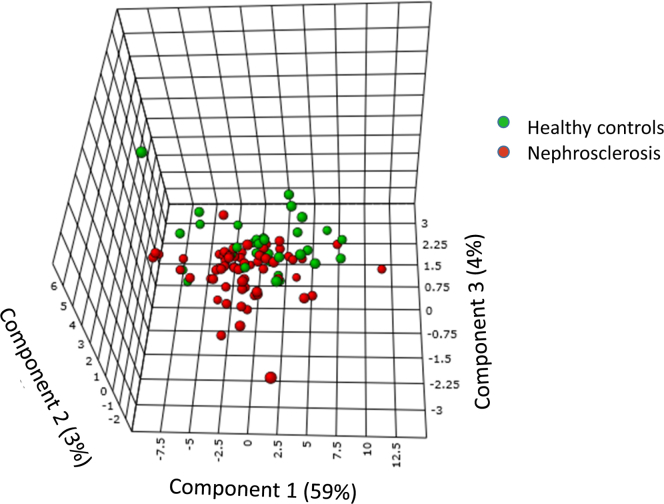
We analyzed gene expression in kidneys biopsied from 20 patients with nephrosclerosis and 31 healthy controls with an Affymetrix array. Thirty-one amino acids were measured by liquid chromatography coupled with mass spectrometry (LC-MS) in urine samples from 62 patients with clinical hypertensive nephrosclerosis and 33 age- and sex-matched healthy controls, and major findings were confirmed in an independent cohort of 45 cases and 15 controls.
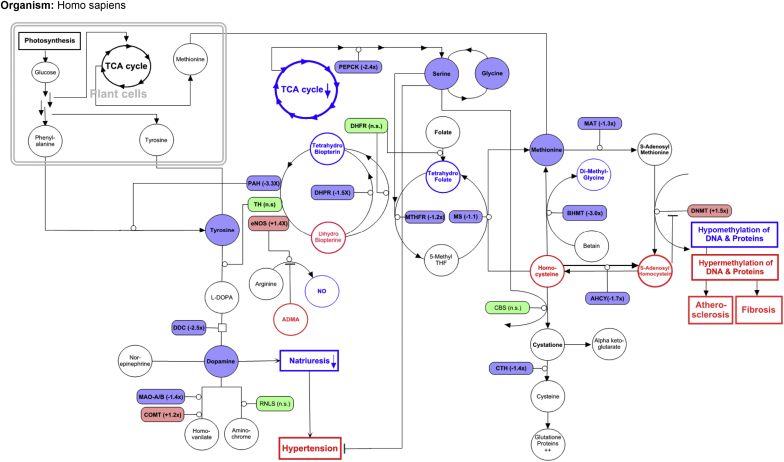
Amino acid catabolism and synthesis were strongly underexpressed in hypertensive nephrosclerosis (13- and 7-fold, respectively), and these patients also showed gene expression patterns indicating decreased fatty acid oxidation (12-fold) and increased interferon gamma (10-fold) and cellular defense response (8-fold). Metabolomics analysis revealed significant distribution differences in 11 amino acids in hypertensive nephrosclerosis, among them tyrosine, phenylalanine, dopamine, homocysteine, and serine, with 30% to 70% lower urine excretion. These findings were replicated in the independent cohort. Integrated gene-metabolite pathway analysis showed perturbations of renal dopamine biosynthesis. There were also significant differences in homocysteine/methionine homeostasis and the serine pathway, which have strong influence on 1-carbon metabolism. Several of these disturbances could be interconnected through reduced regeneration of tetrahydrofolate and tetrahydrobiopterin.
Early hypertensive nephrosclerosis showed perturbations of intrarenal biosynthesis of dopamine, which regulates natriuresis and blood pressure. There were also disturbances in serine/glycine and methionine/homocysteine metabolism, which may contribute to endothelial dysfunction, atherosclerosis, and renal fibrosis.
高血压性肾硬化是终末期肾病的主要病因之一,但其病理生理学仍知之甚少。我们希望通过基因表达和靶向代谢组学分析来探索早期代谢变化。
我们使用Affymetrix芯片分析了20例肾硬化患者和31例健康对照者的肾脏活检组织中的基因表达。通过液相色谱-质谱联用(LC-MS)测定了62例临床高血压性肾硬化患者和33例年龄及性别匹配的健康对照者尿液样本中的31种氨基酸,并在一个由45例病例和15例对照组成的独立队列中对主要发现进行了验证。
高血压性肾硬化患者的氨基酸分解代谢和合成显著低表达(分别低13倍和7倍),这些患者还表现出脂肪酸氧化减少(低12倍)、干扰素γ增加(高10倍)和细胞防御反应增加(高8倍)的基因表达模式。代谢组学分析显示,高血压性肾硬化患者的11种氨基酸存在显著的分布差异,其中酪氨酸、苯丙氨酸、多巴胺、同型半胱氨酸和丝氨酸的尿排泄量降低了30%至70%。这些发现在独立队列中得到了重复。整合的基因-代谢物途径分析显示肾脏多巴胺生物合成受到干扰。同型半胱氨酸/蛋氨酸稳态和丝氨酸途径也存在显著差异,这对一碳代谢有很大影响。其中一些干扰可能通过四氢叶酸和四氢生物蝶呤再生减少而相互关联。
早期高血压性肾硬化表现出肾脏多巴胺生物合成的干扰,多巴胺可调节利钠和血压。丝氨酸/甘氨酸和蛋氨酸/同型半胱氨酸代谢也存在紊乱,这可能导致内皮功能障碍、动脉粥样硬化和肾纤维化。