Respiratory, Inflammation and Autoimmunity Translational Medicine Unit, Early Clinical Development, IMED Biotech Unit, AstraZeneca, 35 Gatehouse Drive, Waltham, MA, 02451, USA.
PAREXEL, International GmbH House 18, Klinikum Westend, Spandauer Damm 130, 14050, Berlin, Germany.
Respir Res. 2019 Feb 18;20(1):37. doi: 10.1186/s12931-019-1000-7.
Inhaled corticosteroids reduce inflammation in asthma but chronic use may cause adverse effects. AZD7594, an inhaled non-steroidal selective glucocorticoid receptor modulator, has the potential of an improved risk-benefit profile. We investigated the safety and efficacy of AZD7594 in asthma.
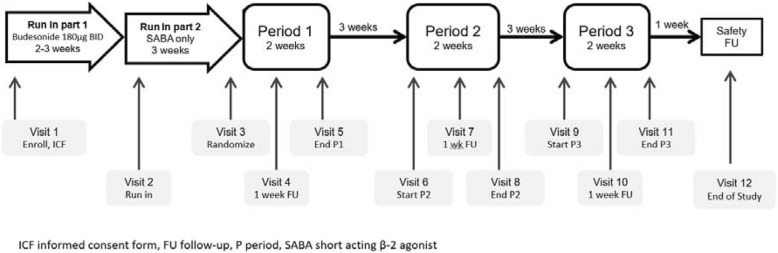
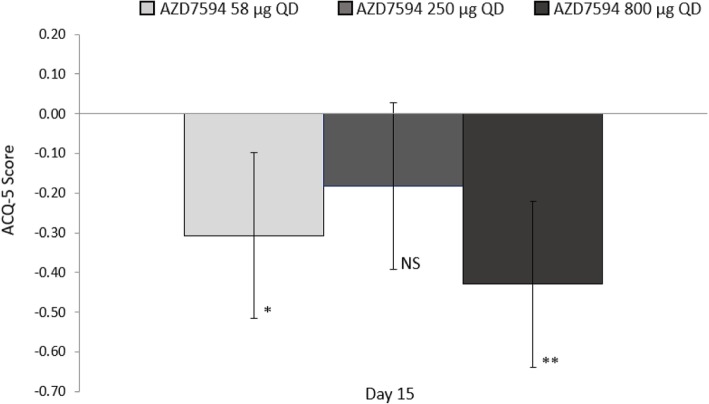
This phase 2a multi-center, randomized, double-blind, placebo-controlled crossover study enrolled adults with asthma aged 18 to 75 years. Patients were treated with budesonide 200 μg twice daily for 2-3 3 weeks (run in part one). If controlled, as demonstrated by an asthma control questionnaire-5 score of < 1.5, patients entered a three-week run-in (part two) where they received a short acting bronchodilator alone. Thereafter, patients with a fractional exhaled nitric oxide (FNO) ≥25 ppb and pre-dose FEV 40 to 90% predicted were randomized to one of nine treatment sequences. Each patient received placebo and two of three dose levels of AZD7594 (58, 250, 800 μg) once daily via inhalation, in 14-day treatment periods, separated by three-week washout periods. The primary endpoint was the change from baseline in morning trough FEV versus placebo on day 15. Secondary endpoints included measures of airway inflammation and asthma control.
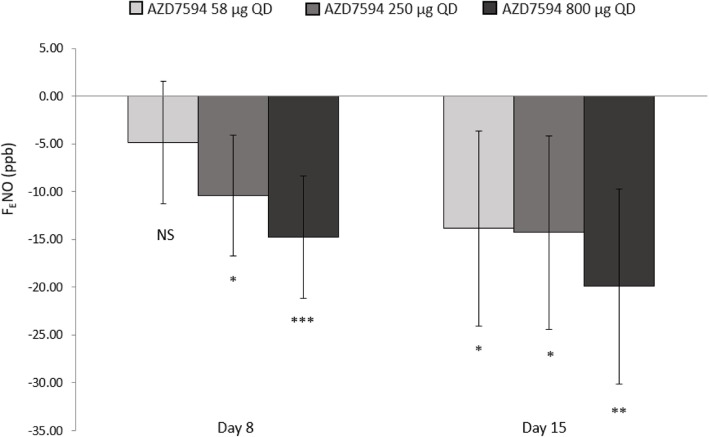
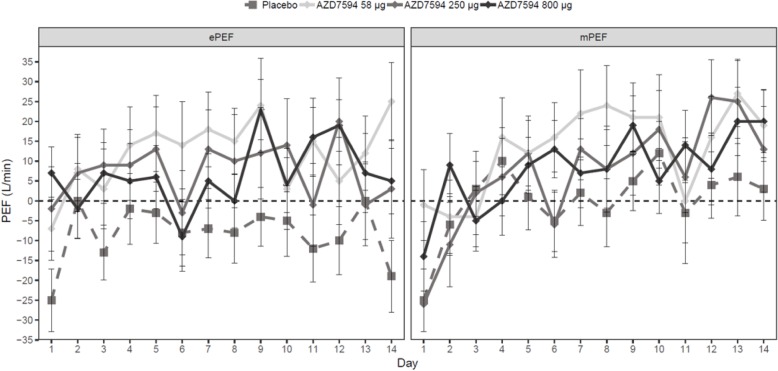
Fifty-four patients were randomized and received at least 1 dose of treatment, 48 patients completed the study. Overall 52 patients received placebo, 34 received AZD7594 58 μg, 34 received AZD7594 250 μg, and 34 received AZD7594 800 μg. AZD7594 800 μg demonstrated a significant improvement in Day 15 morning trough FEVversus placebo (LS means difference 0.148 L 95% CI 0.035-0.261, p = 0.011), with a dose-dependent response seen in the 250 μg (0.076 L -0·036-0·188, p = 0.183) and 58 μg (0·027 L -0·086-0·140, p = 0.683). All secondary endpoints showed statistically significant improvement at the 800 μg dose. All doses demonstrated a significant reduction in FNO at day 15 p < 0.01. No statistically significant difference in plasma cortisol level was observed between AZD7594 and placebo at any dose. AZD7594 was considered safe and well tolerated.
Two-week treatment with AZD7594 demonstrated a favorable risk-benefit profile in patients with mild to moderate asthma. Further clinical studies are needed to fully characterize AZD7594.
ClinicalTrials.gov number NCT02479412 .
吸入性皮质类固醇可减轻哮喘的炎症,但长期使用可能会引起不良反应。AZD7594 是一种吸入性非甾体类选择性糖皮质激素受体调节剂,具有改善风险效益比的潜力。我们研究了 AZD7594 在哮喘中的安全性和疗效。
这是一项多中心、随机、双盲、安慰剂对照的 2a 期交叉研究,纳入了年龄在 18 至 75 岁的哮喘成年患者。患者接受布地奈德 200μg,每日 2 次,持续 2-3 周(第 1 部分)。如果哮喘控制问卷-5 评分<1.5,则患者进入持续 3 周的第 2 部分(run-in 部分),在此期间,他们单独使用短效支气管扩张剂。之后,对于呼出气一氧化氮(FNO)≥25ppb 和预剂量 FEV 40 至 90%预测值的患者,随机分为 9 种治疗序列之一。每位患者接受安慰剂和三种剂量水平的 AZD7594(58、250、800μg)中的两种,每日一次吸入,持续 14 天治疗期,每个治疗期之间间隔 3 周的洗脱期。主要终点是与安慰剂相比,第 15 天早晨谷值 FEV 的变化。次要终点包括气道炎症和哮喘控制的测量。
54 名患者被随机分配并至少接受了 1 次治疗,48 名患者完成了研究。共有 52 名患者接受了安慰剂,34 名患者接受了 AZD7594 58μg,34 名患者接受了 AZD7594 250μg,34 名患者接受了 AZD7594 800μg。与安慰剂相比,AZD7594 800μg 组在第 15 天早晨谷值 FEV 方面有显著改善(LS 均值差值 0.148L,95%CI 0.035-0.261,p=0.011),在 250μg(0.076L -0·036-0·188,p=0.183)和 58μg(0.027L -0·086-0·140,p=0.683)剂量时也观察到剂量依赖性反应。所有次要终点在 800μg 剂量时均显示出统计学上的显著改善。所有剂量在第 15 天均显著降低了 FNO(p<0.01)。AZD7594 和安慰剂在任何剂量下,血浆皮质醇水平均无统计学显著差异。AZD7594 被认为是安全且耐受良好的。
AZD7594 治疗 2 周后,在轻度至中度哮喘患者中表现出有利的风险效益比。需要进一步的临床研究来充分描述 AZD7594。
ClinicalTrials.gov 编号 NCT02479412。