Ortí-Casañ Natalia, Wu Yingying, Naudé Petrus J W, De Deyn Peter P, Zuhorn Inge S, Eisel Ulrich L M
Department of Molecular Neurobiology, Groningen Institute for Evolutionary Life Sciences, Faculty of Science and Engineering, University of Groningen, Groningen, Netherlands.
Department of Neurology and Alzheimer Center, University of Groningen, University Medical Center Groningen, Groningen, Netherlands.
Front Neurosci. 2019 Feb 4;13:49. doi: 10.3389/fnins.2019.00049. eCollection 2019.
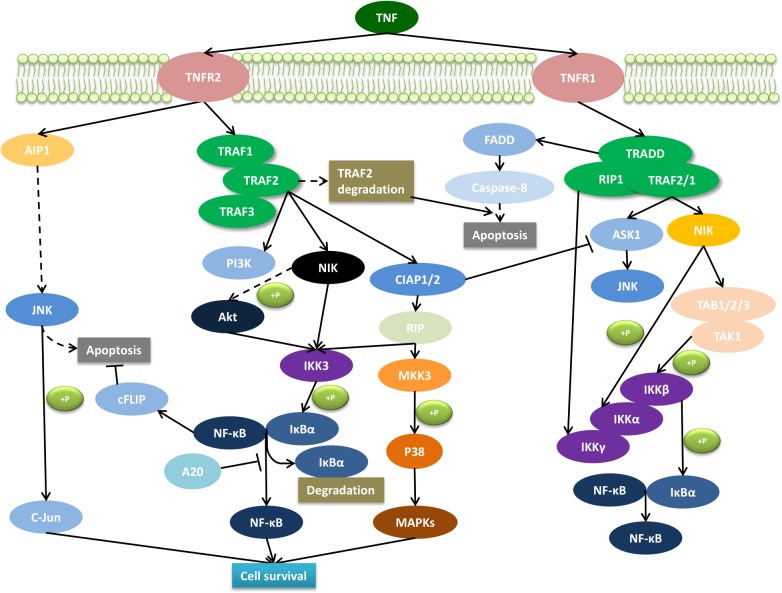
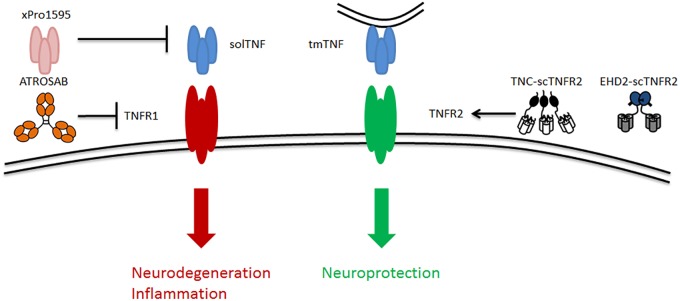
Alzheimer's disease (AD) is a progressive neurodegenerative disorder and the most common cause of dementia. Accumulating experimental evidence shows the important linkage between tumor necrosis factor-α (TNF) and AD, but the exact role of TNF in AD is still not completely understood. Although TNF-inhibitors are successfully used for treating several diseases, total inhibition of TNF can cause side effects, particularly in neurological diseases. This is attributed to the opposing roles of the two TNF receptors. TNF receptor 1 (TNFR1) predominantly mediates inflammatory and pro-apoptotic signaling pathways, whereas TNF receptor 2 (TNFR2) is neuroprotective and promotes tissue regeneration. Therefore, the specific activation of TNFR2 signaling, either by directly targeting TNFR2 via TNFR2 agonists or by blocking TNFR1 signaling with TNFR1-selective antagonists, seems a promising strategy for AD therapy. This mini-review discusses the involvement of TNFR2 and its signaling pathway in AD and outlines its potential application as therapeutic target. A better understanding of the function of TNFR2 may lead to the development of a treatment for AD.
阿尔茨海默病(AD)是一种进行性神经退行性疾病,也是痴呆最常见的病因。越来越多的实验证据表明肿瘤坏死因子-α(TNF)与AD之间存在重要联系,但TNF在AD中的确切作用仍未完全明确。尽管TNF抑制剂已成功用于治疗多种疾病,但完全抑制TNF会产生副作用,尤其是在神经疾病方面。这归因于两种TNF受体的相反作用。TNF受体1(TNFR1)主要介导炎症和促凋亡信号通路,而TNF受体2(TNFR2)具有神经保护作用并促进组织再生。因此,通过TNFR2激动剂直接靶向TNFR2或用TNFR1选择性拮抗剂阻断TNFR1信号来特异性激活TNFR2信号通路,似乎是一种有前景的AD治疗策略。这篇综述讨论了TNFR2及其信号通路在AD中的作用,并概述了其作为治疗靶点的潜在应用。更好地理解TNFR2的功能可能会带来AD治疗方法的发展。