Johns Hopkins School of Medicine Baltimore, MD, US.
Johns Hopkins School of Medicine, Baltimore, MD, US.
Ann Glob Health. 2018 Nov 5;84(4):683-691. doi: 10.9204/aogh.2378.
Many medical and nursing schools offer opportunities for students to participate in global health experiences abroad, but little is known about the efficacy of pre-departure training in preparing students for these experiences.
The primary aim was to identify characteristics of pre-departure training associated with participants' reporting a high level of preparedness for their global health experiences. Secondary objectives included identifying students' preferred subjects of study and teaching modalities for pre-departure training.
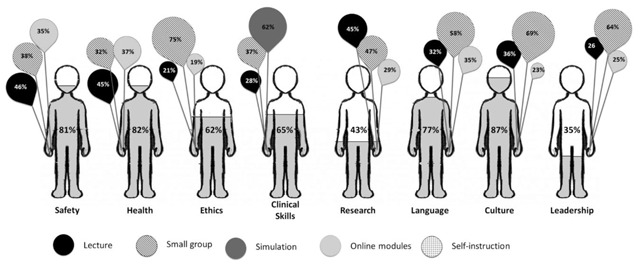
A questionnaire was distributed to all medical and nursing students at our institution from 2013 to 2015. Questions addressed prior global health experiences and pre-departure training, preferences for pre-departure training, and demographic information. Findings: Of 517 respondents, 55% reported having a prior global health experience abroad, 77% of whom felt prepared for their experience. Fifty-three percent received pre-departure training. Simply receiving pre-departure training was not associated with perceived preparedness, but pre-departure training in the following learning domains was: travel safety, personal health, clinical skills, cultural awareness, and leadership. Perceiving pre-departure training as useful was also independently associated with self-reported preparedness. Students' preferred instruction methods included discussion, lecture, and simulation, and their most desired subjects of study were travel safety (81%), cultural skills (87%), and personal health (82%).
Incorporating travel safety, personal health, clinical skills, cultural awareness, and/or leadership into pre-departure training may increase students' preparedness for global health experiences. Student perceptions of the usefulness of pre-departure training is also associated with self-reported preparedness, suggesting a possible "buy-in" effect.
许多医学和护理学校为学生提供参与海外全球健康体验的机会,但对于出发前培训在使学生为这些体验做好准备方面的效果知之甚少。
主要目的是确定与参与者报告对全球健康体验高度准备相关的出发前培训的特点。次要目的包括确定学生对出发前培训的首选学习科目和教学模式。
2013 年至 2015 年,我们向机构内的所有医学生和护生发放了一份问卷。问题涉及先前的全球健康经验和出发前培训、对出发前培训的偏好以及人口统计学信息。
在 517 名受访者中,55%的人报告曾有过海外全球健康体验,其中 77%的人感到为自己的体验做好了准备。53%的人接受了出发前培训。仅仅接受出发前培训与自我感知的准备程度无关,但在以下学习领域接受出发前培训与自我感知的准备程度有关:旅行安全、个人健康、临床技能、文化意识和领导力。感知出发前培训有用也与自我报告的准备程度独立相关。学生们最喜欢的教学方法包括讨论、讲座和模拟,他们最希望学习的科目是旅行安全(81%)、文化技能(87%)和个人健康(82%)。
将旅行安全、个人健康、临床技能、文化意识和/或领导力纳入出发前培训可能会增加学生对全球健康体验的准备程度。学生对出发前培训有用性的看法也与自我报告的准备程度相关,这表明可能存在“接受”效应。