Department of Oncology, Henan Academy Institute of Traditional Chinese Medicine, Zhengzhou 450000, Henan, China.
School of Basic Medicine Sciences, Henan University of Chinese Medicine, Zhengzhou 450002, Henan, China.
Molecules. 2019 Feb 13;24(4):656. doi: 10.3390/molecules24040656.
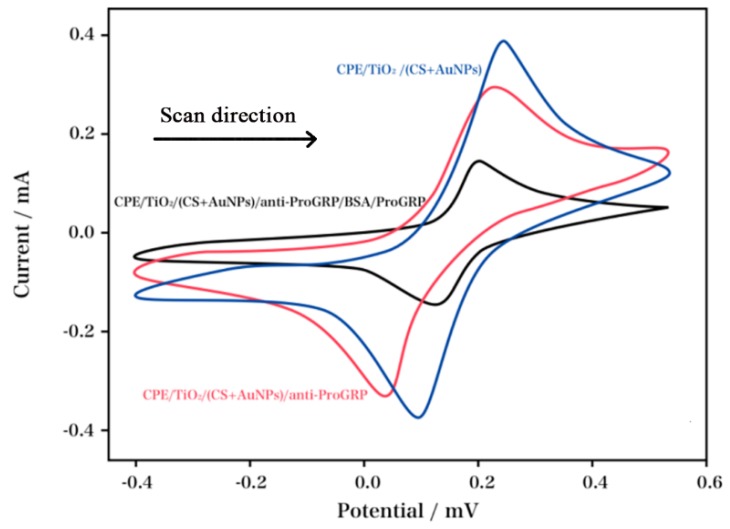
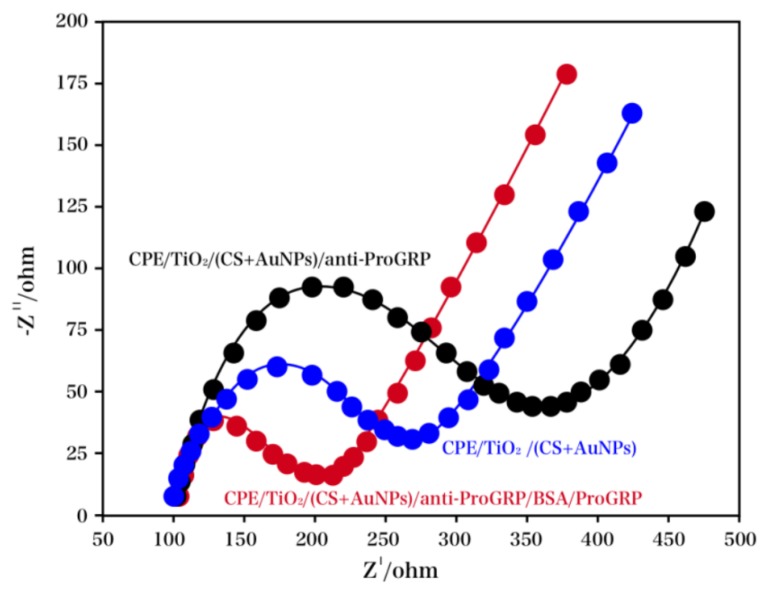
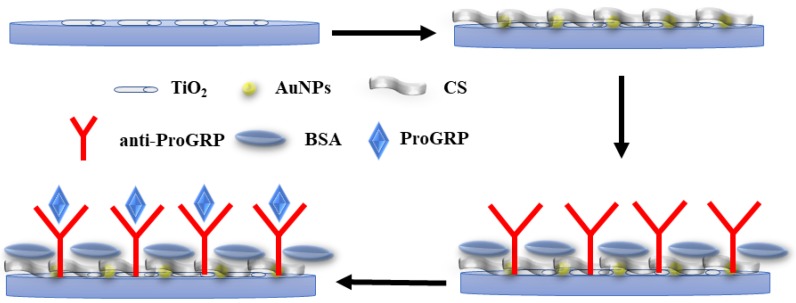
Progastrin-releasing peptide (ProGRP), which is known to be highly specific and sensitive to small cell lung cancer (SCLC), has been proven to be a valuable substitute for neuron-specific enolase in SCLC diagnostics and monitoring, especially in its early stages. The detection of ProGRP levels also facilitates a selection of therapeutic treatments. For the fabrication of our proposed biosensor, titanium (IV) oxide microparticles were first used, followed by dispersing gold nanoparticles into chitosan and immobilizing them onto a carbon paste electrode (CPE) surface. The developed immunosensor exhibits a much higher biosensing performance in comparison with current methods, when it comes to the detection of ProGRP. Therefore, the proposed CPE/TiO₂/(CS+AuNPs)/anti-ProGRP/BSA/ProGRP is excellent for the development of a compact diagnostics apparatus.
胃泌素释放肽(ProGRP)是小细胞肺癌(SCLC)高度特异和敏感的标志物,已被证明是 SCLC 诊断和监测中神经元特异性烯醇化酶的有价值替代品,尤其是在疾病早期阶段。检测 ProGRP 水平还有助于选择治疗方法。为了制备我们提出的生物传感器,首先使用了二氧化钛(IV)微粒子,然后将金纳米粒子分散到壳聚糖中并将其固定在碳糊电极(CPE)表面上。与目前的方法相比,所开发的免疫传感器在检测 ProGRP 时具有更高的生物传感性能。因此,所提出的 CPE/TiO₂/(CS+AuNPs)/抗 ProGRP/BSA/ProGRP 非常适合开发紧凑型诊断仪器。