Basu Alakananda
Department of Microbiology, Immunology & Genetics, University of North Texas Health Science Center, Fort Worth, TX 76107, USA.
Cancers (Basel). 2019 Feb 13;11(2):214. doi: 10.3390/cancers11020214.
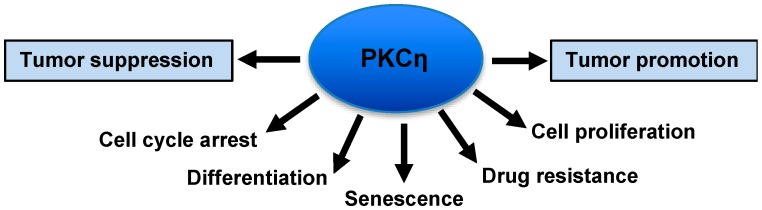
Protein kinase C (PKC), a multi-gene family, plays critical roles in signal transduction and cell regulation. Protein kinase C-eta (PKCη) is a unique member of the PKC family since its regulation is distinct from other PKC isozymes. PKCη was shown to regulate cell proliferation, differentiation and cell death. It was also shown to contribute to chemoresistance in several cancers. PKCη has been associated with several cancers, including renal cell carcinoma, glioblastoma, breast cancer, non-small cell lung cancer, and acute myeloid leukemia. However, mice lacking PKCη were more susceptible to tumor formation in a two-stage carcinogenesis model, and it is downregulated in hepatocellular carcinoma. Thus, the role of PKCη in cancer remains controversial. The purpose of this review article is to discuss how PKCη regulates various cellular processes that may contribute to its contrasting roles in cancer.
蛋白激酶C(PKC)是一个多基因家族,在信号转导和细胞调节中发挥关键作用。蛋白激酶C-η(PKCη)是PKC家族的一个独特成员,因为其调节方式与其他PKC同工酶不同。研究表明,PKCη可调节细胞增殖、分化和细胞死亡。它还被证明在几种癌症中促成化学抗性。PKCη与多种癌症相关,包括肾细胞癌、胶质母细胞瘤、乳腺癌、非小细胞肺癌和急性髓性白血病。然而,在两阶段致癌模型中,缺乏PKCη的小鼠更易发生肿瘤形成,并且它在肝细胞癌中表达下调。因此,PKCη在癌症中的作用仍存在争议。这篇综述文章的目的是讨论PKCη如何调节各种细胞过程,而这些过程可能导致其在癌症中发挥相反的作用。