Goodnight Family Department of Sustainable Development, Appalachian State University, Boone, NC, USA; Emerging Pathogens Institute, Gainesville, FL, USA; Department of Environmental and Global Health, University of Florida, Gainesville, FL, USA.
Department of Environmental and Global Health, University of Florida, Gainesville, FL, USA; Bagamian Scientific Consulting, Gainesville, FL, USA.
Lancet Glob Health. 2019 Mar;7(3):e321-e330. doi: 10.1016/S2214-109X(18)30483-2.
Enterotoxigenic Escherichia coli (ETEC) and shigella are two major pathogens that cause moderate-to-severe diarrhoea in children younger than 5 years. Diarrhoea is associated with an increased risk of stunting, which puts children at risk of death due to other infectious diseases.
We modelled ETEC-related and shigella-related mortality and the effect of moderate-to-severe diarrhoea episodes to determine the number of children with stunting due to these infections in 79 low-income and lower middle-income countries. We applied population attributable risk for increased number of deaths due to other infectious diseases in children who are stunted. We calculated 95% uncertainty intervals (UIs) for the point estimates.
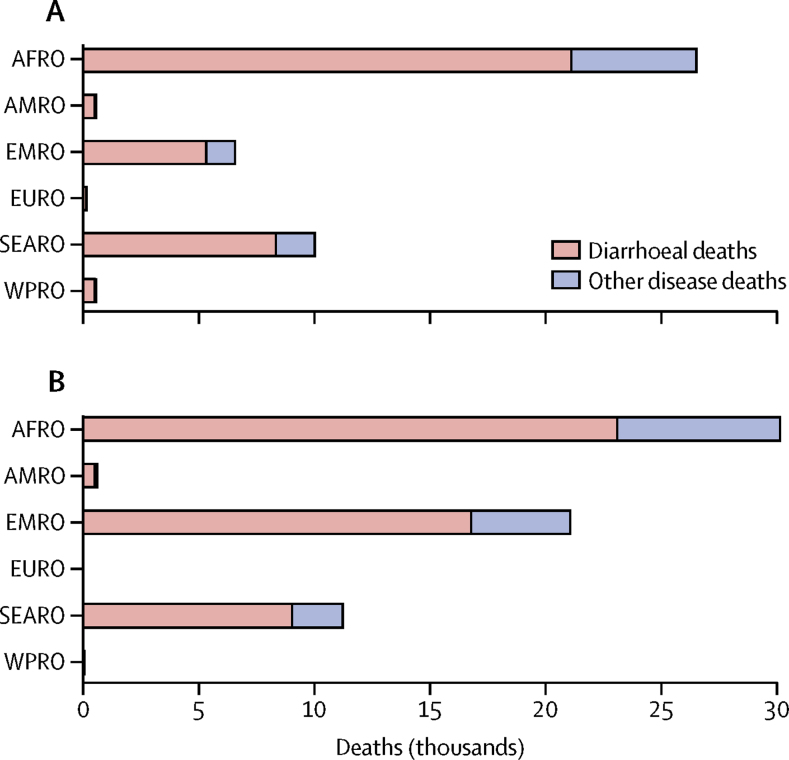
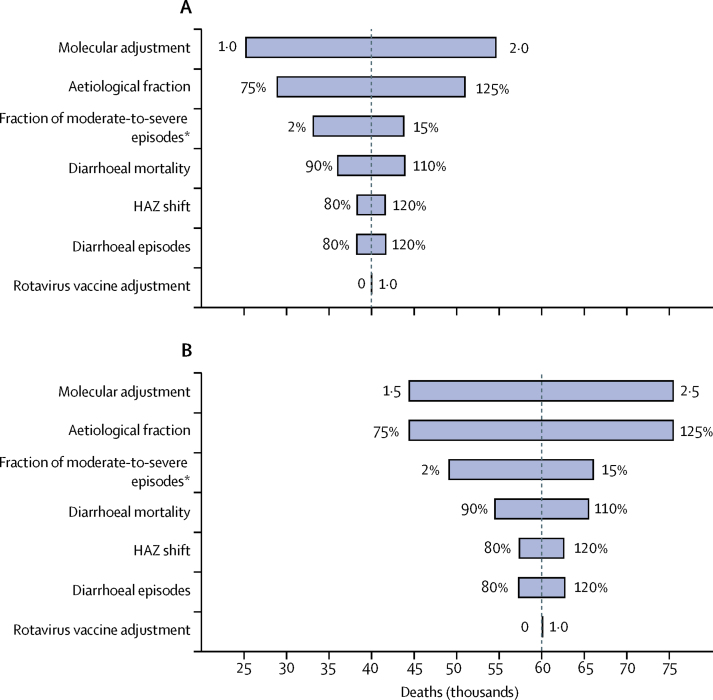
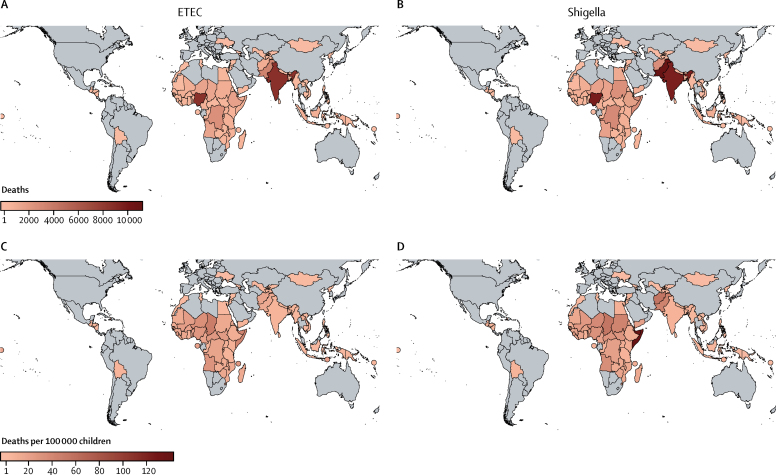
In children younger than 5 years, we estimate 196 million (95% UI 135-269) episodes of ETEC and shigella diarrhoea occur annually, resulting in 3·5 million (0·8-5·4) cases of moderate-to-severe stunting and 44 400 (29 400-59 800) total ETEC deaths and 63 100 (44 000-81 900) total shigella deaths in 2015. Additional infectious disease mortality due to stunting resulted in increases of 24% (8-34; for ETEC) and 28% (10-39; for shigella) over direct deaths due to diarrhoeal episodes. The distribution of mortality and morbidity varied geographically, with African Region and Eastern Mediterranean Region countries bearing the greatest burden.
The expanded effects of non-fatal ETEC and shigella-related diarrhoeal episodes can have lasting consequences. Prevention of these infections could reduce the risk of direct death and stunting and deaths due to other infectious diseases. Understanding the countries and populations with the highest disease risk helps to target interventions for the most vulnerable populations.
The Bill & Melinda Gates Foundation.
肠毒素性大肠杆菌(ETEC)和志贺氏菌是导致 5 岁以下儿童中重度腹泻的两种主要病原体。腹泻会增加发育迟缓的风险,使儿童面临因其他传染病而死亡的风险。
我们建立了 ETEC 相关和志贺氏菌相关死亡率模型,以及中重度腹泻发作的影响,以确定在 79 个低收入和中低收入国家中,因这些感染而导致发育迟缓的儿童人数。我们应用了因其他传染病而死亡的儿童因发育迟缓而增加的人群归因风险。我们计算了点估计的 95%置信区间(UI)。
在 5 岁以下儿童中,我们估计每年有 1.96 亿(95% UI 1.35-2.69)例 ETEC 和志贺氏菌腹泻,导致 350 万(0.8-5.4)例中重度发育迟缓病例和 44400(29400-59800)例 ETEC 总死亡病例和 63100(44000-81900)例志贺氏菌总死亡病例。因发育迟缓导致的额外传染病死亡导致直接因腹泻发作导致的死亡增加了 24%(8-34;ETEC)和 28%(10-39;志贺氏菌)。死亡率和发病率的分布在地理上有所不同,非洲区域和东地中海区域的国家负担最重。
非致命性 ETEC 和志贺氏菌相关腹泻发作的扩大影响可能会产生持久的后果。预防这些感染可以降低直接死亡和发育迟缓以及因其他传染病而死亡的风险。了解疾病风险最高的国家和人群有助于针对最脆弱人群的干预措施。
比尔及梅琳达·盖茨基金会。