Botega Iara Inácio, Zamarioli Ariane, Guedes Patrícia Madalena San Gregório, Silva Raquel Assed Bezerra da, Issa João Paulo Mardegan, Butezloff Mariana Maloste, Sousa Yara Terezinha Corrêa Silva, Ximenez João Paulo Bianchi, Volpon José Batista
Fellow Master degree, Postgraduate Program in Health Sciences Applied to the Locomotor System, School of Medicine, Universidade de São Paulo (USP), Ribeirao Preto-SP, Brazil. Design of the study, technical procedures, acquisition and interpretation of data, manuscript preparation.
Researcher, Laboratory of Bioengineering, School of Medicine, USP, Ribeirao Preto-SP, Brazil. Design of the study, interpretation of data, manuscript preparation, critical revision.
Acta Cir Bras. 2019 Feb 14;34(1):e20190010000002. doi: 10.1590/s0102-865020190010000002.
To evaluate the effects of food restriction on fracture healing in growing rats.
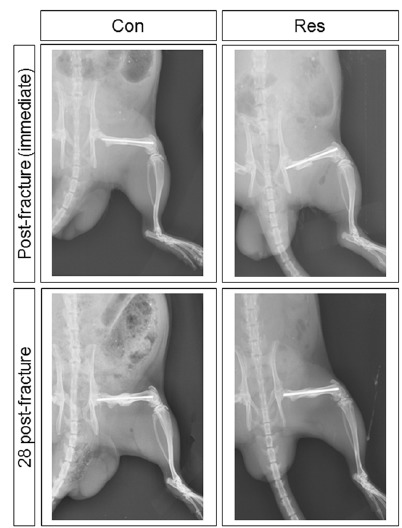
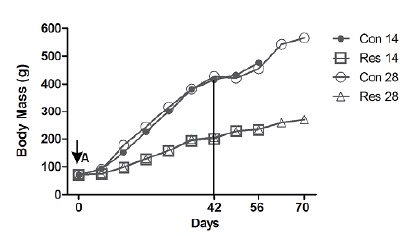
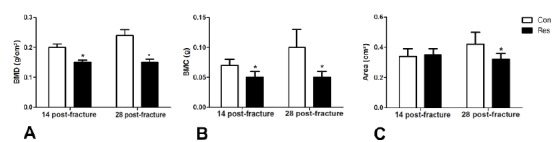
Sixty-eight male Wistar rats were assigned to two groups: (1) Control and (2) Dietary restriction. After weaning the dietary restricted animals were fed ad libitum for 42 days with 50% of the standard chow ingested by the control group. Subsequently, the animals underwent bone fracture at the diaphysis of the right femur, followed by surgical stabilization of bone fragments. On days 14 and 28 post-fracture, the rats were euthanized, and the fractured femurs were dissected, the callus was analyzed by dual-energy X-ray absorptiometry, micro-computed tomography, histomorphometry, mechanical tests, and gene expression.
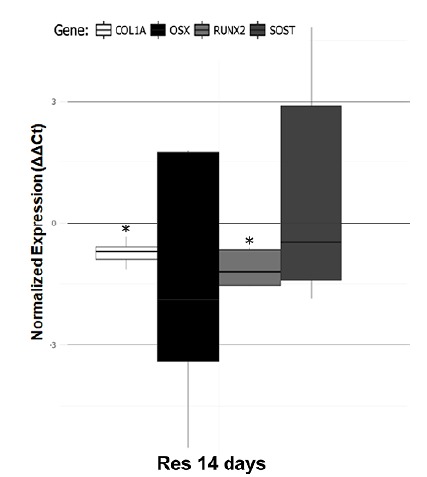
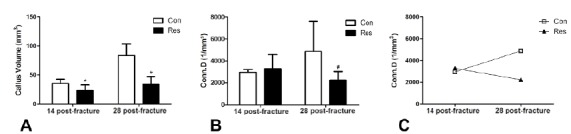
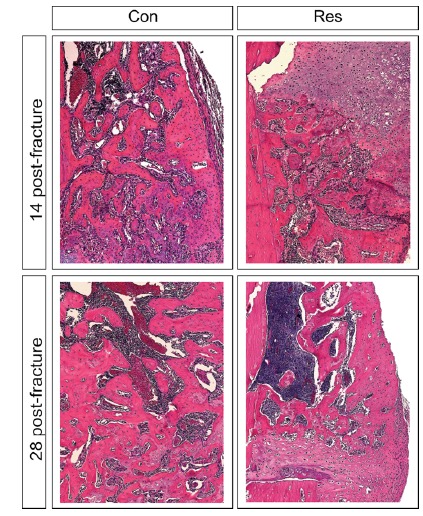
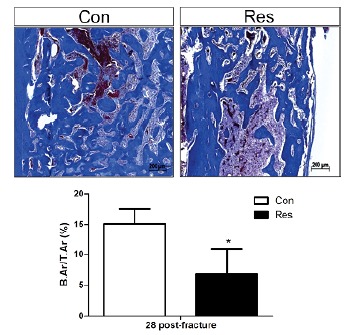
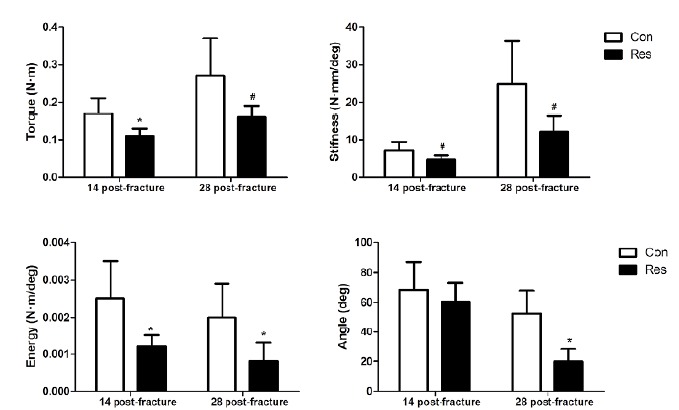
Dietary restriction decreased body mass gain and resulted in several phenotypic changes at the bone callus (a delay in cell proliferation and differentiation, lower rate of newly formed bone and collagen deposition, reductions in bone callus density and size, decrease in tridimensional callus volume, deterioration in microstructure, and reduction in bone callus strength), together with the downregulated expression of osteoblast-related genes.
Dietary restriction had detrimental effects on osseous healing, with a healing delay and a lower quality of bone callus formation.
评估食物限制对生长中大鼠骨折愈合的影响。
将68只雄性Wistar大鼠分为两组:(1)对照组和(2)饮食限制组。断奶后,对饮食限制组动物随意喂食42天,其摄入量为对照组标准食物摄入量的50%。随后,对动物的右股骨干进行骨折,接着对骨碎片进行手术固定。在骨折后第14天和第28天,将大鼠安乐死,解剖骨折的股骨,通过双能X线吸收法、显微计算机断层扫描、组织形态计量学、力学测试和基因表达分析骨痂情况。
饮食限制降低了体重增加,并导致骨痂出现多种表型变化(细胞增殖和分化延迟、新形成骨和胶原沉积速率降低、骨痂密度和大小减小、三维骨痂体积减小、微观结构恶化以及骨痂强度降低),同时成骨细胞相关基因的表达下调。
饮食限制对骨愈合有不利影响,导致愈合延迟和骨痂形成质量降低。