Department of Education for Clinical Research, National Center for Child Health and Development, 2-10-1 Okura, Setagaya-ku, Tokyo, 157-8535, Japan.
Medical Support Center for Japan Environment and Children's Study (JECS), National Center for Child Health and Development, 2-10-1 Okura, Setagaya-ku, Tokyo, 157-8535, Japan.
BMC Pregnancy Childbirth. 2019 Feb 20;19(1):77. doi: 10.1186/s12884-019-2213-y.
Although pregnancies conceived by assisted reproductive technology (ART) have a higher risk of maternal/perinatal complications, the overall risk of adverse outcomes necessitating advanced obstetric care has not been closely examined. The present study aimed to assess and compare the risk of maternal/perinatal complications and adverse outcomes in pregnancy and childbirth conceived by ART with those conceived naturally.
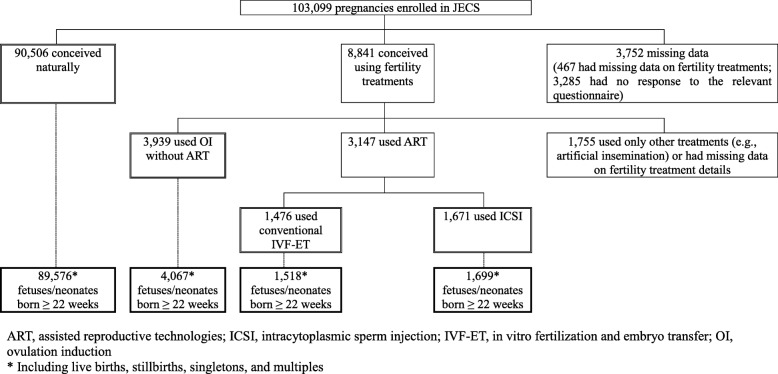
This study was conducted as a part of the Japan environment and children's study (JECS), an ongoing nationwide birth cohort study in Japan. The risk of maternal/perinatal complications and adverse outcomes was assessed by mode of conception (natural conception, ovulation induction [OI] without ART, conventional in vitro fertilization and embryo transfer [IVF-ET], or intracytoplasmic sperm injection [ICSI]) using logistic regression and generalized estimating equations controlling for potential confounders.
The final dataset included women who conceived naturally (N = 90,506), by OI without ART (N = 3939), by conventional IVF-ET (N = 1476), and by ICSI (N = 1671). Compared with women who conceived naturally, those who conceived by conventional IVF-ET were at higher risk of placenta previa (adjusted OR 2.90 [95% CI 1.94, 4.34]), morbidly adherent placenta (6.85 [3.88, 12.13]), and pregnancy-induced hypertension (1.40 [1.10, 1.78]) whereas those who conceived by ICSI had a higher risk of placental abruption (2.16 [1.20, 3.88]) as well as placenta previa (2.01 [1.29, 3.13]) and morbidly adherent placenta (7.81 [4.56, 13.38]). Women who conceived by ART had a higher risk of blood transfusion (conventional IVF-ET: 3.85 [2.52, 5.88]; ICSI: 3.76 [2.49, 5.66]) and ICU admission (conventional IVF-ET: 2.58 [1.11, 6.01]; ICSI: 3.45 [1.68, 7.06]) even after controlling for potential confounders. Neonates conceived by ART had a higher risk of preterm birth (conventional IVF-ET: 1.42 [1.13, 1.78]; ICSI: 1.31 [1.05, 1.64]).
Women who conceived by ART had a higher risk of maternal/perinatal complications necessitating advanced obstetric care. Obstetricians should be aware of the increased risk of adverse outcomes among this population.
尽管通过辅助生殖技术(ART)受孕的妊娠存在更高的母婴/围产期并发症风险,但需要接受高级产科护理的不良结局的总体风险尚未得到密切关注。本研究旨在评估和比较通过 ART 受孕与自然受孕的妊娠和分娩中母婴/围产期并发症和不良结局的风险。
本研究是在日本正在进行的全国性出生队列研究日本环境与儿童研究(JECS)的一部分。使用逻辑回归和广义估计方程,通过受孕方式(自然受孕、无 ART 的排卵诱导[OI]、常规体外受精和胚胎移植[IVF-ET]或胞浆内精子注射[ICSI])评估母婴/围产期并发症和不良结局的风险,并控制潜在混杂因素。
最终数据集包括自然受孕的女性(N=90,506)、无 ART 的 OI 受孕的女性(N=3939)、常规 IVF-ET 受孕的女性(N=1476)和 ICSI 受孕的女性(N=1671)。与自然受孕的女性相比,接受常规 IVF-ET 的女性更有可能发生前置胎盘(调整后的 OR 2.90 [95%CI 1.94, 4.34])、粘连性胎盘(6.85 [3.88, 12.13])和妊娠高血压(1.40 [1.10, 1.78]),而接受 ICSI 的女性更有可能发生胎盘早剥(2.16 [1.20, 3.88])以及前置胎盘(2.01 [1.29, 3.13])和粘连性胎盘(7.81 [4.56, 13.38])。接受 ART 受孕的女性更有可能需要输血(常规 IVF-ET:3.85 [2.52, 5.88];ICSI:3.76 [2.49, 5.66])和入住 ICU(常规 IVF-ET:2.58 [1.11, 6.01];ICSI:3.45 [1.68, 7.06]),即使在控制了潜在混杂因素后也是如此。通过 ART 受孕的新生儿更有可能早产(常规 IVF-ET:1.42 [1.13, 1.78];ICSI:1.31 [1.05, 1.64])。
通过 ART 受孕的女性发生需要高级产科护理的母婴/围产期并发症的风险更高。妇产科医生应该意识到这一人群不良结局风险增加。