Department of Psychiatry, University of Pittsburgh School of Medicine Western Psychiatric Institute and Clinic, Pittsburgh, Pennsylvania, USA
Department of Molecular Genetics & Microbiology, University of Florida College of Medicine, Gainesville, Florida, USA.
J Virol. 2019 Apr 17;93(9). doi: 10.1128/JVI.00111-19. Print 2019 May 1.
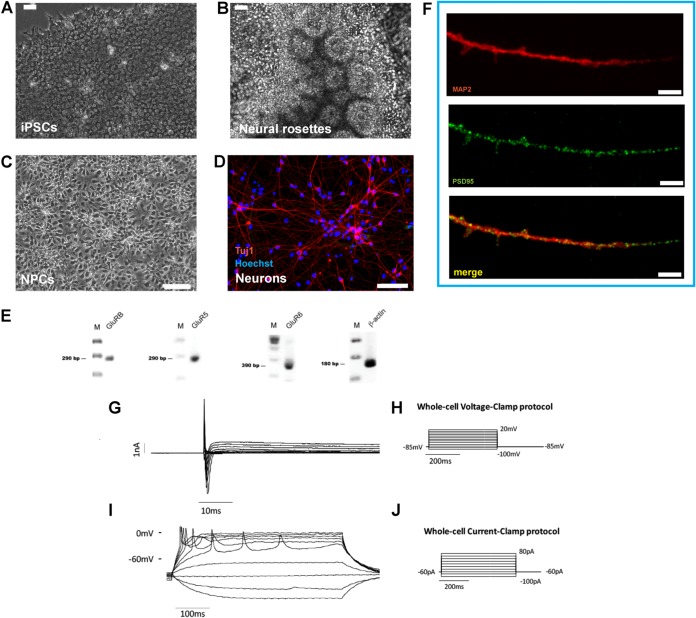
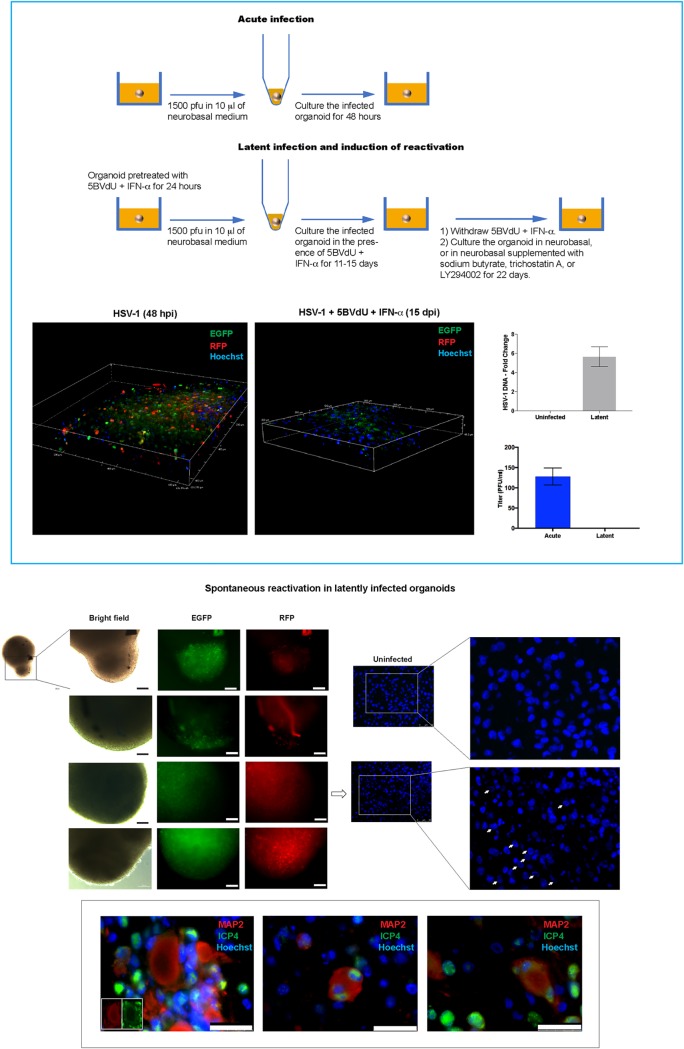
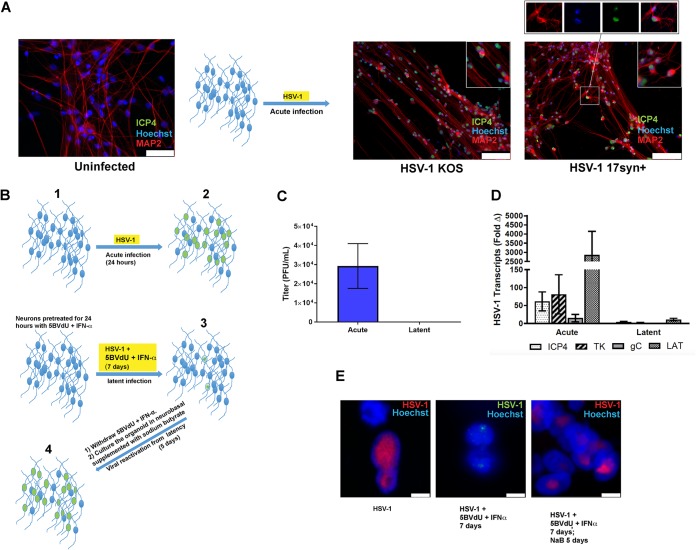
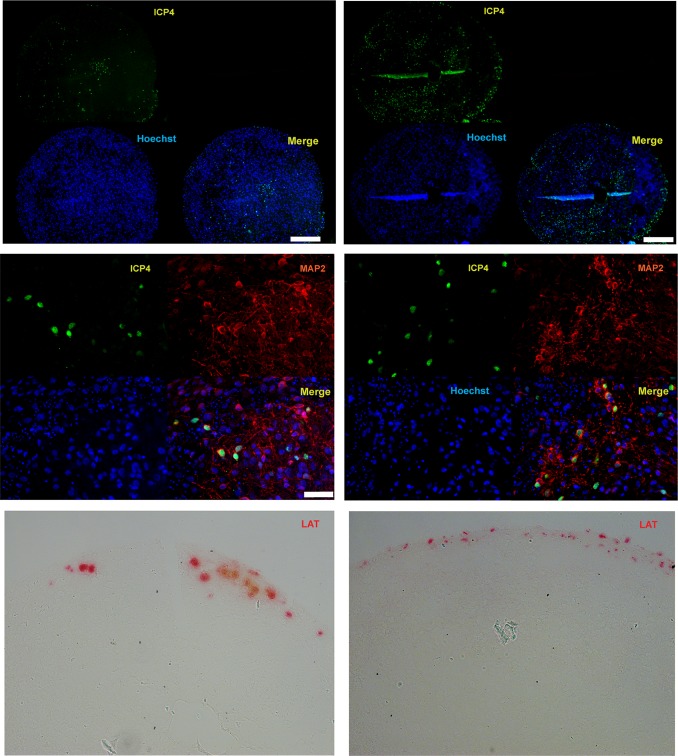
Herpes simplex virus 1 (HSV-1) establishes latency in both peripheral nerve ganglia and the central nervous system (CNS). The outcomes of acute and latent infections in these different anatomic sites appear to be distinct. It is becoming clear that many of the existing culture models using animal primary neurons to investigate HSV-1 infection of the CNS are limited and not ideal, and most do not recapitulate features of CNS neurons. Human induced pluripotent stem cells (hiPSCs) and neurons derived from them are documented as tools to study aspects of neuropathogenesis, but few have focused on modeling infections of the CNS. Here, we characterize functional two-dimensional (2D) CNS-like neuron cultures and three-dimensional (3D) brain organoids made from hiPSCs to model HSV-1-human-CNS interactions. Our results show that (i) hiPSC-derived CNS neurons are permissive for HSV-1 infection; (ii) a quiescent state exhibiting key landmarks of HSV-1 latency described in animal models can be established in hiPSC-derived CNS neurons; (iii) the complex laminar structure of the organoids can be efficiently infected with HSV, with virus being transported from the periphery to the central layers of the organoid; and (iv) the organoids support reactivation of HSV-1, albeit less efficiently than 2D cultures. Collectively, our results indicate that hiPSC-derived neuronal platforms, especially 3D organoids, offer an extraordinary opportunity for modeling the interaction of HSV-1 with the complex cellular and architectural structure of the human CNS. This study employed human induced pluripotent stem cells (hiPSCs) to model acute and latent HSV-1 infections in two-dimensional (2D) and three-dimensional (3D) CNS neuronal cultures. We successfully established acute HSV-1 infections and infections showing features of latency. HSV-1 infection of the 3D organoids was able to spread from the outer surface of the organoid and was transported to the interior lamina, providing a model to study HSV-1 trafficking through complex neuronal tissue structures. HSV-1 could be reactivated in both culture systems; though, in contrast to 2D cultures, it appeared to be more difficult to reactivate HSV-1 in 3D cultures, potentially paralleling the low efficiency of HSV-1 reactivation in the CNS of animal models. The reactivation events were accompanied by dramatic neuronal morphological changes and cell-cell fusion. Together, our results provide substantive evidence of the suitability of hiPSC-based neuronal platforms to model HSV-1-CNS interactions in a human context.
单纯疱疹病毒 1(HSV-1)在周围神经节和中枢神经系统(CNS)中建立潜伏感染。这些不同解剖部位的急性和潜伏感染的结果似乎是不同的。越来越明显的是,许多使用动物原代神经元来研究 HSV-1 感染中枢神经系统的现有培养模型存在局限性,并不理想,而且大多数模型都不能再现中枢神经系统神经元的特征。人类诱导多能干细胞(hiPSC)及其衍生的神经元已被证明是研究神经发病机制各个方面的工具,但很少有研究集中在模拟中枢神经系统感染上。在这里,我们描述了功能二维(2D)中枢神经系统样神经元培养物和源自 hiPSC 的三维(3D)脑类器官,以模拟 HSV-1-人类-CNS 相互作用。我们的结果表明:(i)hiPSC 衍生的中枢神经系统神经元允许 HSV-1 感染;(ii)可以在 hiPSC 衍生的中枢神经系统神经元中建立表现出动物模型中描述的 HSV-1 潜伏期关键标志物的静止状态;(iii)类器官的复杂层状结构可以有效地被 HSV 感染,病毒从外周向类器官的中央层运输;(iv)类器官支持 HSV-1 的再激活,尽管效率低于 2D 培养物。总的来说,我们的结果表明,hiPSC 衍生的神经元平台,特别是 3D 类器官,为模拟 HSV-1 与人类中枢神经系统复杂的细胞和结构结构之间的相互作用提供了极好的机会。本研究使用人类诱导多能干细胞(hiPSC)在二维(2D)和三维(3D)中枢神经系统神经元培养物中模拟急性和潜伏性 HSV-1 感染。我们成功建立了急性 HSV-1 感染和表现出潜伏特征的感染。HSV-1 对 3D 类器官的感染能够从类器官的外表面传播,并被运输到内部层,为研究 HSV-1 通过复杂的神经元组织结构运输提供了模型。在两种培养系统中都可以重新激活 HSV-1;尽管与 2D 培养物相比,在 3D 培养物中重新激活 HSV-1 似乎更加困难,这可能与动物模型中 HSV-1 重新激活的低效率相平行。再激活事件伴随着明显的神经元形态变化和细胞-细胞融合。总之,我们的结果提供了实质性证据,证明基于 hiPSC 的神经元平台适合在人类环境中模拟 HSV-1-CNS 相互作用。