Department of Psychiatry, Western Psychiatric Institute and Clinic, University of Pittsburgh School of Medicine, Pittsburgh, Pennsylvania, USA.
Third Xiangya Hospital, Xiangya School of Medicine, Central South University, Changsha, China.
J Virol. 2020 Jul 30;94(16). doi: 10.1128/JVI.00994-20.
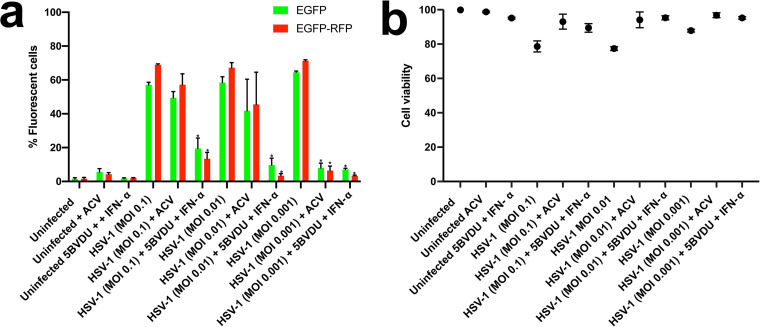
Herpes simplex virus 1 (HSV-1) can induce damage in brain regions that include the hippocampus and associated limbic structures. These neurogenic niches are important because they are associated with memory formation and are highly enriched with neural progenitor cells (NPCs). The susceptibility and fate of HSV-1-infected NPCs are largely unexplored. We differentiated human induced pluripotent stem cells (hiPSCs) into NPCs to generate two-dimensional (2D) and three-dimensional (3D) culture models to examine the interaction of HSV-1 with NPCs. Here, we show that (i) NPCs can be efficiently infected by HSV-1, but infection does not result in cell death of most NPCs, even at high multiplicities of infection (MOIs); (ii) limited HSV-1 replication and gene expression can be detected in the infected NPCs; (iii) a viral silencing mechanism is established in NPCs exposed to the antivirals (E)-5-(2-bromovinyl)-2'-deoxyuridine (5BVdU) and alpha interferon (IFN-α) and when the antivirals are removed, spontaneous reactivation can occur at low frequency; (iv) HSV-1 impairs the ability of NPCs to migrate in a dose-dependent fashion in the presence of 5BVdU plus IFN-α; and (v) 3D cultures of NPCs are less susceptible to HSV-1 infection than 2D cultures. These results suggest that NPC pools could be sites of HSV-1 reactivation in the central nervous system (CNS). Finally, our results highlight the potential value of hiPSC-derived 3D cultures to model HSV-1-NPC interaction. This study employed human induced pluripotent stem cells (hiPSCs) to model the interaction of HSV-1 with NPCs, which reside in the neurogenic niches of the CNS and play a fundamental role in adult neurogenesis. Herein, we provide evidence that in NPCs infected at an MOI as low as 0.001, HSV-1 can establish a latent state, suggesting that (i) a variant of classical HSV-1 latency can be established during earlier stages of neuronal differentiation and (ii) neurogenic niches in the brain may constitute additional sites of viral reactivation. Lytic HSV-1 infections impaired NPC migration, which represents a critical step in neurogenesis. A difference in susceptibility to HSV-1 infection between two-dimensional (2D) and three-dimensional (3D) NPC cultures was observed, highlighting the potential value of 3D cultures for modeling host-pathogen interactions. Together, our results are relevant in light of observations relating HSV-1 infection to postencephalitic cognitive dysfunction.
单纯疱疹病毒 1(HSV-1)可引起包括海马体和相关边缘结构在内的大脑区域损伤。这些神经发生龛位非常重要,因为它们与记忆形成有关,并且富含神经祖细胞(NPC)。HSV-1 感染的 NPC 的易感性和命运在很大程度上尚未得到探索。我们将人诱导多能干细胞(hiPSC)分化为 NPC,以生成二维(2D)和三维(3D)培养模型,以研究 HSV-1 与 NPC 的相互作用。在这里,我们表明:(i)NPC 可以被 HSV-1 有效感染,但即使在高感染复数(MOI)下,感染也不会导致大多数 NPC 死亡;(ii)在感染的 NPC 中可以检测到有限的 HSV-1 复制和基因表达;(iii)在暴露于抗病毒药物(E)-5-(2-溴乙烯基)-2'-脱氧尿苷(5BVdU)和α干扰素(IFN-α)的 NPC 中建立了病毒沉默机制,并且当去除抗病毒药物时,自发性再激活可能以低频率发生;(iv)HSV-1 以剂量依赖性方式损害 NPC 在存在 5BVdU 加 IFN-α时迁移的能力;(v)与 2D 培养物相比,NPC 的 3D 培养物对 HSV-1 感染的敏感性较低。这些结果表明,NPC 池可能是中枢神经系统(CNS)中 HSV-1 再激活的部位。最后,我们的结果强调了 hiPSC 衍生的 3D 培养物在模拟 HSV-1-NPC 相互作用方面的潜在价值。本研究采用人诱导多能干细胞(hiPSC)来模拟 HSV-1 与 NPC 的相互作用,NPC 存在于 CNS 的神经发生龛位,在成人神经发生中起关键作用。在此,我们提供的证据表明,在 MOI 低至 0.001 的情况下感染的 NPC 中,HSV-1 可以建立潜伏状态,这表明:(i)在神经元分化的早期阶段可能建立了经典 HSV-1 潜伏期的变体,以及(ii)大脑中的神经发生龛位可能构成病毒再激活的其他部位。裂解性 HSV-1 感染损害 NPC 迁移,这是神经发生的关键步骤。观察到二维(2D)和三维(3D)NPC 培养物对 HSV-1 感染的易感性存在差异,突出了 3D 培养物在模拟宿主-病原体相互作用方面的潜在价值。总的来说,鉴于 HSV-1 感染与脑炎后认知功能障碍有关的观察结果,我们的研究结果具有相关性。