Laboratory for Viral Vector Technology and Gene Therapy, Department of Pharmaceutical and Pharmacological Sciences, KU Leuven, 3000, Leuven, Belgium.
Laboratory for Molecular Virology and Drug Discovery, Department of Pharmaceutical and Pharmacological Sciences, KU Leuven, 3000, Leuven, Belgium.
Sci Rep. 2019 Feb 20;9(1):2389. doi: 10.1038/s41598-019-38718-0.
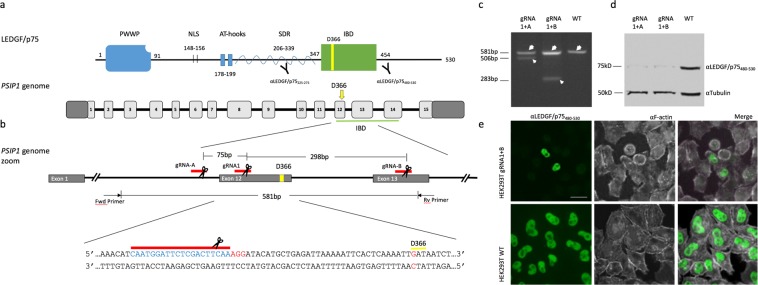
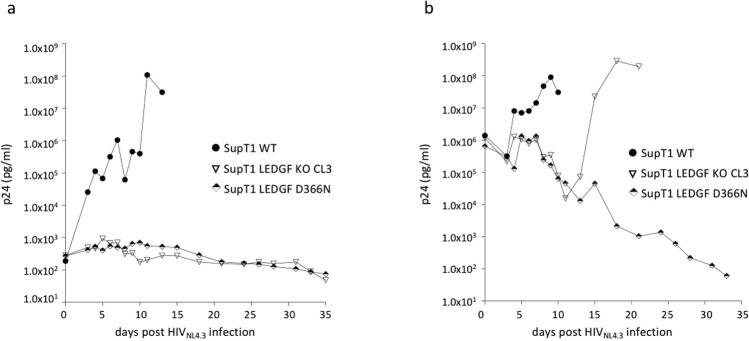
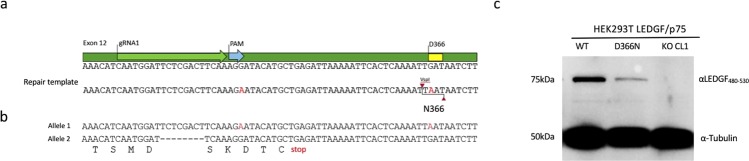
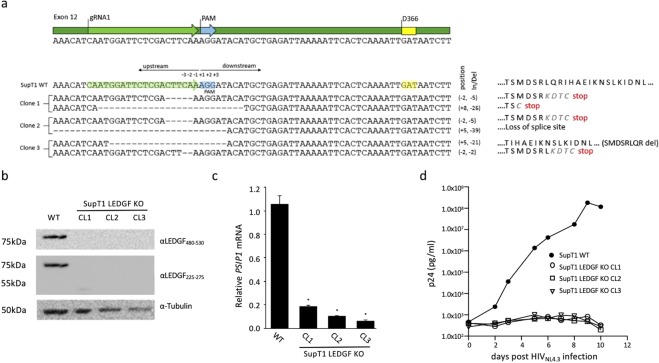
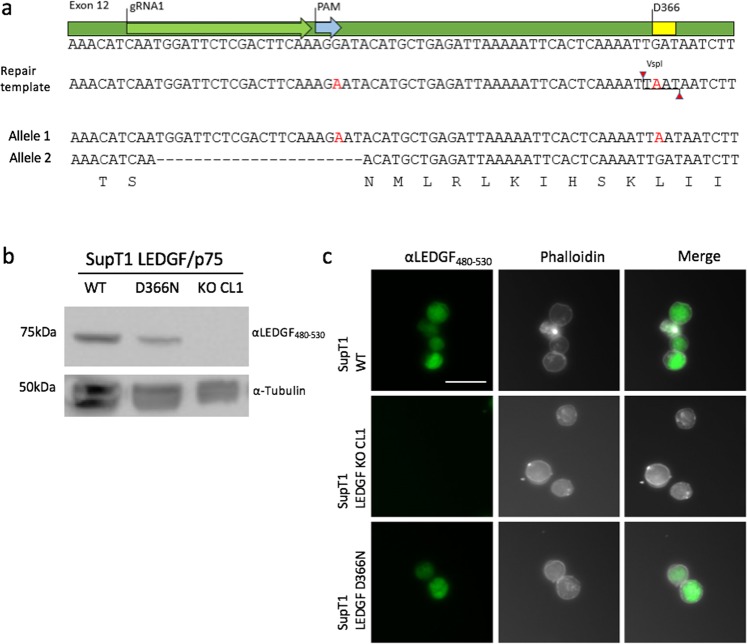
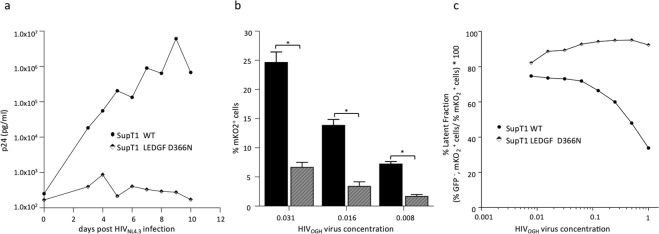
To fulfill a productive infection cycle the human immunodeficiency virus (HIV) relies on host-cell factors. Interference with these co-factors holds great promise in protecting cells against HIV infection. LEDGF/p75, encoded by the PSIP1 gene, is used by the integrase (IN) protein in the pre-integration complex of HIV to bind host-cell chromatin facilitating proviral integration. LEDGF/p75 depletion results in defective HIV replication. However, as part of its cellular function LEDGF/p75 tethers cellular proteins to the host-cell genome. We used site-specific editing of the PSIP1 locus using CRISPR/Cas to target the aspartic acid residue in position 366 and mutated it to asparagine (D366N) to disrupt the interaction with HIV IN but retain LEDGF/p75 cellular function. The resulting cell lines demonstrated successful disruption of the LEDGF/p75 HIV-IN interface without affecting interaction with cellular binding partners. In line with LEDGF/p75 depleted cells, D366N cells did not support HIV replication, in part due to decreased integration efficiency. In addition, we confirm the remaining integrated provirus is more silent. Taken together, these results support the potential of site-directed CRISPR/Cas9 mediated knock-in to render cells more resistant to HIV infection and provides an additional strategy to protect patient-derived T-cells against HIV-1 infection as part of cell-based therapy.
为了完成一个有生产力的感染周期,人类免疫缺陷病毒(HIV)依赖于宿主细胞因子。干扰这些辅助因子在保护细胞免受 HIV 感染方面具有很大的前景。由 PSIP1 基因编码的 LEDGF/p75,被 HIV 整合酶(IN)蛋白在 HIV 的整合前复合物中使用,与宿主细胞染色质结合,促进前病毒整合。LEDGF/p75 的耗竭导致 HIV 复制缺陷。然而,作为其细胞功能的一部分,LEDGF/p75 将细胞蛋白固定在宿主细胞基因组上。我们使用 CRISPR/Cas 对 PSIP1 基因座进行了位点特异性编辑,靶向位置 366 的天冬氨酸残基,并将其突变为天冬酰胺(D366N),以破坏与 HIV IN 的相互作用,但保留 LEDGF/p75 的细胞功能。结果表明,这些细胞系成功地破坏了 LEDGF/p75-HIV-IN 界面,而不影响与细胞结合伙伴的相互作用。与 LEDGF/p75 耗竭细胞一致,D366N 细胞不支持 HIV 复制,部分原因是整合效率降低。此外,我们还证实剩余的整合前病毒更加沉默。总之,这些结果支持了通过靶向 CRISPR/Cas9 介导的基因敲入使细胞更能抵抗 HIV 感染的潜力,并为保护患者来源的 T 细胞免受 HIV-1 感染提供了另一种策略,作为细胞治疗的一部分。