Larson Peter S, Espira Leon, Grabow Cole, Wang Christine A, Muloi Dishon, Browne A Springer, Deem Sharon L, Fèvre Eric M, Foufopoulos Johannes, Hardin Rebecca, Eisenberg Joseph N S
School for Environment and Sustainability, University of Michigan, Ann Arbor, Michigan.
Department of Epidemiology, School of Public Health, University of Michigan, Ann Arbor, Michigan.
Zoonoses Public Health. 2019 May;66(3):316-324. doi: 10.1111/zph.12567. Epub 2019 Feb 20.
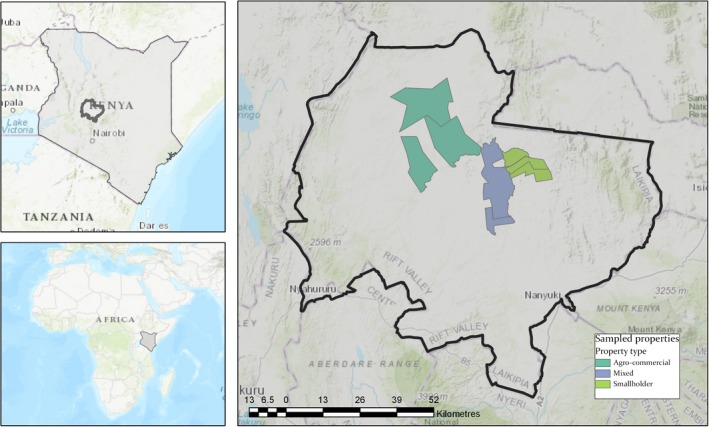
Coxiella burnetii, the causative agent of Query fever (Q fever), is among the most highly infectious zoonotic pathogens transmitted among livestock, with chronic effects challenging to veterinary and medical detection and care systems. Transmission among domestic livestock species can vary regionally due to herd management practices that determine which livestock species are raised, whether or not livestock are in contact with wildlife, and the susceptibility of these livestock to infection. To explore how different livestock management practices are associated with the risk of infection in multispecies environments, we carried out a comparative study of three types of herd management systems in the central Kenyan county of Laikipia: agro-commercial, mixed conservancy/commercial, and smallholder ranches. We tested C. burnetii antibody seroprevalence in four common livestock species. Across all management types, the highest seroprevalence was in camels (20%), followed by goats (18%), sheep (13%), and cattle (6%). We observed a lower odds of testing seropositive for young compared to adult animals (adjusted OR = 0.44 [95% CI 0.24, 0.76]), and for males compared to females (adjusted OR = 0.52 [95% CI 0.33, 0.80]). Animals from mixed conservancy/commercial and smallholder operations had a higher odds of testing seropositive compared to animals from agro-commercial ranches (adjusted OR = 5.17 [95% CI 2.71, 10.44] and adjusted OR = 2.21 [95% CI 1.17, 4.43] respectively). These data suggest that herd management practices might affect the transmission dynamics of C. burnetiiin arid African ecosystems like those seen in Kenya where several transmission modes are possible, risk of drought has promoted new livestock species such as camels, and multiple wildlife species may co-occur with livestock on the landscape. Further longitudinal studies are needed to disentangle the mechanisms underlying these patterns, and further explore transmission patterns between wildlife, domestic animal, and human populations.
伯氏考克斯体是Q热的病原体,是家畜中传播性最强的人畜共患病原体之一,其慢性影响给兽医和医疗检测及护理系统带来了挑战。由于畜群管理方式的不同,家养牲畜物种之间的传播情况在不同地区可能会有所差异,这些管理方式决定了饲养哪些牲畜物种、牲畜是否与野生动物接触以及这些牲畜对感染的易感性。为了探究不同的牲畜管理方式如何与多物种环境中的感染风险相关联,我们对肯尼亚中部莱基皮亚县的三种畜群管理系统进行了比较研究:农业商业型、混合保护/商业型和小农户牧场。我们检测了四种常见牲畜物种中的伯氏考克斯体抗体血清阳性率。在所有管理类型中,血清阳性率最高的是骆驼(20%),其次是山羊(18%)、绵羊(13%)和牛(6%)。我们观察到,与成年动物相比,幼龄动物血清检测呈阳性的几率较低(调整后的比值比=0.44 [95%置信区间0.24, 0.76]),与雌性动物相比,雄性动物血清检测呈阳性的几率较低(调整后的比值比=0.52 [95%置信区间0.33, 0.80])。与农业商业型牧场的动物相比,来自混合保护/商业型和小农户养殖场的动物血清检测呈阳性的几率更高(分别为调整后的比值比=5.17 [95%置信区间2.71, 10.44]和调整后的比值比=2.21 [95%置信区间1.17, 4.43])。这些数据表明畜群管理方式可能会影响伯氏考克斯体在非洲干旱生态系统中的传播动态,比如在肯尼亚所见到的情况,那里存在多种传播方式,干旱风险促使骆驼等新的牲畜物种出现,并且多种野生动物物种可能与牲畜在同一区域共存。需要进一步开展纵向研究,以理清这些模式背后的机制,并进一步探索野生动物、家畜和人类群体之间的传播模式。