Manyenya Sophina, Nthiwa Daniel, Lutta Harrison Osundwa, Muturi Mathew, Nyamota Richard, Mwatondo Athman, Watene Grace, Akoko James, Bett Bernard
Department of Biological Sciences, University of Embu, Embu, Kenya.
International Livestock Research Institute, Nairobi, Kenya.
Front Vet Sci. 2024 Jul 25;11:1415423. doi: 10.3389/fvets.2024.1415423. eCollection 2024.
Understanding multi-pathogen infections/exposures in livestock is critical to inform prevention and control measures against infectious diseases. We investigated the co-exposure of foot-and-mouth disease virus (FMDV), spp., spp., and in cattle in three zones stratified by land use change and with different wildlife-livestock interactions in Narok county, Kenya. We also assessed potential risk factors associated with the transmission of these pathogens in cattle.
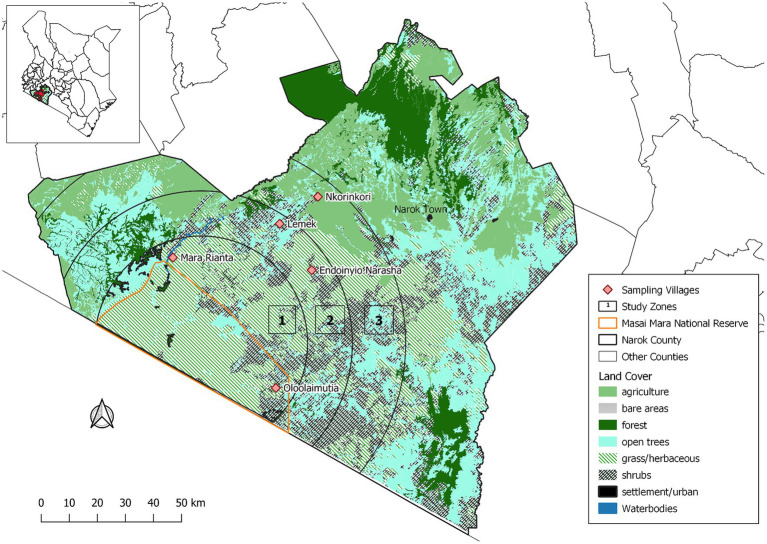
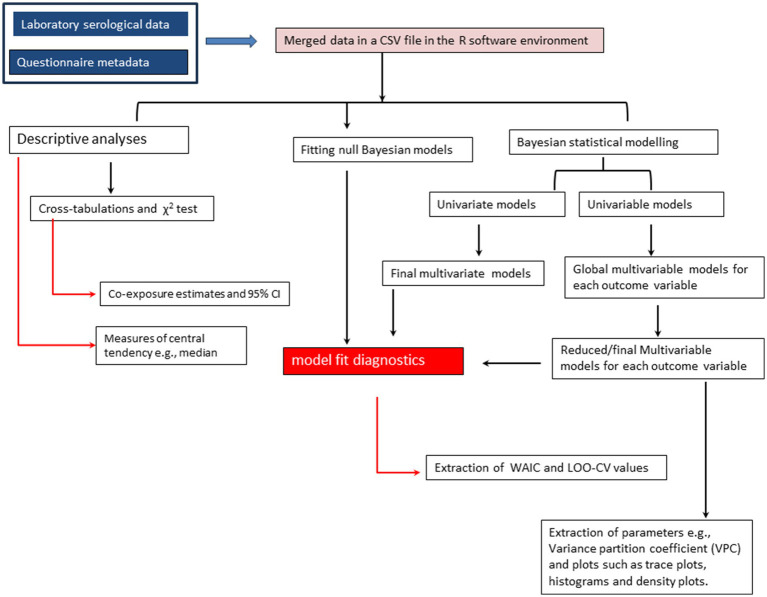
We identified five villages purposively, two each for areas with intensive (zone 1) and moderate wildlife-livestock interactions (zone 2) and one for locations with low wildlife-livestock interactions (zone 3). We sampled 1,170 cattle from 390 herds through a cross-sectional study and tested the serum samples for antibodies against the focal pathogens using enzyme-linked immunosorbent assay (ELISA) kits. A questionnaire was administered to gather epidemiological data on the putative risk factors associated with cattle's exposure to the investigated pathogens. Data were analyzed using the Bayesian hierarchical models with herd number as a random effect to adjust for the within-herd clustering of the various co-exposures among cattle.
Overall, 88.0% (95% CI: 85.0-90.5) of the cattle tested positive for at least one of the targeted pathogens, while 41.7% (95% CI: 37.7-45.8) were seropositive to at least two pathogens. FMDV and spp. had the highest co-exposure at 33.7% (95% CI: 30.9-36.5), followed by FMDV and spp. (21.8%, 95% CI: 19.5-24.4), spp. and spp. (8.8%, 95% CI: 7.2-10.6), FMDV and (1.5%, 95% CI: 0.7-2.8), spp. and (1.0%, 95% CI: 0.3-2.2), and lowest for spp. and (0.3%, 95% CI: 0.0-1.2). Cattle with FMDV and spp., and spp. and spp. co-exposures and those simultaneously exposed to FMDV, spp. and spp. were significantly higher in zone 1 than in zones 2 and 3. However, FMDV and spp. co-exposure was higher in zones 1 and 2 than zone 3.
DISCUSSION/CONCLUSION: We recommend the establishment of a One Health surveillance system in the study area to reduce the morbidity of the targeted zoonotic pathogens in cattle and the risks of transmission to humans.
了解家畜中的多病原体感染/暴露情况对于制定传染病预防和控制措施至关重要。我们在肯尼亚纳罗克县三个因土地利用变化分层且野生动物与家畜互动情况不同的区域,调查了牛群中口蹄疫病毒(FMDV)、[此处原文缺失部分物种名称]、[此处原文缺失部分物种名称]和[此处原文缺失部分物种名称]的共同暴露情况。我们还评估了与这些病原体在牛群中传播相关的潜在风险因素。
我们有目的地确定了五个村庄,其中两个位于野生动物与家畜互动频繁(1区)和中等(2区)的区域,一个位于野生动物与家畜互动较少(3区)的区域。我们通过横断面研究从390个牛群中采集了1170头牛的样本,并使用酶联免疫吸附测定(ELISA)试剂盒检测血清样本中针对目标病原体的抗体。通过问卷调查收集与牛接触所调查病原体相关的假定风险因素的流行病学数据。使用以牛群编号为随机效应的贝叶斯分层模型分析数据,以调整牛群中各种共同暴露的群内聚类情况。
总体而言,88.0%(95%置信区间:85.0 - 90.5)的牛至少对一种目标病原体检测呈阳性,而41.7%(95%置信区间:37.7 - 45.8)的牛对至少两种病原体血清学呈阳性。FMDV和[此处原文缺失部分物种名称]的共同暴露率最高,为33.7%(95%置信区间:30.9 - 36.5),其次是FMDV和[此处原文缺失部分物种名称](21.8%,95%置信区间:19.5 - 24.4)、[此处原文缺失部分物种名称]和[此处原文缺失部分物种名称](8.8%,95%置信区间:7.2 - 10.6)、FMDV和[此处原文缺失部分物种名称](1.5%,95%置信区间:0.7 - 2.8)、[此处原文缺失部分物种名称]和[此处原文缺失部分物种名称](1.0%,95%置信区间:0.3 - 2.2),[此处原文缺失部分物种名称]和[此处原文缺失部分物种名称]的共同暴露率最低,为0.3%(95%置信区间:0.0 - 1.2)。1区中FMDV与[此处原文缺失部分物种名称]、[此处原文缺失部分物种名称]与[此处原文缺失部分物种名称]共同暴露以及同时暴露于FMDV、[此处原文缺失部分物种名称]和[此处原文缺失部分物种名称]的牛显著高于2区和3区。然而,FMDV与[此处原文缺失部分物种名称]的共同暴露在1区和2区高于3区。
讨论/结论:我们建议在研究区域建立一个“同一健康”监测系统,以降低牛群中目标人畜共患病原体的发病率以及传播给人类的风险。