Zoonotic Disease Unit Nairobi, Nairobi, Kenya.
International Livestock Research Institute, Nairobi, Kenya.
PLoS Negl Trop Dis. 2021 Mar 26;15(3):e0009275. doi: 10.1371/journal.pntd.0009275. eCollection 2021 Mar.
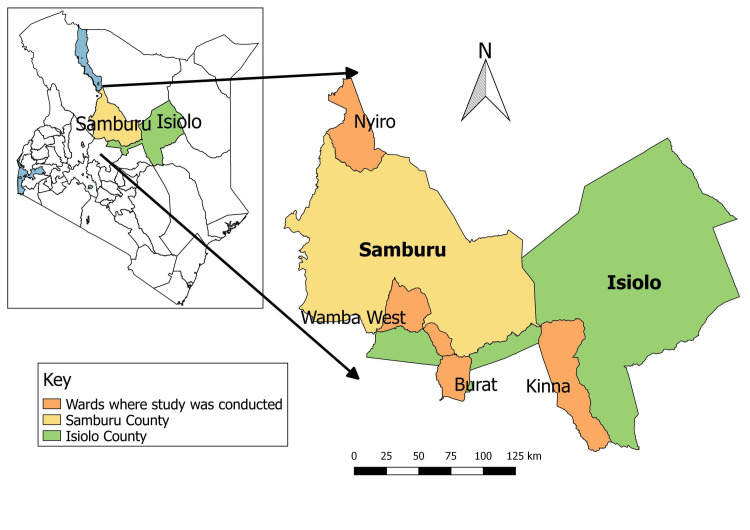
Camels are increasingly becoming the livestock of choice for pastoralists reeling from effects of climate change in semi-arid and arid parts of Kenya. As the population of camels rises, better understanding of their role in the epidemiology of zoonotic diseases in Kenya is a public health priority. Rift Valley fever (RVF), brucellosis and Q fever are three of the top priority diseases in the country but the involvement of camels in the transmission dynamics of these diseases is poorly understood. We analyzed 120 camel serum samples from northern Kenya to establish seropositivity rates of the three pathogens and to characterize the infecting Brucella species using molecular assays. We found seropositivity of 24.2% (95% confidence interval [CI]: 16.5-31.8%) for Brucella, 20.8% (95% CI: 13.6-28.1%) and 14.2% (95% CI: 7.9-20.4%) for Coxiella burnetii and Rift valley fever virus respectively. We found 27.5% (95% CI: 19.5-35.5%) of the animals were seropositive for at least one pathogen and 13.3% (95% CI: 7.2-19.4%) were seropositive for at least two pathogens. B. melitensis was the only Brucella spp. detected. The high sero-positivity rates are indicative of the endemicity of these pathogens among camel populations and the possible role the species has in the epidemiology of zoonotic diseases. Considering the strong association between human infection and contact with livestock for most zoonotic infections in Kenya, there is immediate need to conduct further research to determine the role of camels in transmission of these zoonoses to other livestock species and humans. This information will be useful for designing more effective surveillance systems and intervention measures.
骆驼在肯尼亚半干旱和干旱地区的牧民中越来越受欢迎,成为他们选择的牲畜。随着骆驼数量的增加,更好地了解它们在肯尼亚人畜共患病流行病学中的作用是公共卫生的当务之急。裂谷热(RVF)、布鲁氏菌病和 Q 热是该国的三大优先疾病,但骆驼在这些疾病传播动态中的作用知之甚少。我们分析了肯尼亚北部的 120 份骆驼血清样本,以确定三种病原体的血清阳性率,并使用分子检测方法确定感染的布鲁氏菌种。我们发现布鲁氏菌血清阳性率为 24.2%(95%置信区间[CI]:16.5-31.8%),柯克斯氏体血清阳性率为 20.8%(95% CI:13.6-28.1%),裂谷热病毒血清阳性率为 14.2%(95% CI:7.9-20.4%)。我们发现 27.5%(95% CI:19.5-35.5%)的动物至少对一种病原体呈血清阳性,13.3%(95% CI:7.2-19.4%)的动物至少对两种病原体呈血清阳性。检测到的布鲁氏菌仅为 B. melitensis。高血清阳性率表明这些病原体在骆驼群体中流行,该物种可能在人畜共患病的流行病学中发挥作用。考虑到肯尼亚大多数人畜共患感染与接触牲畜之间存在很强的关联性,立即需要开展进一步的研究,以确定骆驼在这些人畜共患病向其他牲畜和人类传播中的作用。这些信息将有助于设计更有效的监测系统和干预措施。