Department of Electrical and Computer Engineering, University of Nebraska⁻Lincoln, Lincoln, NE 68505, USA.
Department of Animal Science, University of Nebraska⁻Lincoln, Lincoln, NE 68588, USA.
Sensors (Basel). 2019 Feb 19;19(4):852. doi: 10.3390/s19040852.
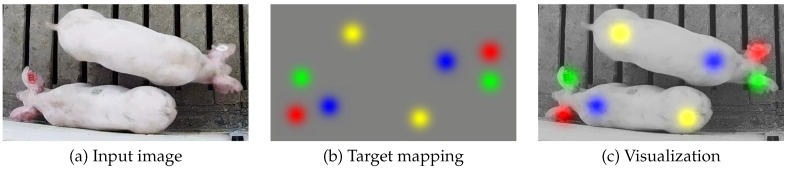
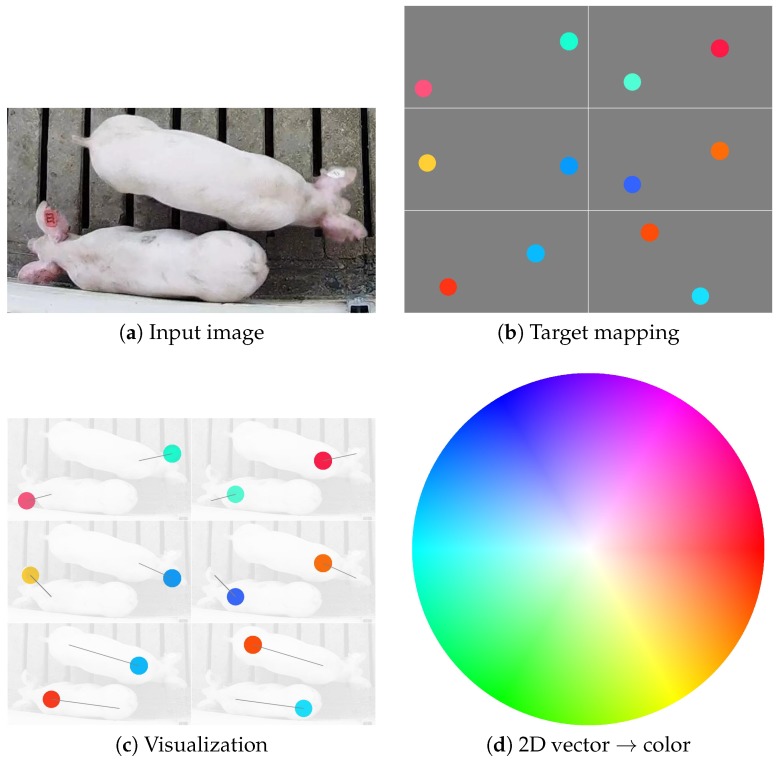
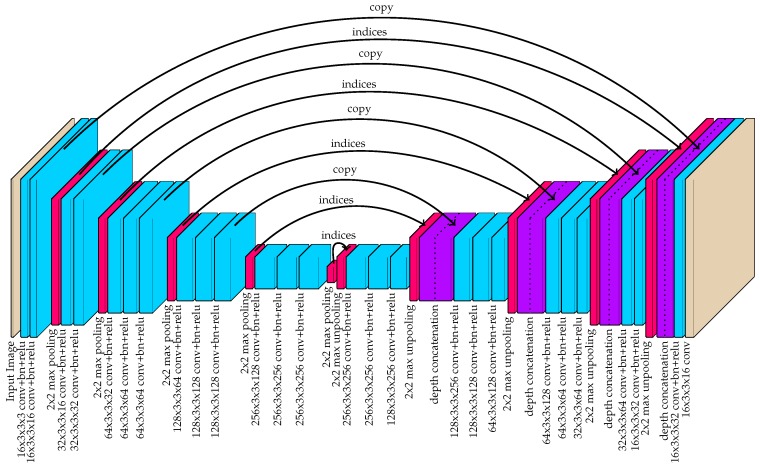
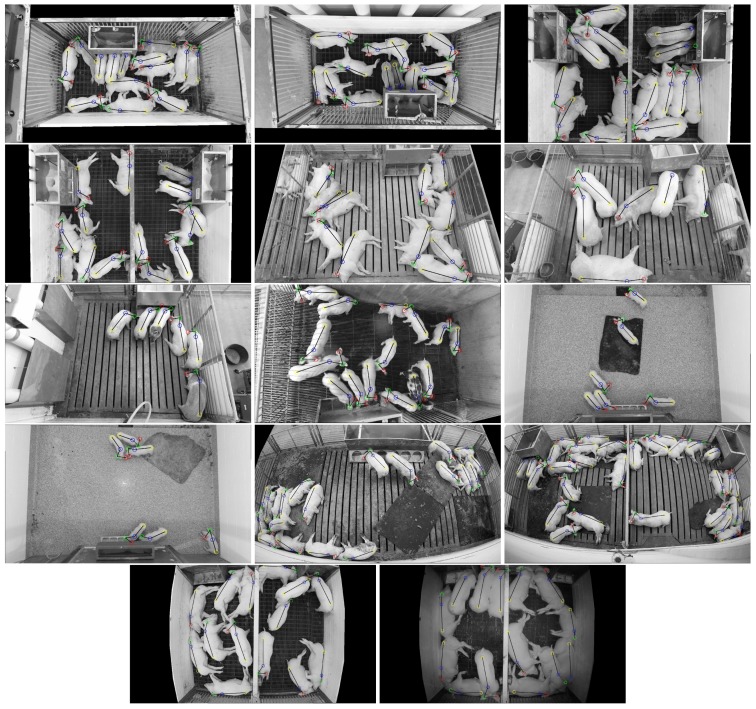
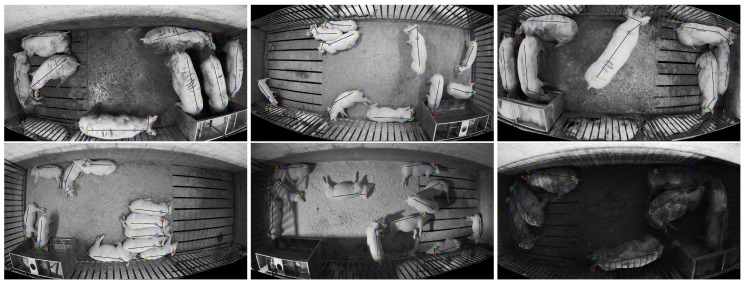
Computer vision systems have the potential to provide automated, non-invasive monitoring of livestock animals, however, the lack of public datasets with well-defined targets and evaluation metrics presents a significant challenge for researchers. Consequently, existing solutions often focus on achieving task-specific objectives using relatively small, private datasets. This work introduces a new dataset and method for instance-level detection of multiple pigs in group-housed environments. The method uses a single fully-convolutional neural network to detect the location and orientation of each animal, where both body part locations and pairwise associations are represented in the image space. Accompanying this method is a new dataset containing 2000 annotated images with 24,842 individually annotated pigs from 17 different locations. The proposed method achieves over 99% precision and over 96% recall when detecting pigs in environments previously seen by the network during training. To evaluate the robustness of the trained network, it is also tested on environments and lighting conditions unseen in the training set, where it achieves 91% precision and 67% recall. The dataset is publicly available for download.
计算机视觉系统有可能提供对牲畜的自动、非侵入式监测,然而,缺乏具有明确定义目标和评估指标的公共数据集,这给研究人员带来了重大挑战。因此,现有的解决方案通常侧重于使用相对较小的私人数据集来实现特定于任务的目标。本工作介绍了一种用于在群体饲养环境中进行多只猪实例级检测的新数据集和方法。该方法使用单个全卷积神经网络来检测每个动物的位置和方向,其中身体部位位置和成对关联都在图像空间中表示。该方法还附带一个新的数据集,其中包含 2000 张标注图像,来自 17 个不同位置的 24842 只单独标注的猪。当在网络训练期间之前看到的环境中检测猪时,所提出的方法的精度超过 99%,召回率超过 96%。为了评估训练网络的鲁棒性,还对训练集中未见过的环境和光照条件进行了测试,其精度达到 91%,召回率为 67%。该数据集可供下载。