Pang Rui, Xie Tengfei, Wu Qingping, Li Yanping, Lei Tao, Zhang Jumei, Ding Yu, Wang Juan, Xue Liang, Chen Moutong, Wei Xianhu, Zhang Youxiong, Zhang Shuhong, Yang Xiaojuan
State Key Laboratory of Applied Microbiology Southern China, Guangdong Provincial Key Laboratory of Microbial Culture Collection and Application, Guangdong Open Laboratory of Applied Microbiology, Guangdong Institute of Microbiology, Guangzhou, China.
Department of Food Science and Technology, Jinan University, Guangzhou, China.
Front Microbiol. 2019 Feb 7;10:186. doi: 10.3389/fmicb.2019.00186. eCollection 2019.
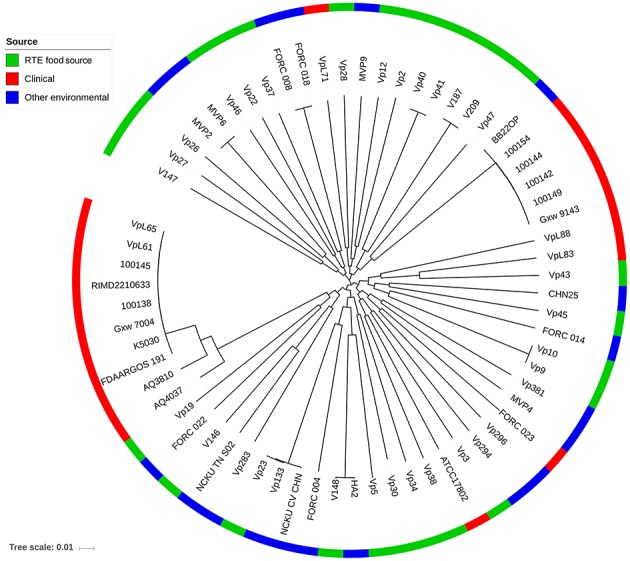
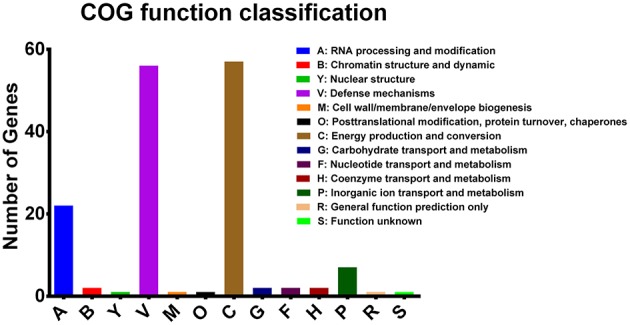
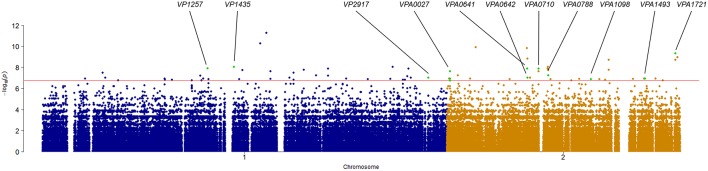
is a major foodborne pathogen associated with the consumption of aquatic products. The presence of this bacterium in ready-to-eat (RTE) foods has recently been reported. However, the genomic features and potential risks of isolated from RTE foods are poorly understood. To help understand the genome-wide characteristics of RTE food isolates, the complete genomes of 27 RTE food isolates were sequenced and compared to those of 20 clinical and 19 other environmental (e.g., water and aquatic product source) isolates using a comparative genomics approach. Analysis revealed that RTE food isolates had higher numbers of genes on average and possessed more accessory genes than isolates from other sources. Most RTE food isolates were positive for some known virulence-associated genes and pathogenicity islands (PAIs), and some of these isolates were genetically homologous to clinical isolates. Genome-wide association analysis revealed 79 accessory genes and 78 missense single-nucleotide polymorphisms that affected 11 protein-coding genes were significantly associated with RTE food sources. These genes were mostly involved in defense mechanisms and energy production and conversion according to functional annotation in the COG database. KEGG Pathway analysis showed that these genes mainly affected the biofilm formation of , and subsequent experiments confirmed that nearly all RTE food isolates possessed the ability to form biofilm. The biofilm formation can facilitate the persistence of in RTE foods, and the presence of virulence-associated genes poses a pathogenic potential to humans. Our findings highlight the potential risk of in Chinese RTE foods and illustrate the genomic basis for the persistence of these isolates. This study will aid in re-evaluating the food safety threats conferred by this bacterium.
是一种与食用水产品相关的主要食源性病原体。最近有报道称在即食(RTE)食品中存在这种细菌。然而,从RTE食品中分离出的该细菌的基因组特征和潜在风险却知之甚少。为了帮助了解RTE食品分离株的全基因组特征,对27株RTE食品分离株的完整基因组进行了测序,并使用比较基因组学方法将其与20株临床分离株和19株其他环境(如水和水产品来源)分离株进行了比较。分析表明,RTE食品分离株平均具有更多的基因,并且比其他来源的分离株拥有更多的辅助基因。大多数RTE食品分离株对一些已知的毒力相关基因和致病岛(PAIs)呈阳性,其中一些分离株与临床分离株在基因上具有同源性。全基因组关联分析显示,79个辅助基因和78个影响11个蛋白质编码基因的错义单核苷酸多态性与RTE食品来源显著相关。根据COG数据库中的功能注释,这些基因大多参与防御机制以及能量产生和转换。KEGG通路分析表明,这些基因主要影响该细菌的生物膜形成,随后的实验证实几乎所有RTE食品分离株都具有形成生物膜的能力。生物膜的形成可以促进该细菌在即食食品中的存活,而毒力相关基因的存在对人类构成致病潜力。我们的研究结果突出了中国RTE食品中该细菌的潜在风险,并阐明了这些分离株持续存在的基因组基础。这项研究将有助于重新评估这种细菌所带来的食品安全威胁。