1Department of Anatomy, MTA-PTE PACAP Research Group, Centre for Neuroscience, Medical School, University of Pécs, Pécs, Hungary.
2Department of Pharmacology and Pharmacotherapy; Medical School, University of Pécs, Pécs, Hungary.
Int Breastfeed J. 2019 Feb 11;14:9. doi: 10.1186/s13006-019-0203-3. eCollection 2019.
Breast milk provides nutrition for infants and also contains a variety of bioactive factors that influence the development of the newborn. Human milk is a complex biological fluid that can be separated into different layers (water phase and lipid phase with its component water and lipid fractions). It can affect the developing human body along the whole length of the gastrointestinal tract, and through the circulation, its factors may reach every organ.
In the present study, we analyzed milk samples collected monthly for 6 months from 16 mothers from the 4 week postpartum between 2014 and 2016 in Baranya County, Hungary. The 96 samples provided us information about the fluctuation of certain bioactive factors during the first 6 months of lactation. We investigated with Luminex technology the concentrations of several cytokines (CD40, Flt-3L), chemokines (MCP-1, RANTES, GRO, MIP-1ß, MDC, eotaxin, fractalkine), and epidermal growth factor (EGF). Paired t-tests and one-way ANOVA followed by Bonferroni post-hoc tests were used to compare the data.
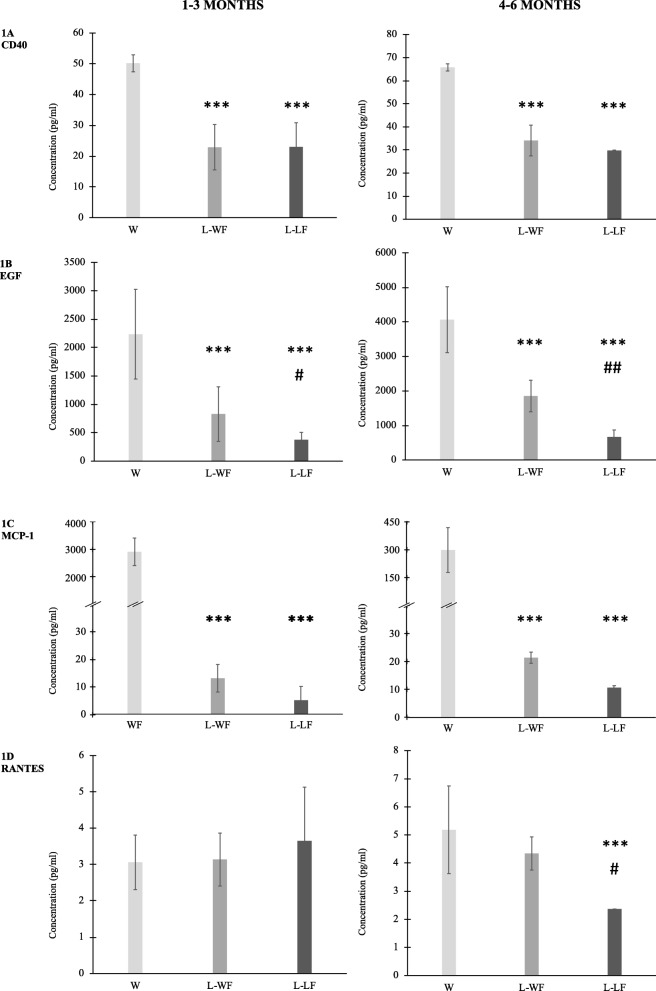
We detected the presence of each bioactive factor in every layer of the milk samples during the first 6 months of breastfeeding in widespread concentration ranges. In the case of GRO, MIP-1ß, MDC, Flt-3L, fractalkine, and eotaxin, the concentrations were constant during the first 6 months of lactation. The water phase of human milk contained higher factor concentrations compared to both fractions of the lipid phase for most factors (except eotaxin and MIP-1ß). The concentrations of CD40, EGF, MCP-1, and RANTES in the first 3 months were significantly different compared to the values detected between 4 and 6 months. In the water phase, the level of MCP-1 was significantly decreased, while all of the other factors increased during the 4 through 6 months. We found significantly higher EGF, GRO, and RANTES levels in the water fraction compared to the lipid fraction of the lipid phase.
The novel findings of this investigation were the presence of Flt-3L and MDC in all layers of breast milk, and nearly all bioactive factors in the lipid phase. Due to their widespread physiological effects these factors may have an essential role in organogenesis.
母乳为婴儿提供营养,还含有多种影响新生儿发育的生物活性因子。人乳是一种复杂的生物流体,可分为不同的层(水相和脂质相及其组成的水相和脂质部分)。它可以沿着整个胃肠道影响发育中的人体,并且通过循环,其因子可能到达每个器官。
本研究分析了 2014 年至 2016 年期间,匈牙利巴兰尼亚县 16 名母亲产后 4 周内每月收集的 6 个月的母乳样本。96 个样本提供了我们关于哺乳期头 6 个月某些生物活性因子波动的信息。我们使用 Luminex 技术检测了几种细胞因子(CD40、Flt-3L)、趋化因子(MCP-1、RANTES、GRO、MIP-1β、MDC、嗜酸性粒细胞趋化因子、 fractalkine)和表皮生长因子(EGF)的浓度。采用配对 t 检验和单因素方差分析,然后进行 Bonferroni 事后检验比较数据。
在母乳喂养的头 6 个月中,我们在每个母乳样本的各个层中都检测到了每种生物活性因子的存在,其浓度范围广泛。在 GRO、MIP-1β、MDC、Flt-3L、 fractalkine 和嗜酸性粒细胞趋化因子的情况下,在哺乳期的头 6 个月中,浓度保持不变。与大多数因子(除了嗜酸性粒细胞趋化因子和 MIP-1β)相比,人乳的水相含有更高的因子浓度。在头 3 个月,CD40、EGF、MCP-1 和 RANTES 的浓度与 4 至 6 个月之间检测到的浓度显著不同。在水相中,MCP-1 的水平显著降低,而在 4 至 6 个月期间,所有其他因子的水平均增加。我们发现,水相中 EGF、GRO 和 RANTES 的水平明显高于脂质相的脂质部分。
本研究的新发现是 Flt-3L 和 MDC 存在于母乳的所有层中,以及几乎所有的生物活性因子存在于脂质相中。由于它们具有广泛的生理作用,这些因子可能在器官发生中具有重要作用。