Seeruttun Sharvesh Raj, Cheung Wing Yan, Wang Wei, Fang Cheng, Liu Zhi-Min, Li Jin-Qing, Wu Ting, Wang Jun, Liang Chun, Zhou Zhi-Wei
Department of Gastric Surgery, Sun Yat-sen University Cancer Center, Guangzhou, Guangdong, P.R. China.
State Key Laboratory of Oncology in South China, Guangzhou, Guangdong, P.R. China.
Gastroenterol Rep (Oxf). 2019 Feb;7(1):57-66. doi: 10.1093/gastro/goy023. Epub 2018 Aug 13.
Biomarkers are important tools for prompt diagnosis of cancer. This study aimed to identify reliable biomarkers for clinical applications in the diagnosis of gastric cancer and lymph-node (LN) metastasis.
Between 1 December 2014 and 31 December 2015, we prospectively collected samples of gastric-cancer tissues, corresponding matched-pair normal gastric mucosa, and their peri-gastric metastatic and non-metastatic LNs to identify quantitatively reliable genes using quantitative real-time polymerase chain reaction. Relative quantity (RQ) was used to calculate the mRNA expression levels of our target genes. Statistics were calculated using one-way analysis of variance (ANOVA) and Tukey's multiple comparison test. Analytical graphs were plotted using GraphPad Prism.
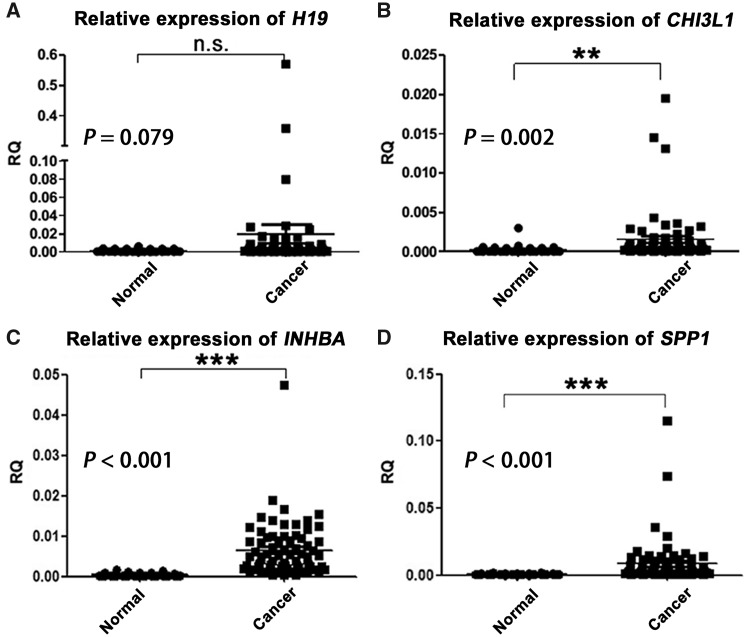
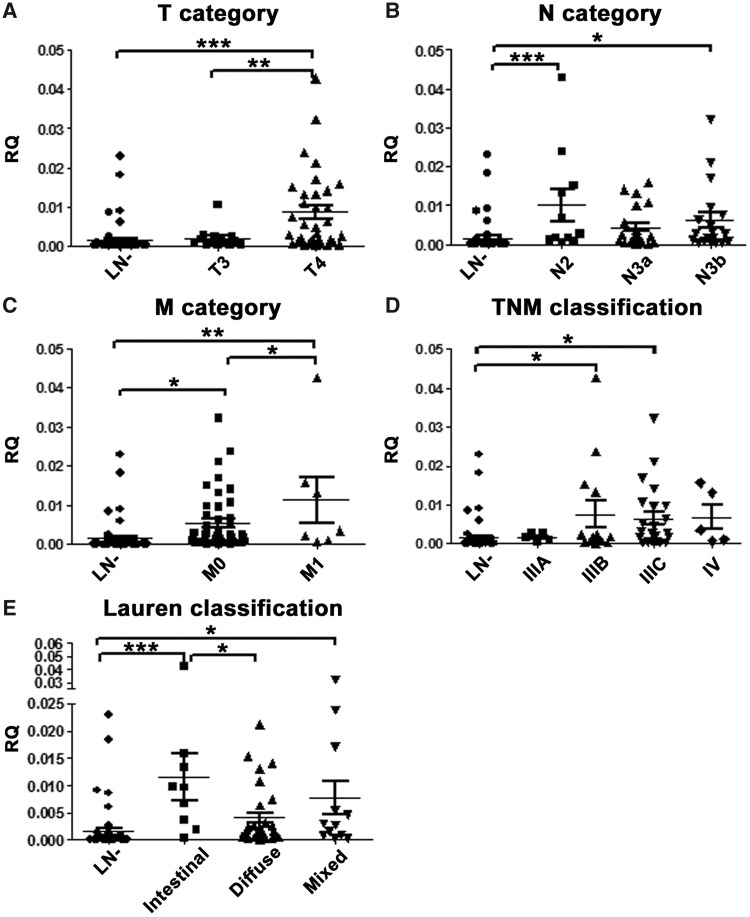
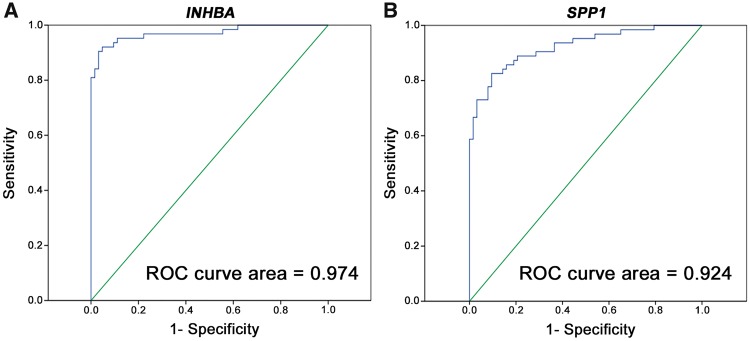
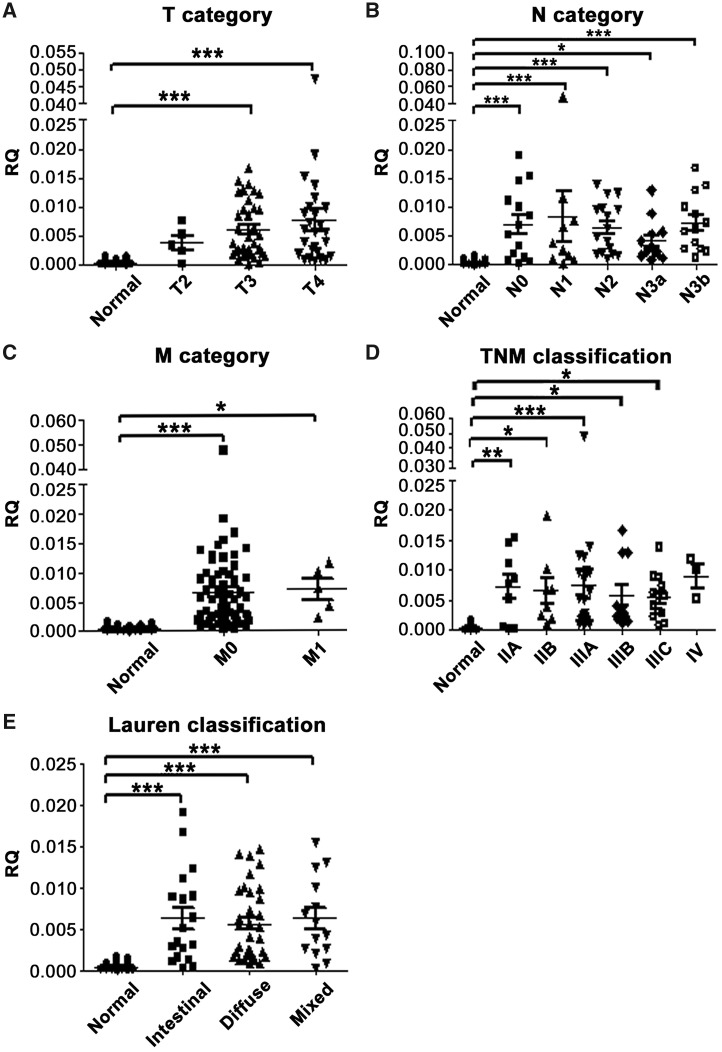
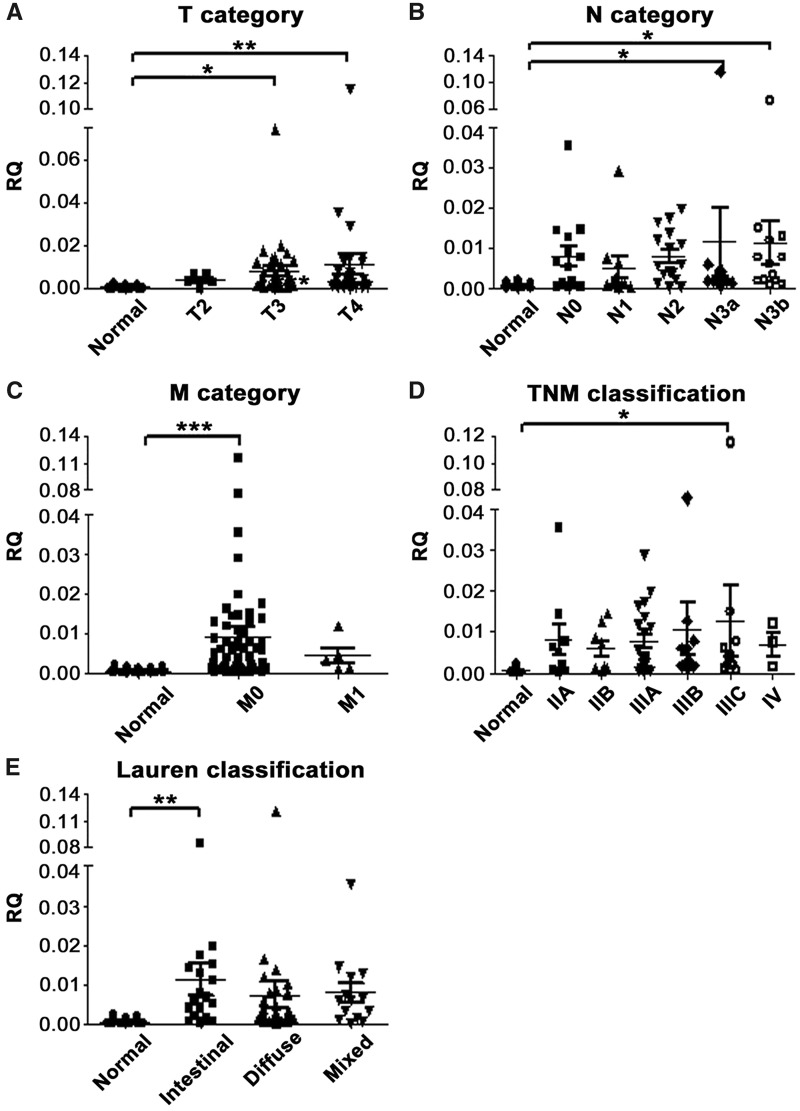
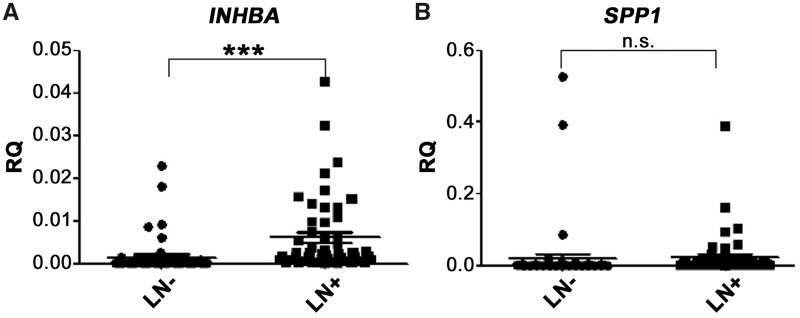
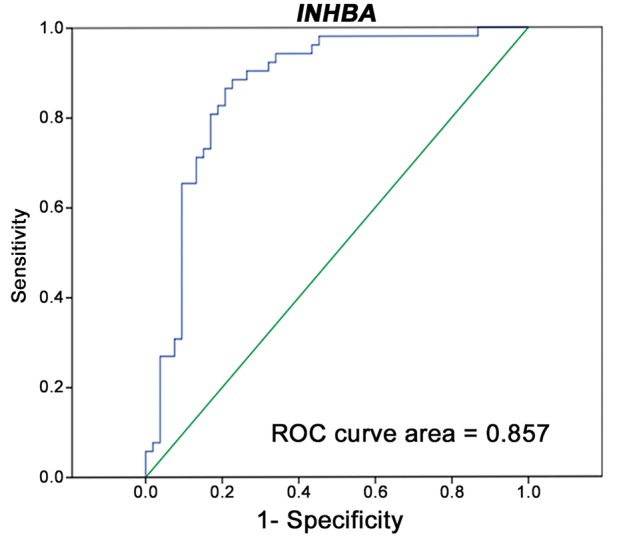
Of nine assessed genes, the mRNA levels of inhibin beta A () and secreted phosphoprotein 1 () were most consistently highly expressed in tumor tissues by 15.4- and 15.6-fold, respectively, as compared with normal tissues ( < 0.001), with 91.3% sensitivity and 95.7% specificity (receiver operating characteristic [ROC] curve area = 0.974) for the former and 82.6% sensitivity and 87.0% specificity (ROC curve area = 0.924) for the latter. Further analysis revealed no differentiating significance of mRNA expression between metastatic and non-metastatic LNs ( = 0.470). In contrast, the mRNA level was up-regulated 4.1-fold in metastatic LNs ( < 0.001), with 80.0% sensitivity and 81.5% specificity (ROC curve area = 0.857), and was also able to successfully differentiate between more severe disease conditions, T3 and T4 ( = 0.003), M0 and M1 ( = 0.043) and different histological variants (intestinal type vs diffuse type, = 0.019).
Our results showed that was the most optimally reliable biomarker for diagnosing gastric cancer and LN metastasis.
生物标志物是癌症快速诊断的重要工具。本研究旨在鉴定可用于胃癌及淋巴结(LN)转移诊断临床应用的可靠生物标志物。
在2014年12月1日至2015年12月31日期间,我们前瞻性收集了胃癌组织样本、相应配对的正常胃黏膜样本以及其胃周转移性和非转移性淋巴结样本,以通过定量实时聚合酶链反应鉴定定量可靠的基因。使用相对定量(RQ)计算目标基因的mRNA表达水平。采用单因素方差分析(ANOVA)和Tukey多重比较检验进行统计计算。使用GraphPad Prism绘制分析图。
在评估的9个基因中,与正常组织相比,抑制素βA()和分泌性磷蛋白1()的mRNA水平在肿瘤组织中分别最一致地高表达15.4倍和15.6倍(<0.001),前者的敏感性为91.3%,特异性为95.7%(受试者操作特征[ROC]曲线面积=0.974),后者的敏感性为82.6%,特异性为87.0%(ROC曲线面积=0.924)。进一步分析显示,转移性和非转移性淋巴结之间的mRNA表达无差异(=0.470)。相反,mRNA水平在转移性淋巴结中上调了4.1倍(<0.001),敏感性为80.0%,特异性为81.5%(ROC曲线面积=0.857),并且还能够成功区分更严重的疾病状态,T3和T4(=0.003),M0和M1(=0.043)以及不同的组织学类型(肠型与弥漫型,=0.019)。
我们的结果表明,是诊断胃癌和LN转移的最可靠生物标志物。