Colvin Robert
School of Information Technology and Electrical Engineering, University of Queensland, Brisbane, QLD, Australia.
NPJ Sci Learn. 2016 Jul 6;1:16012. doi: 10.1038/npjscilearn.2016.12. eCollection 2016.
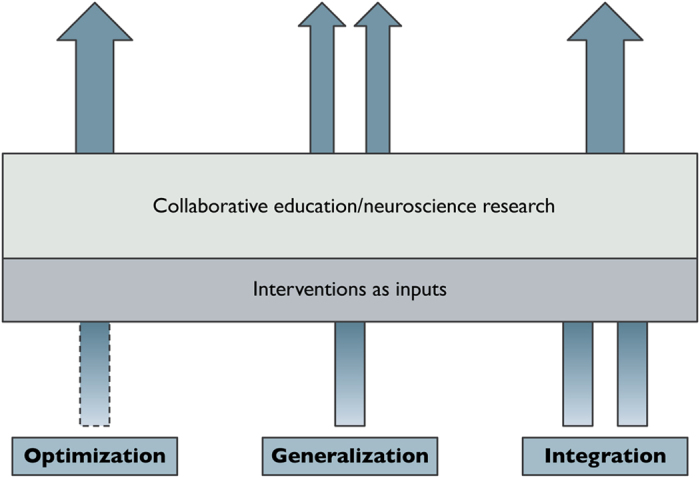
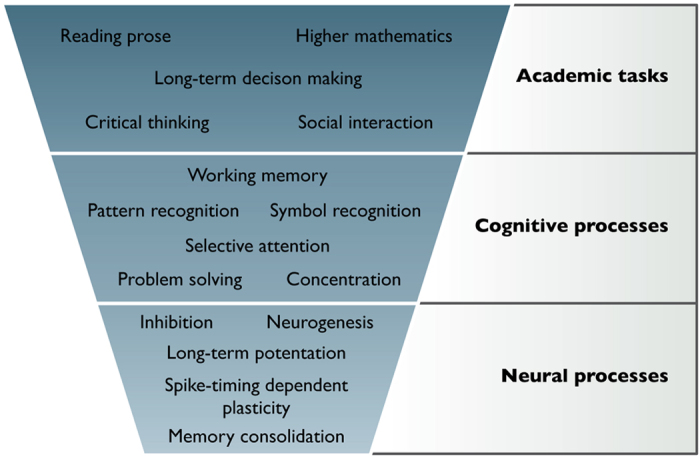
Practical collaboration at the intersection of education and neuroscience research is difficult because the combined discipline encompasses both the activity of microscopic neurons and the complex social interactions of teachers and students in a classroom. Taking a pragmatic view, this paper discusses three education objectives to which neuroscience can be effectively applied: optimising, generalising and integrating instructional techniques. These objectives are characterised by: (1) being of practical importance; (2) building on existing education and cognitive research; and (3) being infeasible to address based on behavioural experiments alone. The focus of the neuroscientific aspect of collaborative research should be on the activity of the brain before, during and after learning a task, as opposed to performance of a task. The objectives are informed by literature that highlights possible pitfalls with educational neuroscience research, and are described with respect to the static and dynamic aspects of brain physiology that can be measured by current technology.
在教育与神经科学研究的交叉领域开展切实可行的合作颇具难度,因为这一综合学科既涵盖微观神经元的活动,又涉及课堂上教师与学生复杂的社会互动。从务实的角度出发,本文探讨了神经科学能够有效应用的三个教育目标:优化、推广和整合教学技巧。这些目标具有以下特点:(1)具有实际重要性;(2)以现有的教育和认知研究为基础;(3)仅依靠行为实验无法解决。合作研究的神经科学方面的重点应放在学习任务之前、期间和之后大脑的活动上,而非任务的执行情况。这些目标参考了强调教育神经科学研究可能存在的陷阱的文献,并结合当前技术能够测量的大脑生理学的静态和动态方面进行了描述。