Pereira Gonçalves M A, Escorihuela-Sayalero Carlos, Garca-Fernández Pablo, Junquera Javier, Íñiguez Jorge
Materials Research and Technology Department, Luxembourg Institute of Science and Technology (LIST), Avenue des Hauts-Fourneaux 5, L-4362 Esch/Alzette, Luxembourg.
Departamento de Ciencias de la Tierra y Fsica de la Materia Condensada, Universidad de Cantabria, Cantabria Campus Internacional, Avenida de los Castros s/n, 39005 Santander, Spain.
Sci Adv. 2019 Feb 15;5(2):eaau7023. doi: 10.1126/sciadv.aau7023. eCollection 2019 Feb.
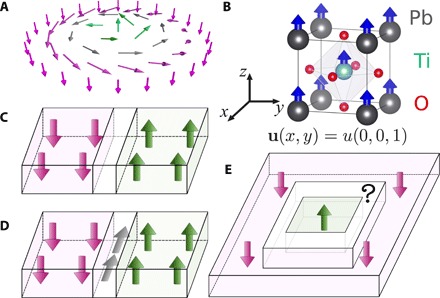
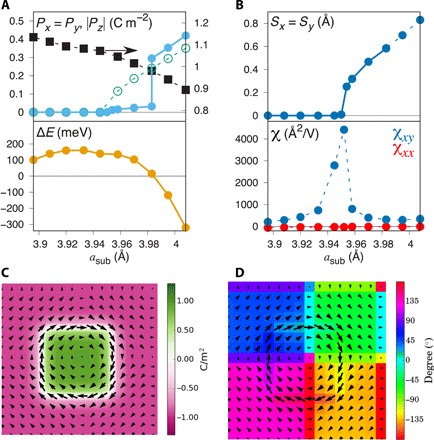
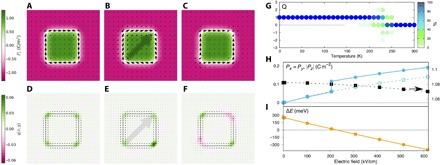
Researchers have long wondered whether ferroelectrics may present topological textures akin to magnetic skyrmions and chiral bubbles, the results being modest thus far. An electric equivalent of a typical magnetic skyrmion would rely on a counterpart of the Dzyaloshinskii-Moriya interaction and seems all but impossible; further, the exotic ferroelectric orders reported to date rely on specific composites and superlattices, limiting their generality and properties. Here, we propose an original approach to write topological textures in simple ferroelectrics in a customary manner. Our second-principles simulations of columnar nanodomains, in prototype material PbTiO, show we can harness the Bloch-type structure of the domain wall to create objects with the usual skyrmion-defining features as well as unusual ones-including isotopological and topological transitions driven by external fields and temperature-and potentially very small sizes. Our results suggest countless possibilities for creating and manipulating such electric textures, effectively inaugurating the field of topological ferroelectrics.
长期以来,研究人员一直想知道铁电体是否可能呈现出类似于磁斯格明子和手性气泡的拓扑结构,到目前为止,相关成果并不显著。典型磁斯格明子的电等效物将依赖于Dzyaloshinskii-Moriya相互作用的对应物,而这似乎几乎是不可能的;此外,迄今为止报道的奇异铁电序依赖于特定的复合材料和超晶格,限制了它们的通用性和性能。在此,我们提出一种原创方法,以常规方式在简单铁电体中写入拓扑结构。我们对原型材料PbTiO₃中的柱状纳米畴进行的第一性原理模拟表明,我们可以利用畴壁的布洛赫型结构来创建具有通常斯格明子定义特征以及不寻常特征的物体,包括由外部场和温度驱动的同拓扑和拓扑转变,以及潜在的非常小的尺寸。我们的结果表明,创建和操纵这种电结构具有无数可能性,有效地开创了拓扑铁电体领域。