Department of Orthopaedic Surgery, Musculoskeletal Research Center, Washington University School of Medicine, St. Louis, MO 63110, USA; Department of Cell Biology and Physiology, Washington University School of Medicine, St. Louis, MO 63110, USA.
Genome Technology Access Center, Washington University School of Medicine, St. Louis, MO 63110, USA.
Osteoarthritis Cartilage. 2019 Jun;27(6):945-955. doi: 10.1016/j.joca.2019.02.792. Epub 2019 Feb 21.
To compare the transcriptome of articular cartilage from knees with meniscus tears to knees with end-stage osteoarthritis (OA).
Articular cartilage was collected from the non-weight bearing medial intercondylar notch of knees undergoing arthroscopic partial meniscectomy (APM; N = 10, 49.7 ± 10.8 years, 50% females) for isolated medial meniscus tears and knees undergoing total knee arthroplasty (TKA; N = 10, 66.0 ± 7.6 years, 70% females) due to end-stage OA. Ribonucleic acid (RNA) preparation was subjected to SurePrint G3 human 8 × 60K RNA microarrays to probe differentially expressed transcripts followed by computational exploration of underlying biological processes. Real-time polymerase chain reaction amplification was performed on selected transcripts to validate microarray data.
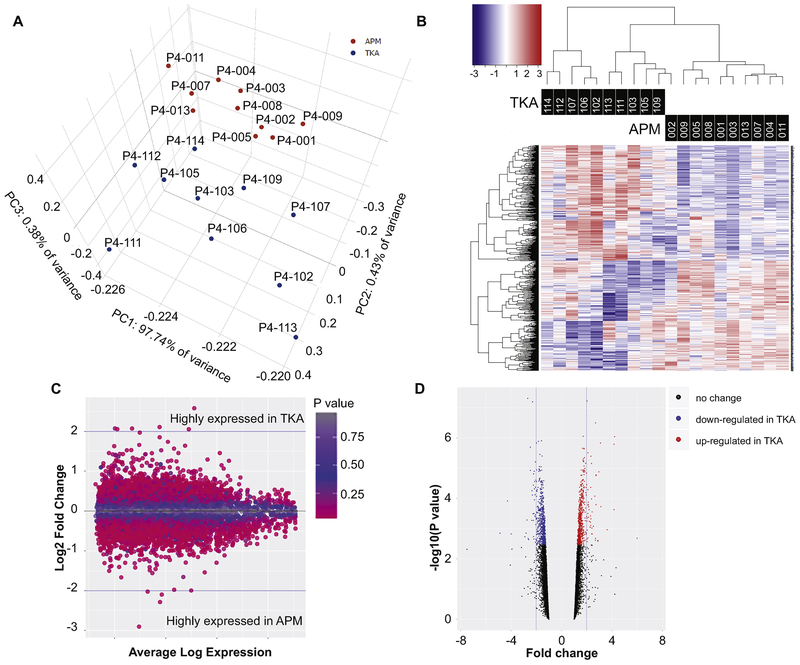
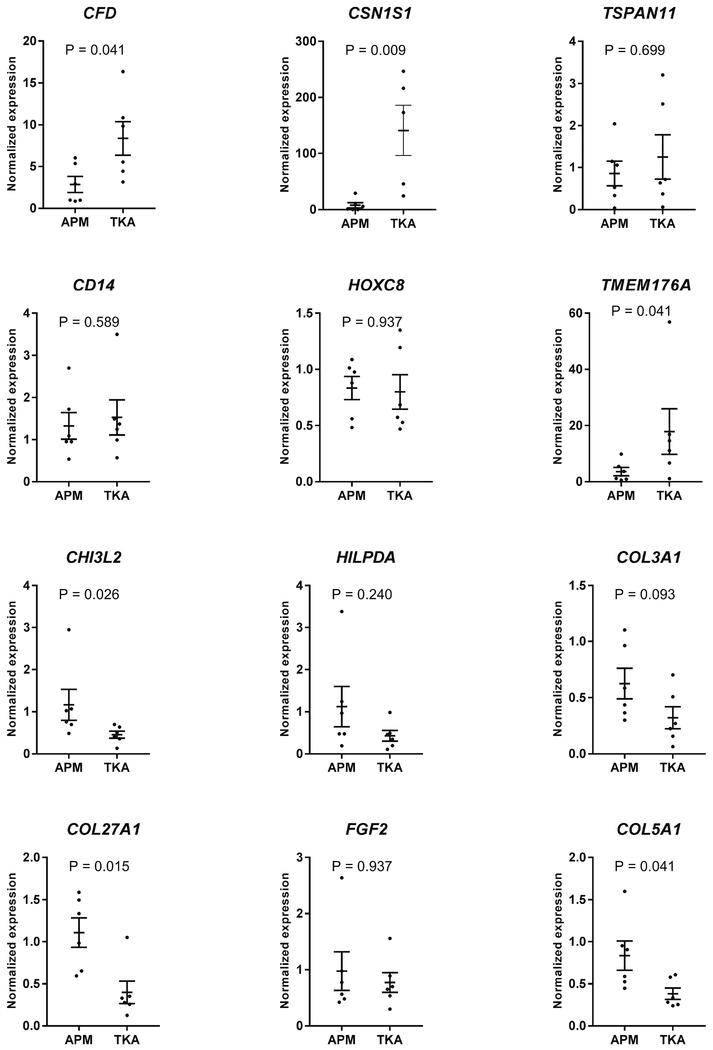
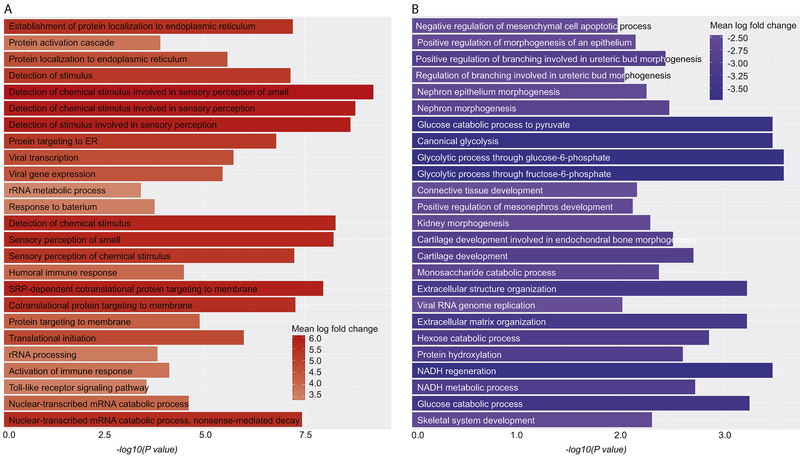
We observed that 81 transcripts were significantly differentially expressed (45 elevated, 36 repressed) between APM and TKA samples (≥ 2 fold) at a false discovery rate of ≤ 0.05. Among these, CFD, CSN1S1, TSPAN11, CSF1R and CD14 were elevated in the TKA group, while CHI3L2, HILPDA, COL3A1, COL27A1 and FGF2 were highly expressed in APM group. A few long intergenic non-coding RNAs (lincRNAs), small nuclear RNAs (snoRNAs) and antisense RNAs were also differentially expressed between the two groups. Transcripts up-regulated in TKA cartilage were enriched for protein localization and activation, chemical stimulus, immune response, and toll-like receptor signaling pathway. Transcripts up-regulated in APM cartilage were enriched for mesenchymal cell apoptosis, epithelial morphogenesis, canonical glycolysis, extracellular matrix organization, cartilage development, and glucose catabolic process.
This study suggests that APM and TKA cartilage express distinct sets of OA transcripts. The gene profile in cartilage from TKA knees represents an end-stage OA whereas in APM knees it is clearly earlier in the degenerative process.
比较半月板撕裂膝关节和终末期骨关节炎(OA)膝关节关节软骨的转录组。
从接受关节镜下部分半月板切除术(APM;N=10,49.7±10.8 岁,50%女性)的膝关节非承重内侧髁间窝和接受全膝关节置换术(TKA;N=10,66.0±7.6 岁,70%女性)的膝关节收集关节软骨,原因是终末期 OA。核糖核酸(RNA)制备物进行 SurePrint G3 人类 8×60K RNA 微阵列以探测差异表达的转录本,然后计算探索潜在的生物学过程。对选定的转录本进行实时聚合酶链反应扩增,以验证微阵列数据。
我们观察到 APM 和 TKA 样本之间有 81 个转录本(45 个上调,36 个下调)差异显著(≥2 倍),假发现率≤0.05。其中,CFD、CSN1S1、TSPAN11、CSF1R 和 CD14 在 TKA 组中上调,而 CHI3L2、HILPDA、COL3A1、COL27A1 和 FGF2 在 APM 组中高表达。两组之间也有一些长非编码 RNA(lncRNA)、核小 RNA(snoRNA)和反义 RNA 差异表达。TKA 软骨中上调的转录本富集于蛋白质定位和激活、化学刺激、免疫反应和 Toll 样受体信号通路。APM 软骨中上调的转录本富集于间充质细胞凋亡、上皮形态发生、经典糖酵解、细胞外基质组织、软骨发育和葡萄糖分解代谢过程。
本研究表明 APM 和 TKA 软骨表达不同的 OA 转录本。TKA 膝关节软骨的基因谱代表终末期 OA,而 APM 膝关节软骨的基因谱显然处于退行性过程的早期。