Witoon Raweewan, Yongsiri Somchai, Buranaburidej Prapan, Nanna Pacharin
Division of Nephrology, Department of Medicine, Faculty of Medicine, Burapha University, Chonburi, Thailand.
Kidney Res Clin Pract. 2019 Mar 31;38(1):108-115. doi: 10.23876/j.krcp.18.0115.
The efficacy of combined diuretic treatment in patients undergoing continuous ambulatory peritoneal dialysis (CAPD) is not known.
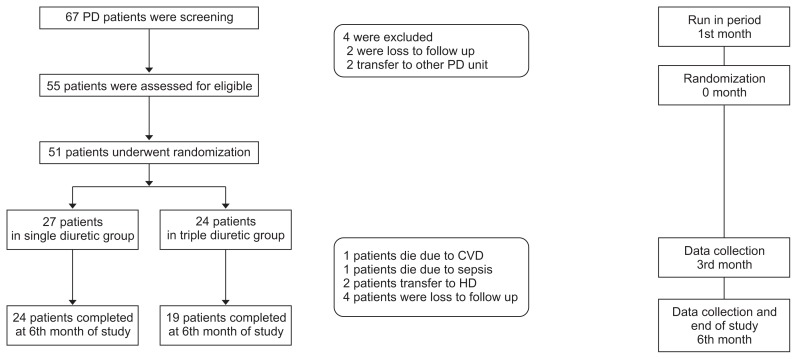
In a single-center, double-blinded, randomized controlled trial, we randomly assigned 51 adult CAPD patients to receive furosemide 1,000 mg/day, hydrochlorothiazide 100 mg/day, and spironolactone 50 mg/day (triple diuretics [TD] group) or furosemide 1,000 mg/day plus placebo (single diuretic [SD] group) for 6 months. The primary outcome was the difference in daily urine output at the 3rd and 6th month of the study compared to baseline (ΔUO) between the SD and TD group. Secondary outcomes were urinary sodium (UNa) and potassium (UK) excretion and overhydration (OH) measured by bioimpedance at 3 and 6 months compared to baseline (ΔUNa, ΔUK, and ΔOH, respectively) and daily glucose exposure (g/day).
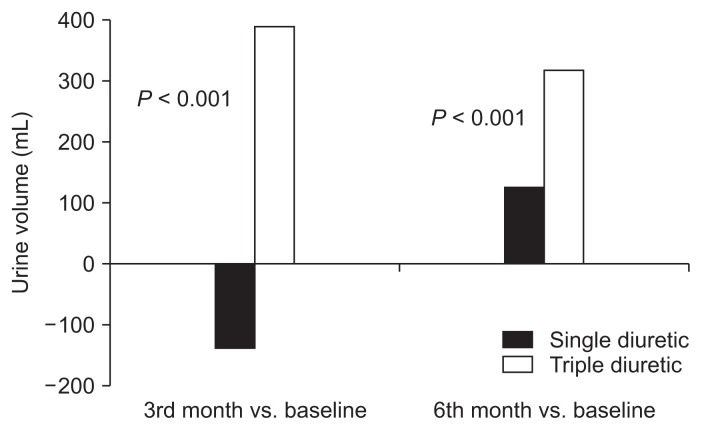
Forty-three of 51 patients completed the 6-month trial. The ΔUO at 3 and 6 months was significantly higher in the TD group compared to the SD group (386.32 ± 733.92 mL/day vs. -136.25 ± 629.08 mL/day, < 0.001, at 3 months; 311.58 ± 640.31 mL/day vs. 120.00 ± 624.07 mL/day, < 0.001, at 6 months) but there was no significant difference in ΔUNa and ΔUK excretion. Hydration status was significantly better in the TD group (ΔOH 1.84 ± 2.27 L vs. 0.44 ± 1.62 L, = 0.03, at 3 months; 1.49 ± 2.82 L vs. -0.48 ± 2.61 L, = 0.02, at 6 months). There was no serious adverse event in this study.
For end-stage renal disease patients on CAPD, the combination of furosemide, hydrochlorothiazide, and spironolactone results in higher urine output and better volume control compared to furosemide alone.
持续性非卧床腹膜透析(CAPD)患者联合使用利尿剂治疗的疗效尚不清楚。
在一项单中心、双盲、随机对照试验中,我们将51例成年CAPD患者随机分为两组,一组接受每日1000毫克呋塞米、100毫克氢氯噻嗪和50毫克螺内酯(三联利尿剂[TD]组),另一组接受每日1000毫克呋塞米加安慰剂(单利尿剂[SD]组),治疗6个月。主要结局是研究第3个月和第6个月时,SD组和TD组与基线相比的每日尿量差异(ΔUO)。次要结局是第3个月和第6个月时与基线相比通过生物电阻抗测量的尿钠(UNa)和钾(UK)排泄量以及水过多(OH)(分别为ΔUNa、ΔUK和ΔOH),以及每日葡萄糖暴露量(克/天)。
51例患者中有43例完成了6个月的试验。与SD组相比,TD组在第3个月和第6个月时的ΔUO显著更高(第3个月时为386.32±733.92毫升/天对-136.25±629.08毫升/天,<0.001;第6个月时为311.58±640.31毫升/天对120.00±624.07毫升/天,<0.001),但ΔUNa和ΔUK排泄量无显著差异。TD组的水合状态明显更好(第3个月时ΔOH为1.84±2.27升对0.44±1.62升,P=0.03;第6个月时为1.49±2.82升对-0.48±2.61升,P=0.02)。本研究中未发生严重不良事件。
对于接受CAPD治疗的终末期肾病患者,与单独使用呋塞米相比,呋塞米、氢氯噻嗪和螺内酯联合使用可导致更高的尿量和更好的容量控制。