Burnet Institute, Melbourne, Australia.
Department of Immunology and Pathology, Monash University, Melbourne, Australia.
BMC Med. 2019 Feb 25;17(1):45. doi: 10.1186/s12916-019-1277-x.
Leading malaria vaccine, RTS,S, is based on the circumsporozoite protein (CSP) of sporozoites. RTS,S confers partial protection against malaria in children, but efficacy wanes relatively quickly after primary immunization. Vaccine efficacy has some association with anti-CSP IgG; however, it is unclear how these antibodies function, and how functional antibodies are induced and maintained over time. Recent studies identified antibody-complement interactions as a potentially important immune mechanism against sporozoites. Here, we investigated whether RTS,S vaccine-induced antibodies could function by interacting with complement.
Serum samples were selected from children in a phase IIb trial of RTS,S/AS02 conducted at two study sites of high and low malaria transmission intensity in Manhiça, Mozambique. Samples following primary immunization and 5-year post-immunization follow-up time points were included. Vaccine-induced antibodies were characterized by isotype, subclass, and epitope specificity, and tested for the ability to fix and activate complement. We additionally developed statistical methods to model the decay and determinants of functional antibodies after vaccination.
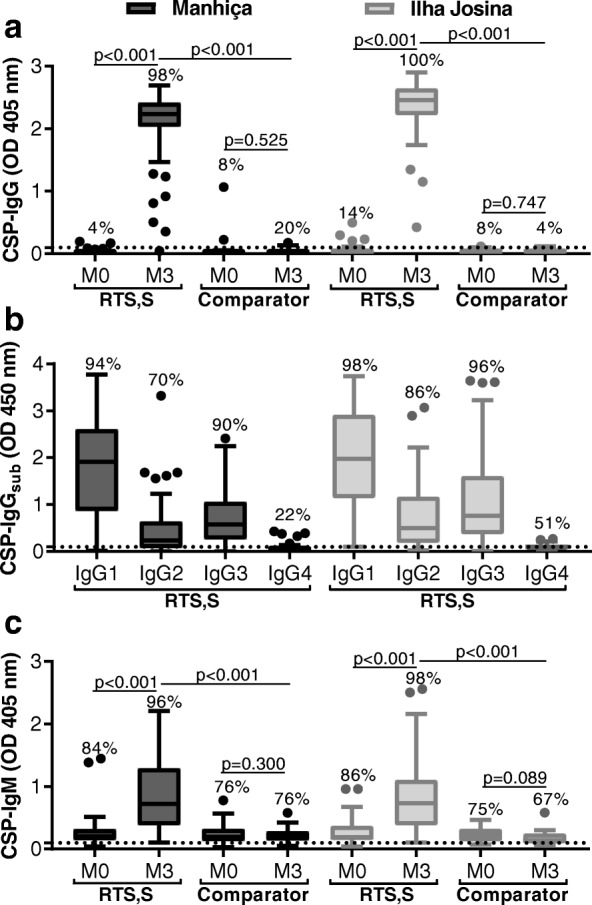
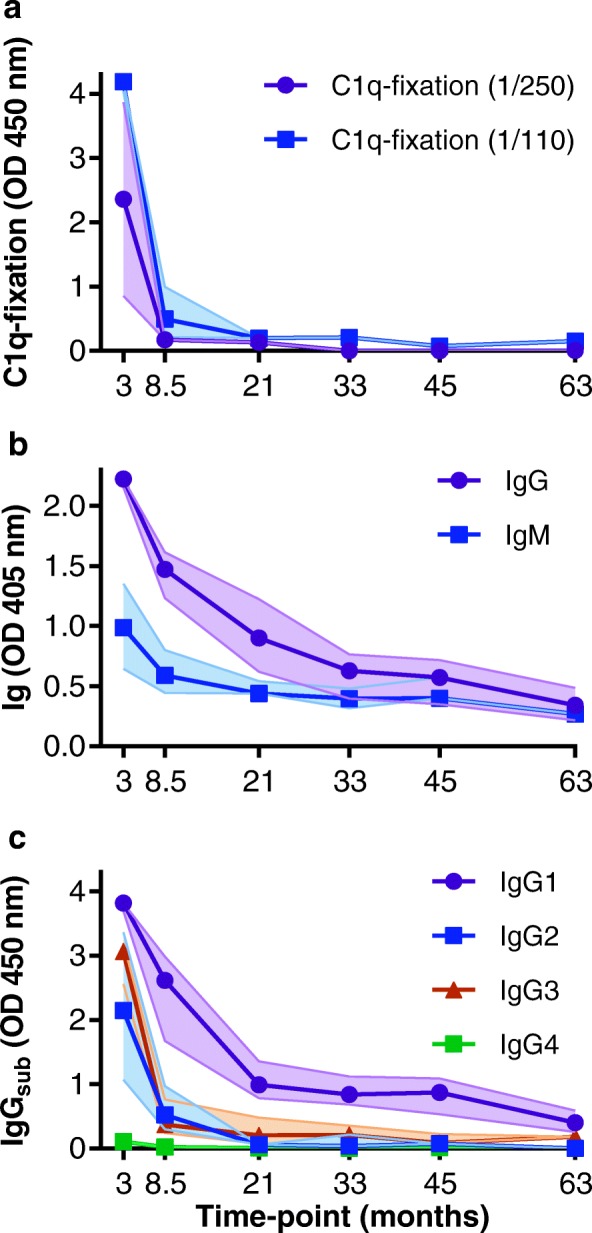
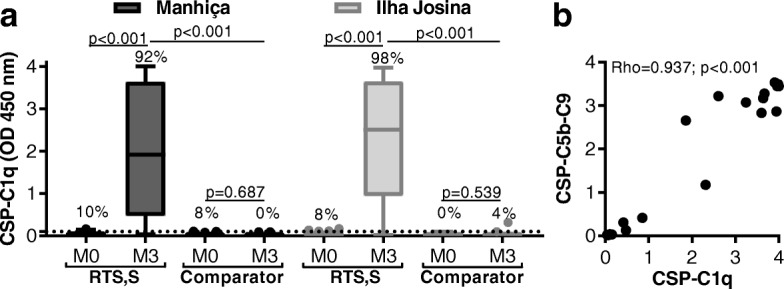
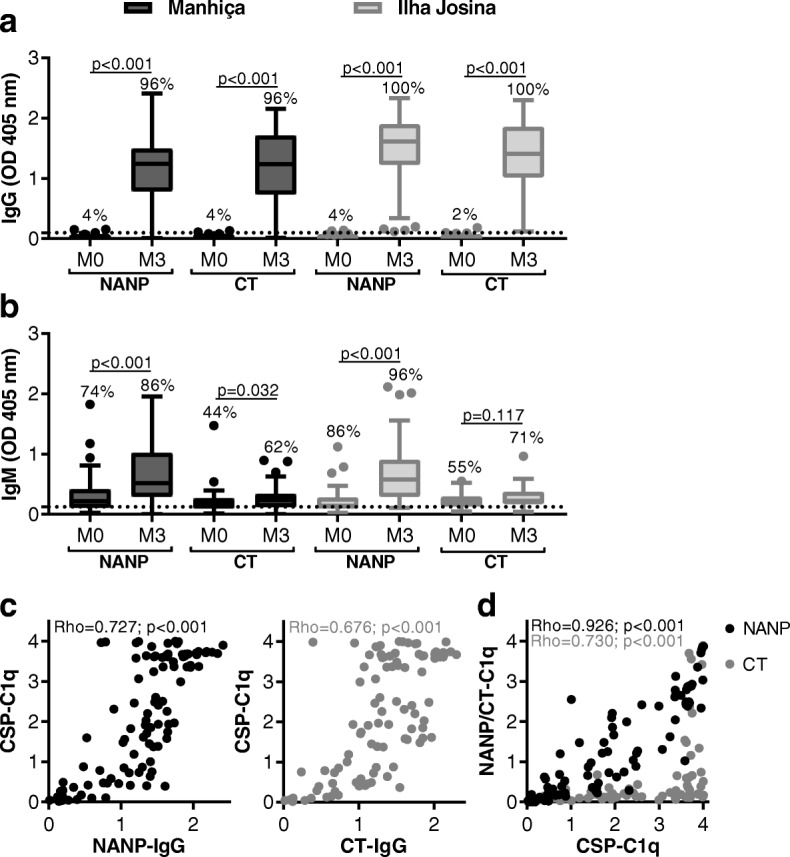
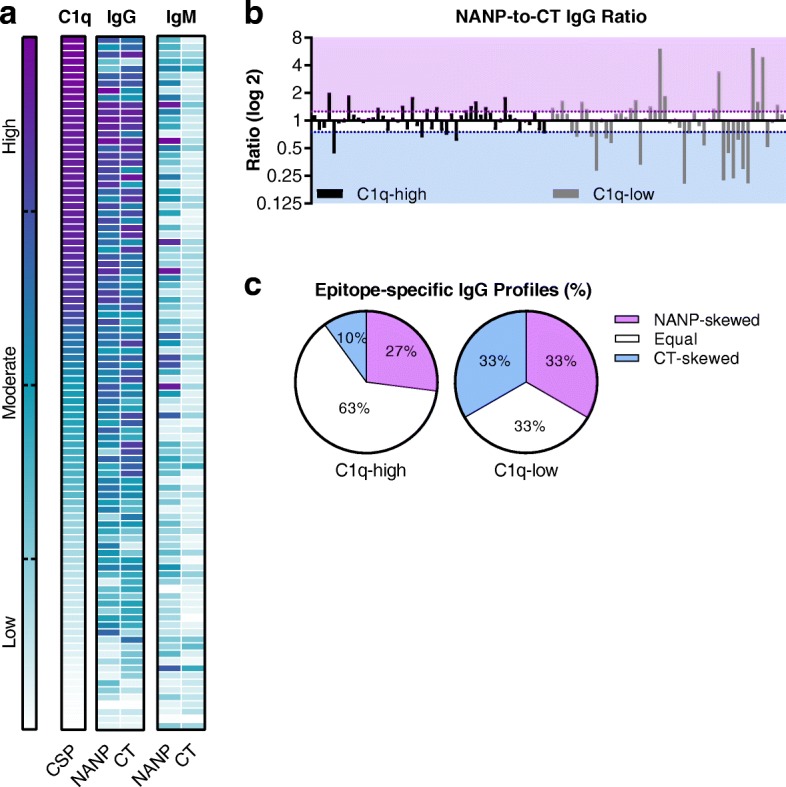
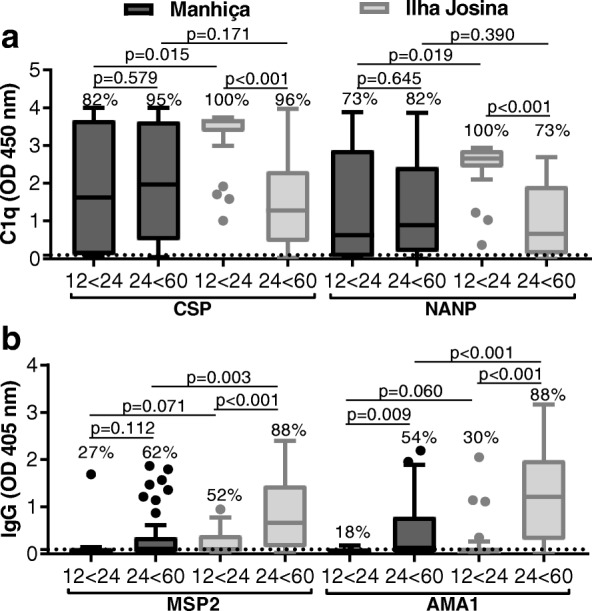
RTS,S vaccination induced anti-CSP antibodies that were mostly IgG1, with some IgG3, IgG2, and IgM. Complement-fixing antibodies were effectively induced by vaccination, and targeted the central repeat and C-terminal regions of CSP. Higher levels of complement-fixing antibodies were associated with IgG that equally recognized both the central repeat and C-terminal regions of CSP. Older age and higher malaria exposure were significantly associated with a poorer induction of functional antibodies. There was a marked decay in functional complement-fixing antibodies within months after vaccination, as well as decays in IgG subclasses and IgM. Statistical modeling suggested the decay in complement-fixing antibodies was mostly attributed to the waning of anti-CSP IgG1, and to a lesser extent IgG3.
We demonstrate for the first time that RTS,S can induce complement-fixing antibodies in young malaria-exposed children. The short-lived nature of functional responses mirrors the declining vaccine efficacy of RTS,S over time. The negative influence of age and malaria exposure on functional antibodies has implications for understanding vaccine efficacy in different settings. These findings provide insights into the mechanisms and longevity of vaccine-induced immunity that will help inform the future development of highly efficacious and long-lasting malaria vaccines.
领先的疟疾疫苗 RTS,S 基于疟原虫的孢子体蛋白 (CSP)。RTS,S 可在儿童中提供对疟疾的部分保护,但在初次免疫后,其效力相对较快地减弱。疫苗效力与抗 CSP IgG 有一定关联;然而,目前尚不清楚这些抗体如何发挥作用,以及功能性抗体如何随时间推移而被诱导和维持。最近的研究确定了抗体-补体相互作用作为一种针对孢子体的潜在重要免疫机制。在这里,我们研究了 RTS,S 疫苗诱导的抗体是否可以通过与补体相互作用而发挥作用。
从莫桑比克马希齐两个高和低疟疾传播强度研究点进行的 RTS,S/AS02 二期临床试验中选择血清样本。包括初次免疫后的样本和 5 年免疫后随访时间点的样本。通过同种型、亚类和表位特异性来描述疫苗诱导的抗体,并测试其固定和激活补体的能力。我们还开发了统计方法来模拟接种疫苗后的功能性抗体的衰减和决定因素。
RTS,S 疫苗接种诱导了主要为 IgG1 的抗 CSP 抗体,其中一些为 IgG3、IgG2 和 IgM。疫苗接种有效地诱导了补体固定抗体,并且靶向 CSP 的中央重复区和 C 末端区。较高水平的补体固定抗体与同样识别 CSP 中央重复区和 C 末端区的 IgG 相关。年龄较大和疟疾暴露水平较高与功能性抗体的诱导较差显著相关。接种后几个月内,功能性补体固定抗体迅速衰减,同时 IgG 亚类和 IgM 也衰减。统计模型表明,补体固定抗体的衰减主要归因于抗 CSP IgG1 的衰减,其次是 IgG3 的衰减。
我们首次证明,RTS,S 可在年轻的疟疾暴露儿童中诱导补体固定抗体。功能性反应的短暂性质反映了 RTS,S 随时间推移而降低的疫苗效力。年龄和疟疾暴露对功能性抗体的负面影响对不同环境下疫苗效力的理解具有影响。这些发现为疫苗诱导免疫的机制和持久性提供了深入的了解,有助于为高效和持久的疟疾疫苗的未来发展提供信息。