Wheeler Gavin, Deng Shujie, Toussaint Nicolas, Pushparajah Kuberan, Schnabel Julia A, Simpson John M, Gomez Alberto
School of Imaging Sciences & Biomedical Engineering, King's College London, London, UK.
Department of Congenital Heart Disease, Evelina London Children's Hospital, London, UK.
Healthc Technol Lett. 2018 Sep 21;5(5):148-153. doi: 10.1049/htl.2018.5064. eCollection 2018 Oct.
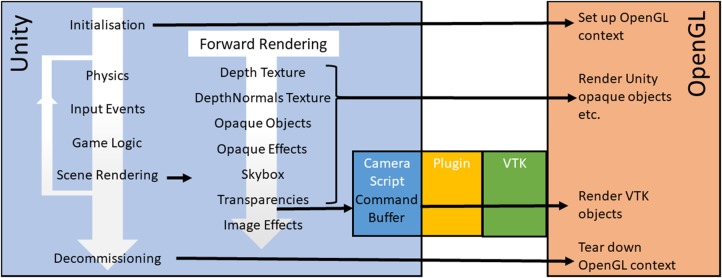
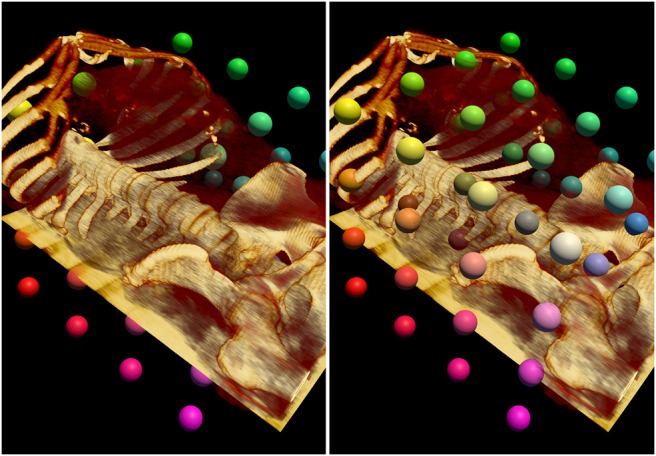
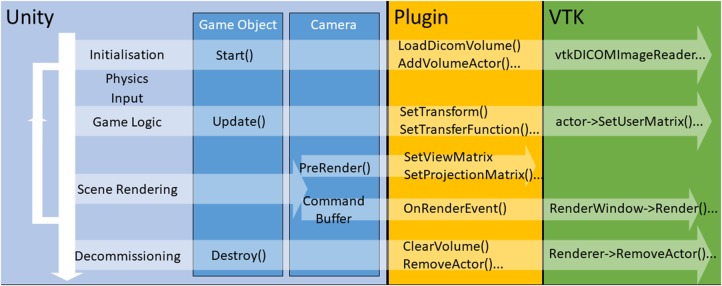
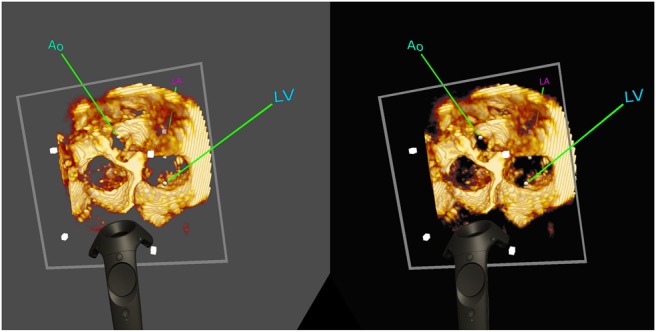
The authors present a method to interconnect the Visualisation Toolkit (VTK) and Unity. This integration enables them to exploit the visualisation capabilities of VTK with Unity's widespread support of virtual, augmented, and mixed reality displays, and interaction and manipulation devices, for the development of medical image applications for virtual environments. The proposed method utilises OpenGL context sharing between Unity and VTK to render VTK objects into the Unity scene via a Unity native plugin. The proposed method is demonstrated in a simple Unity application that performs VTK volume rendering to display thoracic computed tomography and cardiac magnetic resonance images. Quantitative measurements of the achieved frame rates show that this approach provides over 90 fps using standard hardware, which is suitable for current augmented reality/virtual reality display devices.
作者提出了一种将可视化工具包(VTK)与Unity互连的方法。这种集成使他们能够利用VTK的可视化功能以及Unity对虚拟、增强和混合现实显示以及交互和操纵设备的广泛支持,来开发用于虚拟环境的医学图像应用程序。所提出的方法利用Unity和VTK之间的OpenGL上下文共享,通过Unity原生插件将VTK对象渲染到Unity场景中。在所提出的方法在一个简单的Unity应用程序中得到了演示,该应用程序执行VTK体绘制以显示胸部计算机断层扫描和心脏磁共振图像。对所实现帧率的定量测量表明,使用标准硬件,这种方法可提供超过90帧/秒的帧率,这适用于当前的增强现实/虚拟现实显示设备。