Fagö-Olsen Helena, Dines Laura Marie, Sørensen Christian Hjort, Jensen Anders
Department of Otolaryngology and audiology, Copenhagen University Hospital Rigshospitalet/Gentofte, Copenhagen, Denmark.
Department of Biomedicine, Faculty of Health Sciences, Aarhus University, Aarhus, Denmark.
mSystems. 2019 Feb 12;4(1). doi: 10.1128/mSystems.00169-18. eCollection 2019 Jan-Feb.
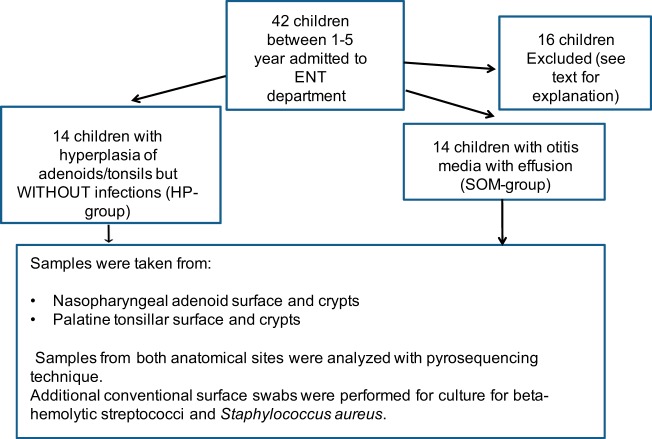
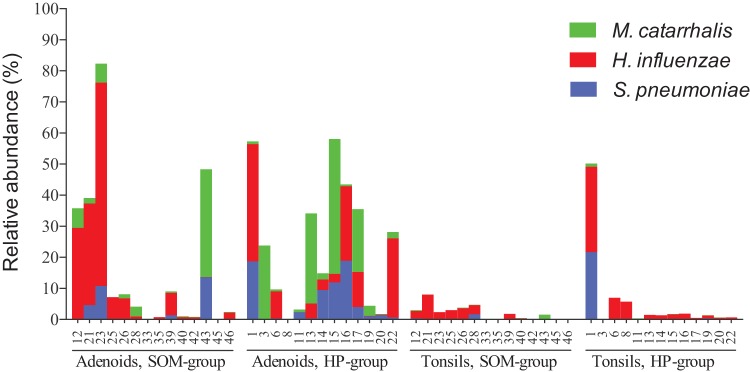
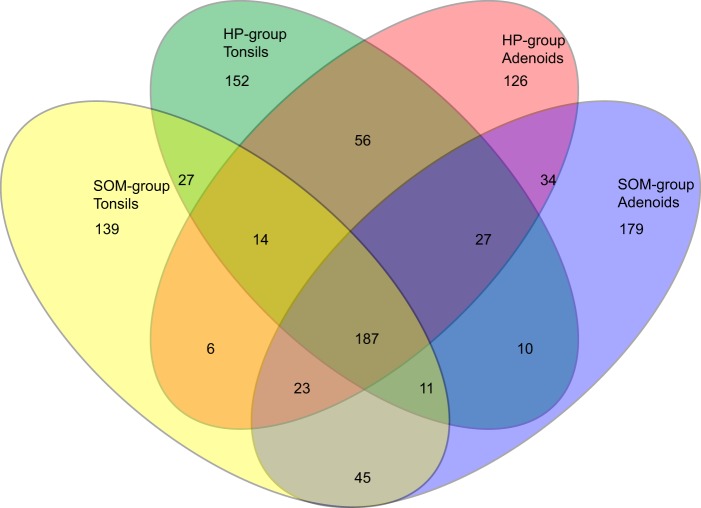
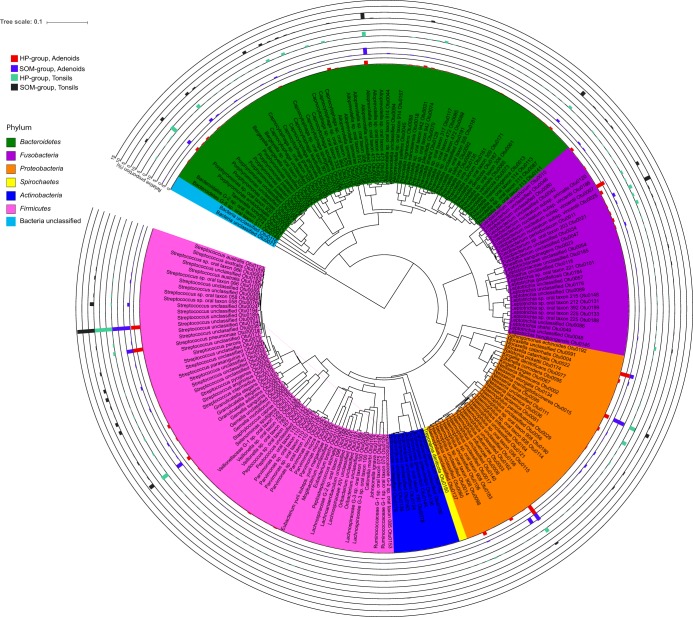
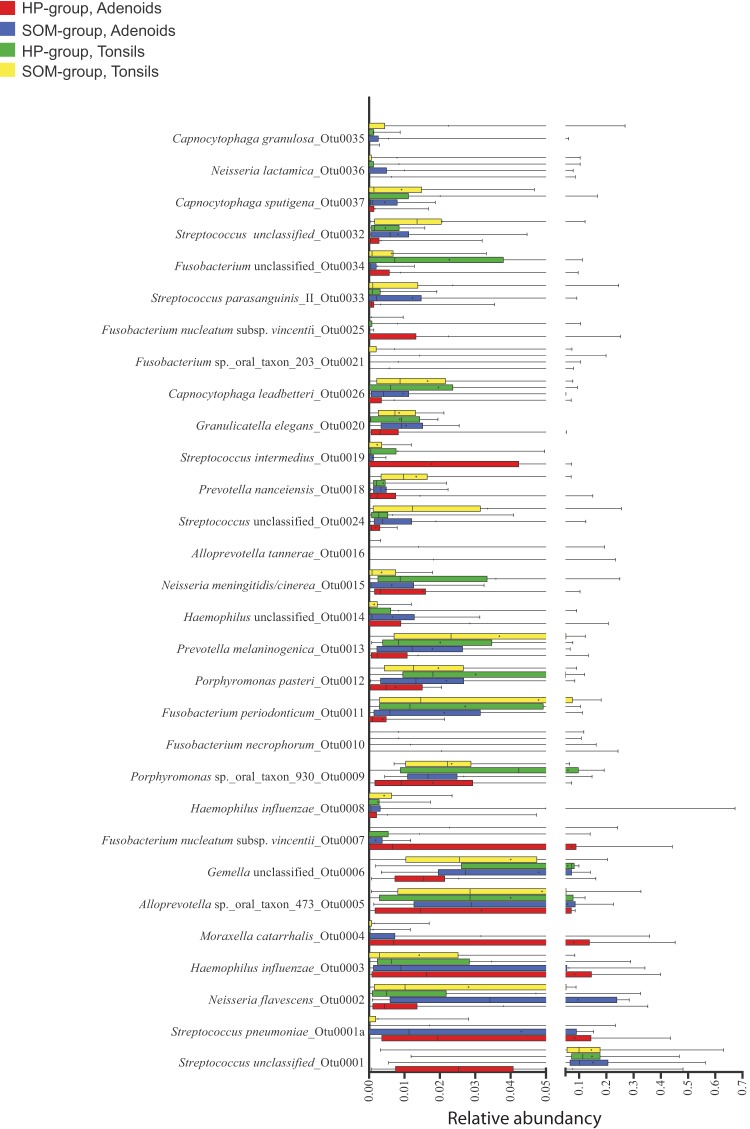
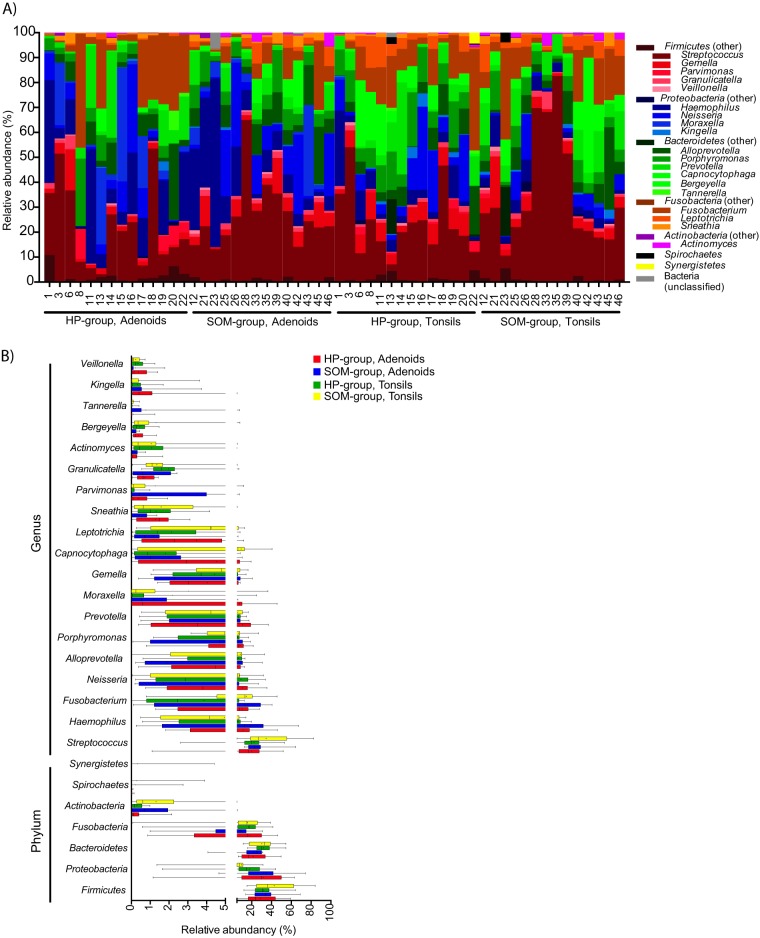
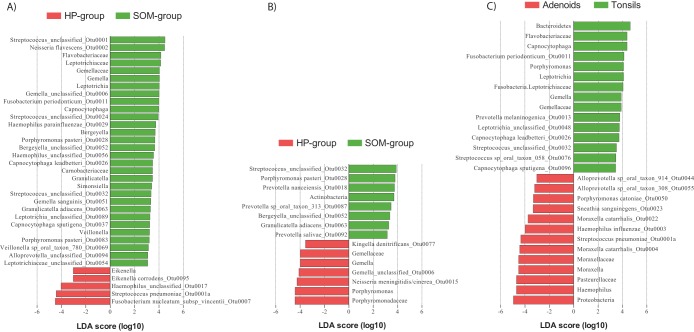
Acute otitis media (AOM), secretory otitis media (SOM), and acute pharyngotonsillitis are the most frequent reasons for visits to general practitioners, pediatricians, and otolaryngologists. Microbial colonization of the epithelial lining of Waldeyer's lymphatic tissues, consisting of the palatine tonsils, lingual tonsils, adenoids, and Eustachian tube tonsil, is a well-known clinical challenge during infancy due to frequent episodes of upper respiratory tract infections. However, no previous studies have investigated the combined role of the palatine tonsils and the adenoids as a reservoir for pathogens associated with SOM in small children. We analyzed the combined crypt microbiome of the palatine tonsils and adenoids from 14 small children with hyperplasia of the tonsils or adenoids and 14 small children with SOM using 16S rRNA gene pyrosequencing. Our study demonstrated a significant difference between the microbiome of the adenoids and that of the palatine tonsils in the two groups but not between the two anatomical locations within the two groups. In particular, the potential pathogens Streptococcus pneumoniae, Haemophilus influenzae, and Moraxella catarrhalis were almost exclusively found in the adenoids of both patient groups, indicating that the adenoids and not the palatine tonsils are the main reservoir for potential pathogens leading to AOM and SOM. Our findings that the microbiome differs between crypts of the adenoids and crypts of the palatine tonsils, including the relative abundances of potential pathogens such as Haemophilus influenzae, Streptococcus pneumoniae, and Moraxella catarrhalis, may be the stepping stone for further investigation of individual microbiomes in a longitudinal design that includes recording of the fluctuating health status of the child. Such studies may have the potential to lead to new preventive measurements such as implantation of protective nonpathogens at the nasopharynx as an alternative to adenoidectomy.
急性中耳炎(AOM)、分泌性中耳炎(SOM)和急性咽扁桃体炎是患者前往全科医生、儿科医生和耳鼻喉科医生处就诊的最常见原因。由腭扁桃体、舌扁桃体、腺样体和咽鼓管扁桃体组成的瓦尔代尔淋巴组织上皮衬里的微生物定植,是婴儿期因上呼吸道感染频繁发作而众所周知的临床挑战。然而,此前尚无研究调查腭扁桃体和腺样体作为幼儿SOM相关病原体储存库的联合作用。我们使用16S rRNA基因焦磷酸测序分析了14例扁桃体或腺样体增生的幼儿和14例SOM幼儿的腭扁桃体和腺样体的联合隐窝微生物组。我们的研究表明,两组中腺样体和腭扁桃体的微生物组存在显著差异,但两组内两个解剖部位之间无显著差异。特别是,潜在病原体肺炎链球菌、流感嗜血杆菌和卡他莫拉菌几乎仅在两组患者的腺样体中发现,这表明腺样体而非腭扁桃体是导致AOM和SOM的潜在病原体的主要储存库。我们的研究结果表明,腺样体隐窝和腭扁桃体隐窝的微生物组不同,包括流感嗜血杆菌、肺炎链球菌和卡他莫拉菌等潜在病原体的相对丰度,这可能是在纵向设计中进一步研究个体微生物组的垫脚石,该设计包括记录儿童健康状况的波动。此类研究可能有潜力带来新的预防措施,如在鼻咽部植入保护性非病原体以替代腺样体切除术。