Shipton Elspeth Erica, Steketee Carole, Bate Frank, Visser Eric John
School of Medicine, University of Notre Dame Australia, Fremantle WA, Australia.
The Learning and Teaching Office, University of Notre Dame Australia, Fremantle WA, Australia.
Pain Rep. 2018 Dec 12;4(1):e704. doi: 10.1097/PR9.0000000000000704. eCollection 2019 Jan-Feb.
Considering the continuing high prevalence and public health burden of pain, it is critical that medical students are equipped with competencies in the field of pain medicine. Robust assessment of student expertise is integral for effective implementation of competency-based medical education.
The aim of this review was to describe the literature regarding methods for assessing pain medicine competencies in medical students.
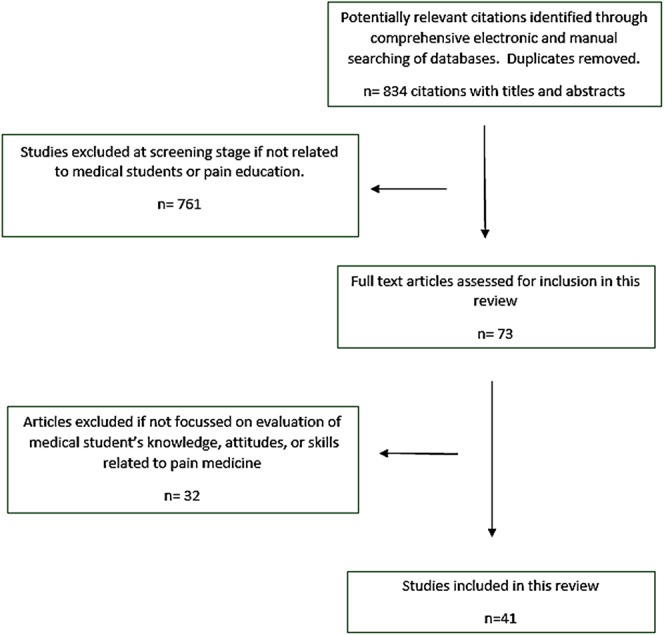
PubMed, Medline, EMBASE, ERIC, and Google Scholar, and BEME data bases were searched for empirical studies primarily focusing on assessment of any domain of pain medicine competencies in medical students published between January 1997 and December 2016.
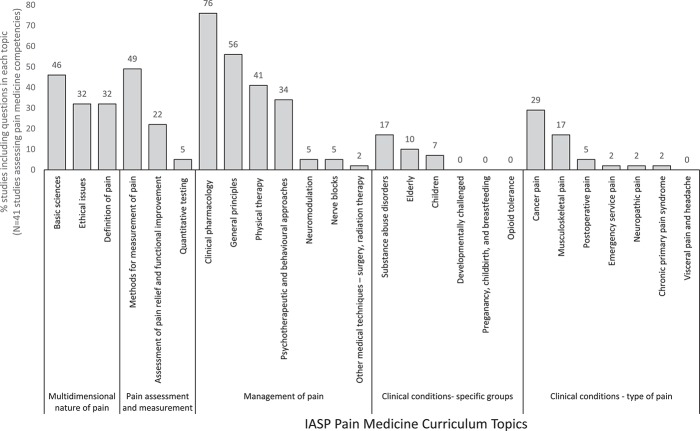
A total of 41 studies met the inclusion criteria. Most assessments were performed for low-stakes summative purposes and did not reflect contemporary theories of assessment. Assessments were predominantly undertaken using written tests or clinical simulation methods. The most common pain medicine education topics assessed were pain pharmacology and the management of cancer and low-back pain. Most studies focussed on assessment of cognitive levels of learning as opposed to more challenging domains of demonstrating skills and attitudes or developing and implementing pain management plans.
This review highlights the need for more robust assessment tools that effectively measure the abilities of medical students to integrate pain-related competencies into clinical practice. A Pain Medicine Assessment Framework has been developed to encourage systematic planning of pain medicine assessment at medical schools internationally and to promote continuous multidimensional assessments in a variety of clinical contexts based on well-defined pain medicine competencies.
鉴于疼痛的高患病率和公共卫生负担持续存在,医学生具备疼痛医学领域的能力至关重要。对学生专业知识进行有力评估是有效实施基于能力的医学教育的不可或缺的部分。
本综述的目的是描述有关评估医学生疼痛医学能力的方法的文献。
检索了PubMed、Medline、EMBASE、ERIC、谷歌学术以及BEME数据库,以查找主要关注1997年1月至2016年12月期间发表的评估医学生疼痛医学能力任何领域的实证研究。
共有41项研究符合纳入标准。大多数评估是出于低风险的总结性目的进行的,并未反映当代评估理论。评估主要采用书面测试或临床模拟方法进行。评估的最常见的疼痛医学教育主题是疼痛药理学以及癌症和腰痛的管理。大多数研究侧重于评估认知学习水平,而不是更具挑战性的展示技能和态度或制定和实施疼痛管理计划的领域。
本综述强调需要更强大的评估工具,以有效衡量医学生将疼痛相关能力整合到临床实践中的能力。已制定了一个疼痛医学评估框架,以鼓励国际上各医学院校系统规划疼痛医学评估,并促进基于明确的疼痛医学能力在各种临床环境中进行持续的多维度评估。