Maiga Youssoufa, Sangho Oumar, Konipo Fatoumata, Diallo Seybou, Coulibaly Souleymane Dit Papa, Sangare Modibo, Péréon Yann, Giumelli Bernard, Sanou Martin, Coulibaly Awa, Diallo Salimata, Daou Mariam, Traoré Zoumana, Albakaye Mohamed, Traoré Hamar A, Guinto Cheick Oumar, Ouologem Madani, Kuate-Tegueu Callixte, Bouhassira Didier, Cowan Robert, Nizard Julien
Department of Neurology, Gabriel Touré Teaching Hospital, Bamako, Mali.
Faculty of Medicine, University of Technical Sciences and Technologies, Bamako, Mali.
eNeurologicalSci. 2021 Jan 9;22:100312. doi: 10.1016/j.ensci.2021.100312. eCollection 2021 Mar.
According to the taxonomy of the International Association for the Study of Pain (IASP 2011), neuropathic pain (NeuP) is defined as "". NeuP is currently well-defined clinically, despite a high degree of etiological variation, and it has become a significant public health problem. This work aimed to study the situation regarding NeuP in current practice in Mali, as well as to analyze the therapeutic environment of the patients.
This was a retrospective and cross-sectional study, carried out in two phases: (1) compilation of the files of patients according to the ICD-11, over a period of 24 months (2) a second prospective phase regarding the Knowledge, Attitudes, and Practices (KAP) of general practitioners and neurologists in regard to NeuP. The focus of the first phase of the study was the files of the patients who had undergone a consultation at the Gabriel Touré UHC. The second phase of the study focused on the general practitioners (Community Health Centers (comHC) of Bamako) and neurologists (Malian or not).
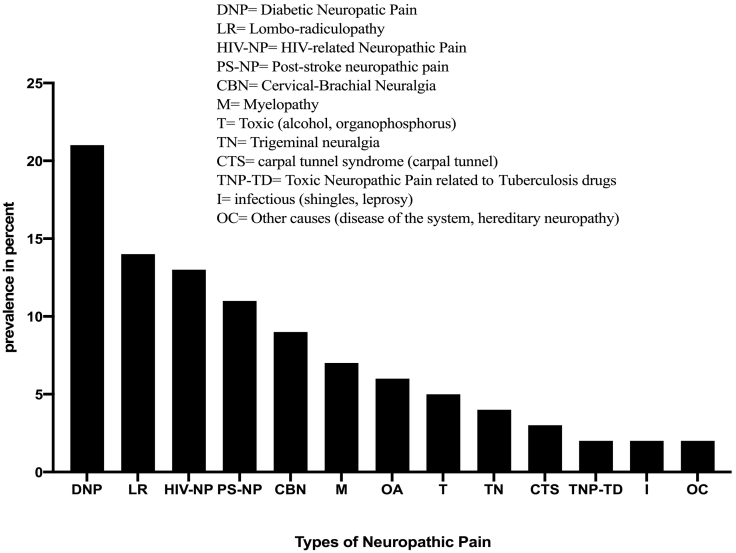
Over the period of the study, 7840 patients were seen in consultation in the Department of Neurology, of whom 903 for NeuP, thus amounting to a NeuP frequency of 11.5%. Women accounted for 58.9% (532/903), with a sex ratio of 1.4. Using a comparative normal law, the difference in frequency was statistically significant between males and females ( < 10) and between two age groups (p 〈10). The 49-58 years of age group was represented the most. Diabetic NeuP (21%), lumbar radiculopathies (14%), HIV/AIDS NeuP (13%), and post-stroke NeuP (11%) were the most represented. The survey among the carers revealed: a need for training, a low level of compliance with the therapeutic guidelines, and the use of traditional medicine by the patients.
DISCUSSION/CONCLUSION: This work confirms that NeuP is encountered frequently in current practice, and its optimal management will involve specific training of carers and improvement of access to the medications recommended in this indication. In light of this issue, we revisit the debate regarding the concept of essential medications and the relevance of taking into account effective medications for the treatment of NeuP.
根据国际疼痛研究协会(IASP 2011)的分类法,神经性疼痛(NeuP)被定义为“……”。尽管病因差异很大,但NeuP目前在临床上已有明确界定,并且已成为一个重大的公共卫生问题。这项工作旨在研究马里当前实践中NeuP的情况,并分析患者的治疗环境。
这是一项回顾性横断面研究,分两个阶段进行:(1)根据国际疾病分类第11版(ICD - 11)汇编患者档案,为期24个月;(2)关于全科医生和神经科医生对NeuP的知识、态度和实践(KAP)的第二个前瞻性阶段。研究的第一阶段重点是在加布里埃尔·图雷大学医院中心接受会诊的患者档案。研究的第二阶段重点是全科医生(巴马科社区卫生中心)和神经科医生(无论是否为马里人)。
在研究期间,神经科共接待了7840名会诊患者,其中903名患有NeuP,因此NeuP的发生率为11.5%。女性占58.9%(532/903),性别比为1.4。使用比较正态分布法,男性和女性之间以及两个年龄组之间的发生率差异具有统计学意义(< 10)(p < 10)。49 - 58岁年龄组的人数最多。糖尿病性NeuP(21%)、腰椎神经根病(14%)、HIV/AIDS相关性NeuP(13%)和中风后NeuP(11%)最为常见。对护理人员的调查显示:需要培训、对治疗指南的依从性较低以及患者使用传统药物。
讨论/结论:这项工作证实,在当前实践中NeuP很常见,其最佳管理将涉及对护理人员进行特定培训,并改善获得该适应症推荐药物的途径。鉴于此问题,我们重新审视关于基本药物概念的辩论以及考虑用于治疗NeuP的有效药物的相关性。