Eze Ikenna C, Esse Clémence, Bassa Fidèle K, Koné Siaka, Acka Felix, Yao Loukou, Imboden Medea, Jaeger Fabienne N, Schindler Christian, Dosso Mireille, Laubhouet-Koffi Véronique, Kouassi Dinard, N'Goran Eliézer K, Utzinger Jürg, Bonfoh Bassirou, Probst-Hensch Nicole
Swiss Tropical and Public Health Institute, Basel, Switzerland.
University of Basel, Basel, Switzerland.
JMIR Res Protoc. 2017 Oct 27;6(10):e210. doi: 10.2196/resprot.8599.
Individual-level concomitance of infectious diseases and noncommunicable diseases (NCDs) is poorly studied, despite the reality of this dual disease burden for many low- and middle-income countries (LMICs).
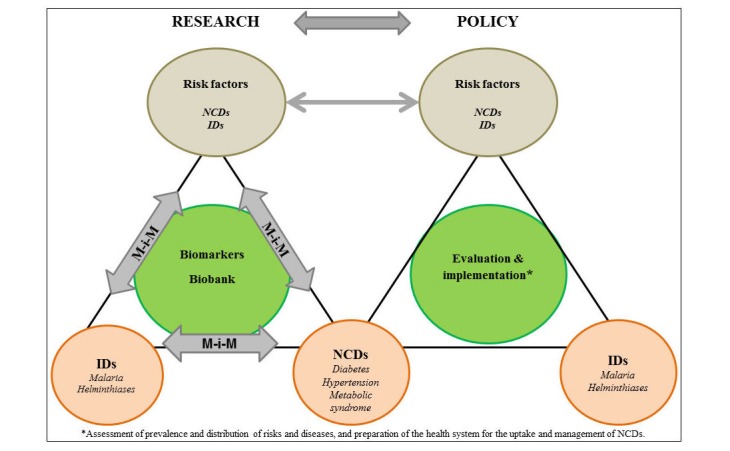
This study protocol describes the implementation of a cohort and biobank aiming for a better understanding of interrelation of helminth and Plasmodium infections with NCD phenotypes like metabolic syndrome, hypertension, and diabetes.
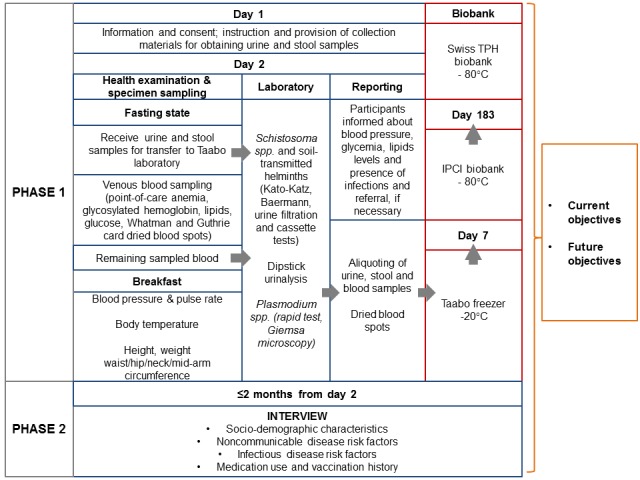
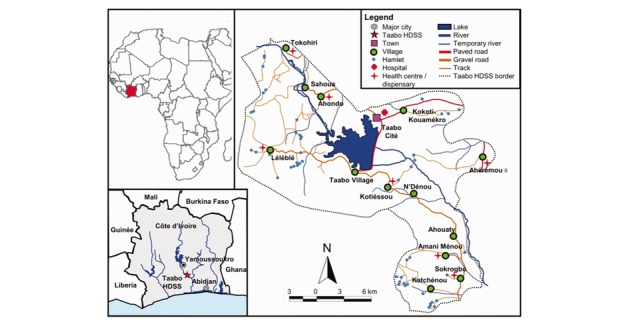
A baseline cross-sectional population-based survey was conducted over one year, in the Taabo health and demographic surveillance system (HDSS) in south-central Côte d'Ivoire. We randomly identified 1020 consenting participants aged ≥18 years in three communities (Taabo-Cité, Amani-Ménou, and Tokohiri) reflecting varying stages of epidemiological transition. Participants underwent health examinations consisting of NCD phenotyping (anthropometry, blood pressure, renal function, glycemia, and lipids) and infectious disease testing (infections with soil-transmitted helminths, schistosomes, and Plasmodium). Individuals identified to have elevated blood pressure, glucose, lipids, or with infections were referred to the central/national health center for diagnostic confirmation and treatment. Aliquots of urine, stool, and venous blood were stored in a biobank for future exposome/phenome research. In-person interviews on sociodemographic attributes, risk factors for infectious diseases and NCDs, medication, vaccinations, and health care were also conducted. Appropriate statistical techniques will be applied in exploring the concomitance of infectious diseases and NCDs and their determinants. Participants' consent for follow-up contact was obtained.
Key results from this baseline study, which will be published in peer-reviewed literature, will provide information on the prevalence and co-occurrence of infectious diseases, NCDs, and their risk factors. The Taabo HDSS consists of rural and somewhat more urbanized areas, allowing for comparative studies at different levels of epidemiological transition. An HDSS setting is ideal as a basis for longitudinal studies since their sustainable field work teams hold close contact with the local population.
The collaboration between research institutions, public health organizations, health care providers, and staff from the Taabo HDSS in this study assures that the synthesized evidence will feed into health policy towards integrated infectious disease-NCD management. The preparation of health systems for the dual burden of disease is pressing in low- and middle-income countries. The established biobank will strengthen the local research capacity and offer opportunities for biomarker studies to deepen the understanding of the cross-talk between infectious diseases and NCDs.
International Standard Randomized Controlled Trials Number (ISRCTN): 87099939; http://www.isrctn.com/ISRCTN87099939 (Archived by WebCite at http://www.webcitation.org/6uLEs1EsX).
尽管许多低收入和中等收入国家(LMICs)面临传染病和非传染性疾病(NCDs)双重疾病负担的现实,但针对个体层面这两种疾病共存情况的研究却很少。
本研究方案描述了一项队列研究和生物样本库的实施情况,旨在更好地了解蠕虫和疟原虫感染与代谢综合征、高血压和糖尿病等非传染性疾病表型之间的相互关系。
在科特迪瓦中南部的塔博健康与人口监测系统(HDSS)中,进行了为期一年的基于人群的基线横断面调查。我们在反映不同流行病学转变阶段的三个社区(塔博市、阿马尼 - 梅努和托科希里)随机确定了1020名年龄≥18岁且同意参与的参与者。参与者接受了健康检查,包括非传染性疾病表型分析(人体测量、血压、肾功能、血糖和血脂)和传染病检测(土壤传播蠕虫、血吸虫和疟原虫感染)。被确定为血压、血糖、血脂升高或感染的个体被转诊至中心/国家健康中心进行诊断确认和治疗。尿液、粪便和静脉血的等分样本被存储在生物样本库中,用于未来的暴露组/表型组研究。还进行了关于社会人口学属性、传染病和非传染性疾病风险因素、药物治疗、疫苗接种和医疗保健的面对面访谈。将应用适当的统计技术来探索传染病和非传染性疾病的共存情况及其决定因素。获得了参与者同意后续联系的许可。
这项基线研究的主要结果将发表在同行评审的文献中,将提供有关传染病、非传染性疾病及其风险因素的患病率和共现情况的信息。塔博HDSS包括农村和城市化程度稍高的地区,便于在不同流行病学转变水平上进行比较研究。HDSS环境是纵向研究的理想基础,因为其可持续的实地工作团队与当地居民保持密切联系。
本研究中研究机构、公共卫生组织、医疗服务提供者与塔博HDSS工作人员之间的合作确保了综合证据将为传染病 - 非传染性疾病综合管理的卫生政策提供参考。在低收入和中等收入国家,为应对双重疾病负担而准备卫生系统迫在眉睫。已建立的生物样本库将加强当地的研究能力,并为生物标志物研究提供机会,以加深对传染病和非传染性疾病之间相互作用的理解。
国际标准随机对照试验编号(ISRCTN):87099939;http://www.isrctn.com/ISRCTN87099939(由WebCite存档于http://www.webcitation.org/6uLEs1EsX)