Université Peleforo Gon Coulibaly, Korhogo, Côte d'Ivoire.
Centre Suisse de Recherches Scientifiques en Côte d'Ivoire, Abidjan 01, Côte d'Ivoire, 01 BP 1303, Abidjan, Côte d'Ivoire.
BMC Pediatr. 2022 Nov 9;22(1):651. doi: 10.1186/s12887-022-03684-6.
A balanced nutrition is important for children's physical and cognitive development; yet, remains a challenge in many parts of low- and middle-income countries (LMICs). Early detection of nutritional deficiency and metabolic syndrome in school-aged children is necessary to prevent non-communicable diseases (NCDs) in later life. This study aimed at obtaining baseline data on health, nutritional status, and metabolic markers of NCDs among primary schoolchildren in Côte d'Ivoire.
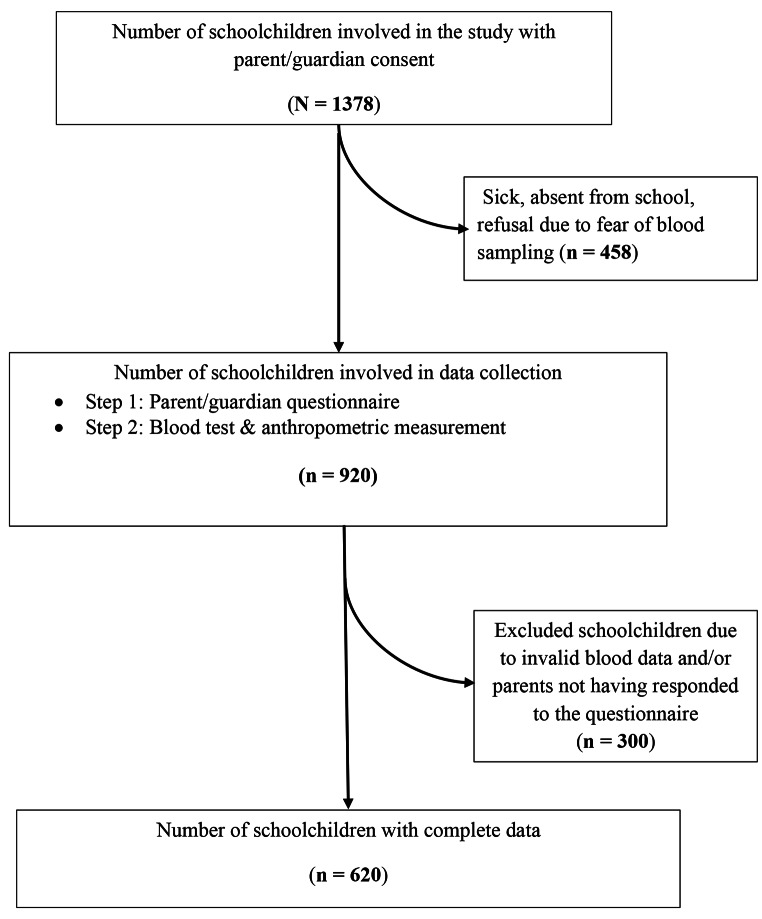
A cross-sectional survey was conducted among 620 children from 8 public primary schools located in the south-central part of Côte d'Ivoire. Underweight and overweight were defined as a body mass index (BMI; kg/m2) < 5th and 85th up to 95th percentile for sex and age, respectively. Dietary diversity of children was calculated based on a 24-hour recall conducted with the primary caretaker according to the guideline of Food and Agriculture Organization. Anaemia, malaria, low-density lipoprotein cholesterol (LDL-C), high-density lipoprotein cholesterol (HDL-C), and blood glucose levels (HbA1c) were assessed, using capillary blood samples. Logistic models were performed to identify risk factors associated with overweight, HDL-C, LDL-C, and HbA1c.
Among the 620 children (330 girls, 290 boys; M 8.0 (± 1.7) years), 530 children attended school in a semi-urban and 90 in a rural area. Around 60% of children had a medium dietary diversity score (DDS). Children in peri-urban areas consumed more cereals (80.2% vs. 63.3%, p < 0.05). Most children were normal weight (n = 496), whereas 3.9% of children classified as prediabetic, 5% were underweight, and 15% overweight. LDL-C and HDL-C levels of children were associated with age, high DDS, and moderate anaemia. A significant association was found between prediabetes and malaria infection, as well as medium and high DDS. Overweight was associated with malaria infection and moderate anaemia.
Overweight, prediabetes, low HDL-C, malaria, and anaemia are the main concerns of children's health in Taabo. Our findings highlight interactions between infectious diseases, particularly malaria, and NCD risk factors. Monitoring NCD risk and infectious disease comorbidity in LMIC paediatric populations simultaneously is essential to better understand the dual diseases burden and apply early prevention measures.
均衡的营养对于儿童的身体和认知发育很重要,但在许多低收入和中等收入国家(LMICs)仍然是一个挑战。早期发现学龄儿童的营养缺乏和代谢综合征对于预防非传染性疾病(NCDs)至关重要。本研究旨在获取科特迪瓦小学生健康、营养状况和 NCD 代谢标志物的基线数据。
在科特迪瓦中南部的 8 所公立小学,对 620 名儿童进行了横断面调查。根据性别和年龄的第 5 至 95 百分位数,将体重指数(BMI;kg/m2)<第 5 百分位和>第 85 百分位定义为消瘦和超重。根据粮农组织的指导方针,用初级看护者进行 24 小时回忆来计算儿童的饮食多样性。使用毛细血管血样评估贫血、疟疾、低密度脂蛋白胆固醇(LDL-C)、高密度脂蛋白胆固醇(HDL-C)和血糖水平(HbA1c)。使用逻辑模型确定与超重、HDL-C、LDL-C 和 HbA1c 相关的危险因素。
在 620 名儿童(330 名女孩,290 名男孩;M 8.0(±1.7)岁)中,530 名儿童在半城市地区上学,90 名在农村地区上学。约 60%的儿童饮食多样性评分中等(DDS)。城市周边地区的儿童摄入更多谷物(80.2%比 63.3%,p<0.05)。大多数儿童体重正常(n=496),而 3.9%的儿童被归类为糖尿病前期,5%的儿童消瘦,15%的儿童超重。儿童的 LDL-C 和 HDL-C 水平与年龄、高 DDS 和中度贫血有关。糖尿病前期与疟疾感染以及中高 DDS 之间存在显著关联。超重与疟疾感染和中度贫血有关。
超重、糖尿病前期、低 HDL-C、疟疾和贫血是 Taabo 儿童健康的主要关注点。我们的研究结果强调了传染病,特别是疟疾与 NCD 危险因素之间的相互作用。同时监测 LMIC 儿科人群的 NCD 风险和传染病合并症对于更好地了解双重疾病负担并实施早期预防措施至关重要。