Institute of Physiotherapy, Department of Physical Education and Physiotherapy, Opole University of Technology, Opole, Poland (Drs Rutkowska, Rutkowski, and Szczegielniak); School of Medicine with the Division of Dentistry, Department of Lung Diseases and Tuberculosis, Medical University of Silesia, Zabrze, Poland (Drs Jastrzebski and Ziora); Department of Physiology and Medicine of Sport (Dr Żebrowska) and Department of Individual Sport (Dr Stanula), Academy of Physical Education, Katowice, Poland; and Los Angeles Biomedical Research Institute at Harbor-UCLA Medical Center, Torrance, California (Dr Casaburi).
J Cardiopulm Rehabil Prev. 2019 Mar;39(2):127-133. doi: 10.1097/HCR.0000000000000410.
The aim of this study was to perform a randomized trial to assess the impact of exercise training in patients with non-small cell lung cancer during chemotherapy on several outcomes in comparison to a control group (CG).
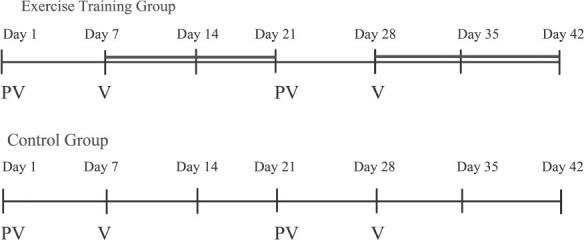
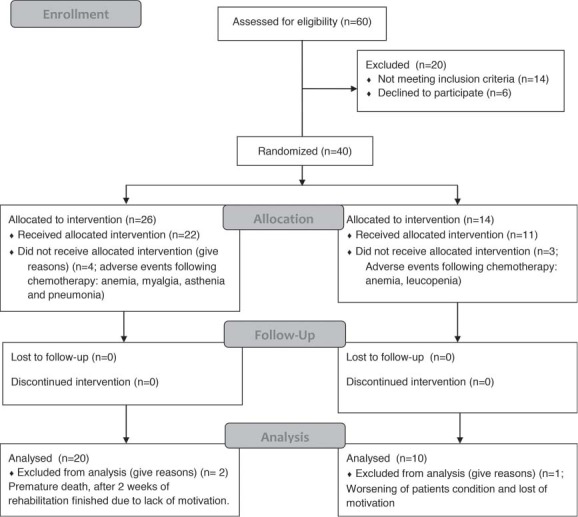
The exercise training group (ETG) consisted of 20 patients and the CG consisted of 10 patients. In the ETG, a 4-wk in-hospital exercise training program was performed in 2-wk cycles interspersed with consecutive rounds of chemotherapy with cytostatic drugs. The exercise training program was individualized and included warm-up, respiratory muscle exercise, training on a cycle ergometer or treadmill, and Nordic walking. CG participants were assessed before and after 6 wk of chemotherapy alone.
Comparing pre- and post-intervention values, the ETG demonstrated an increase in 6-min walk distance (486 ± 92 vs 531 ± 103 m, P = .01). In a battery of physical performance tests: Up and Go Test (6.3 ± 1.0 vs 6.0 ± 1.1 sec, P = .01); chair stand (13.3 ± 2.8 vs 14.3 ± 3.4 repetitions, P = .001); and arm curl (18.4 ± 3.1 vs 20.4 ± 3.5 repetitions, P = .001) all improved significantly. Spirometry values also improved: FEV1 % predicted (76 ± 16 vs 84 ± 15, P = .01), FVC % predicted (87 ± 14 vs 95 ± 13, P = .01), and FEV1/FVC (73 ± 13% vs 76 ± 12%, P = .04). The exercise training was well tolerated, without any adverse events due to exercise. There were no significant improvements in the CG.
This study suggests that planned, individualized, and supervised exercise programs in patients with advanced lung cancer during chemotherapy are a practical and beneficial intervention for enhancing mobility and physical fitness.
本研究旨在进行一项随机试验,评估与对照组(CG)相比,化疗期间非小细胞肺癌患者进行运动训练对多种结局的影响。
运动训练组(ETG)由 20 名患者组成,CG 由 10 名患者组成。在 ETG 中,在连续化疗周期中穿插进行为期 4 周的住院运动训练计划,该计划包括热身、呼吸肌锻炼、自行车或跑步机训练以及北欧行走。CG 参与者仅在化疗 6 周后进行评估。
与干预前相比,ETG 组 6 分钟步行距离增加(486 ± 92 与 531 ± 103 m,P =.01)。在一系列体能测试中:起立行走测试(6.3 ± 1.0 与 6.0 ± 1.1 秒,P =.01);椅子站立测试(13.3 ± 2.8 与 14.3 ± 3.4 次重复,P =.001);和手臂卷曲测试(18.4 ± 3.1 与 20.4 ± 3.5 次重复,P =.001)均显著改善。肺量计值也有所改善:FEV1 预计百分比(76 ± 16 与 84 ± 15,P =.01),FVC 预计百分比(87 ± 14 与 95 ± 13,P =.01)和 FEV1/FVC(73 ± 13%与 76 ± 12%,P =.04)。运动训练耐受性良好,无因运动引起的不良事件。CG 无显著改善。
本研究表明,在化疗期间为晚期肺癌患者制定、个体化和监督的运动计划是增强活动能力和身体健康的一种实用且有益的干预措施。