Program in Nutritional Metabolism, Department of Medicine, Massachusetts General Hospital, Boston, MA, USA.
Translational and Clinical Research Center, Massachusetts General Hospital, Boston, MA, USA.
Nutr Diabetes. 2019 Feb 25;9(1):6. doi: 10.1038/s41387-019-0073-1.
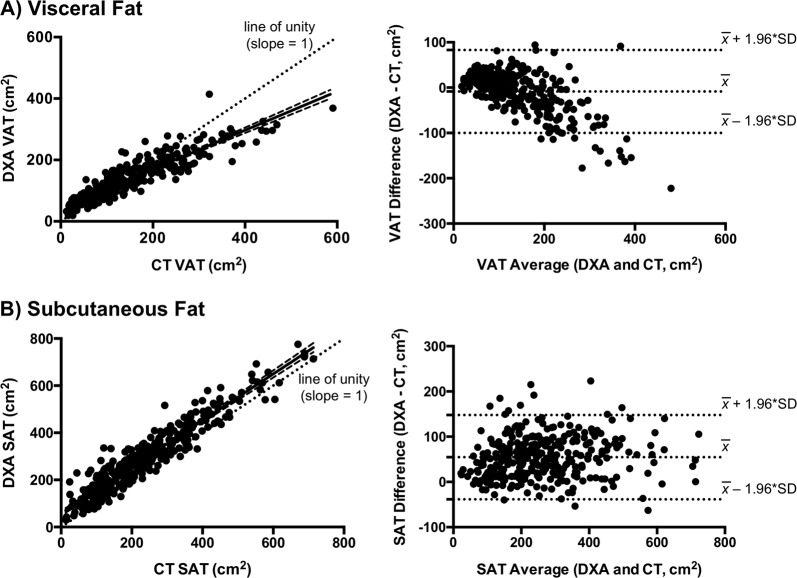
BACKGROUND/OBJECTIVES: Individuals with HIV are susceptible to visceral fat accumulation, which confers an increased risk of cardiometabolic disease. Advanced software to ascertain visceral fat content from dual-energy X-ray absorptiometry (DXA) has not been validated among this population. We sought to compare DXA with computed tomography (CT) in the measurement of visceral fat cross-sectional area (VAT) in HIV and non-HIV using Bland-Altman analyses.
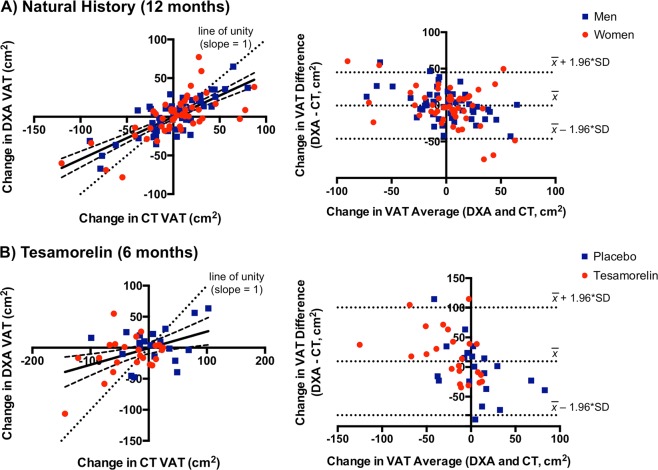
SUBJECTS/METHODS: Data were combined from five previously conducted studies of individuals with HIV (n = 313) and controls without HIV (n = 144) in which paired DXA and CT scans were available. In cross-sectional analyses, DXA-VAT was compared with CT-VAT among participants with and without HIV. In longitudinal analyses, changes in VAT over time were compared between DXA and CT among participants with and without HIV receiving no intervention over 12 months and among individuals with HIV receiving tesamorelin-a medication known to reduce VAT-over 6 months.
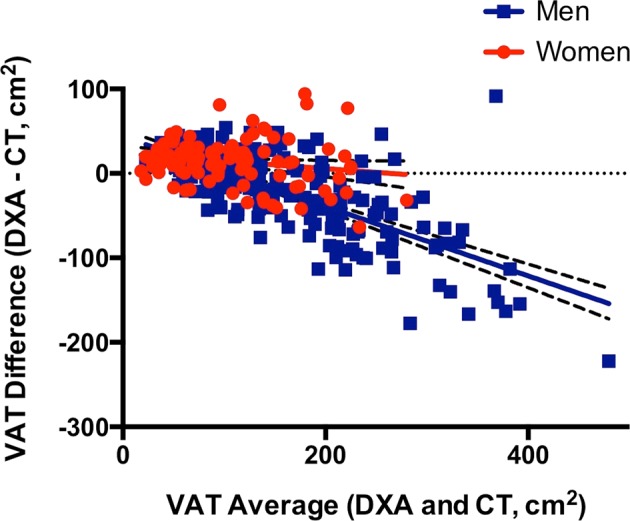
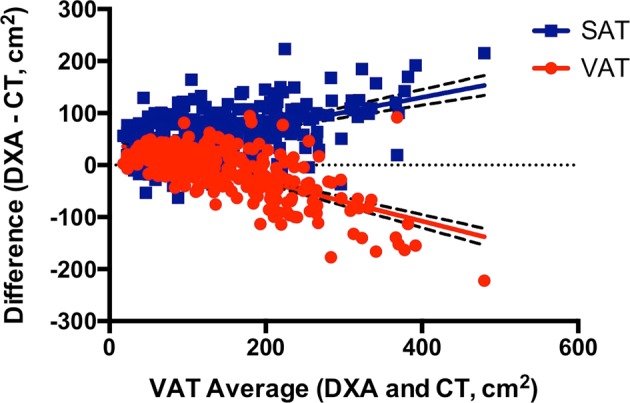
In HIV, DXA underestimated VAT compared with CT among individuals with increased visceral adiposity. The measurement bias was -9 ± 47 cm overall, but became progressively larger with greater VAT (P < 0.0001), e.g., -61 ± 58 cm among those with VAT ≥ 200 cm. Sex-stratified analyses revealed that the relationship between VAT and measurement bias was especially pronounced in men (P < 0.0001). Longitudinally, DXA underestimated changes in VAT, particularly among those at the extremes of VAT gain or loss (P < 0.0001). In contrast to the cross-sectional findings, the tendency for DXA to underestimate longitudinal changes in VAT was evident in both men and women. Analogous findings were seen among controls in cross-sectional and longitudinal analyses.
DXA underestimated VAT relative to CT in men with and without HIV, who had increased visceral adiposity. DXA also underestimated changes in VAT over time in men and women, irrespective of HIV status. DXA-VAT should be used with caution among both HIV and non-HIV-infected populations.
背景/目的:HIV 感染者易发生内脏脂肪堆积,从而增加患心血管代谢疾病的风险。目前尚未对该人群进行双能 X 射线吸收法(DXA)确定内脏脂肪含量的高级软件验证。我们旨在通过 Bland-Altman 分析比较 DXA 与计算机断层扫描(CT)在 HIV 感染者和非 HIV 感染者中测量内脏脂肪横截面积(VAT)的效果。
受试者/方法:将来自五项先前进行的 HIV 感染者(n=313)和无 HIV 感染者(n=144)的研究数据进行了合并,这些研究中均提供了配对的 DXA 和 CT 扫描。在横断面分析中,比较了 HIV 感染者和非 HIV 感染者中 DXA-VAT 与 CT-VAT。在纵向分析中,比较了在 12 个月内未接受任何干预的 HIV 感染者和非 HIV 感染者以及接受特立莫仑(一种已知可减少 VAT 的药物)治疗 6 个月的 HIV 感染者中,DXA 和 CT 随时间变化 VAT 的变化情况。
在 HIV 中,与 CT 相比,DXA 在存在内脏肥胖的个体中低估了 VAT。总体而言,测量偏差为-9±47cm,但随着 VAT 的增加而逐渐增大(P<0.0001),例如,在 VAT≥200cm 的人群中为-61±58cm。按性别分层的分析表明,VAT 与测量偏差之间的关系在男性中更为明显(P<0.0001)。纵向分析显示,DXA 低估了 VAT 的变化,尤其是在 VAT 增加或减少幅度最大的个体中(P<0.0001)。与横断面研究结果相反,DXA 低估 VAT 纵向变化的趋势在男性和女性中均存在。在横断面和纵向分析中,在非 HIV 感染者中也观察到了类似的发现。
在存在内脏肥胖的 HIV 感染者和非 HIV 感染者中,DXA 相对 CT 低估了 VAT。DXA 还低估了男性和女性随时间变化的 VAT,无论 HIV 状态如何。在 HIV 感染者和非 HIV 感染者中,均应谨慎使用 DXA-VAT。