Department of Psychology, New York University, New York, New York, USA.
Center for Neural Science, New York University, New York, New York, USA.
Sci Rep. 2019 Feb 25;9(1):2659. doi: 10.1038/s41598-018-38262-3.
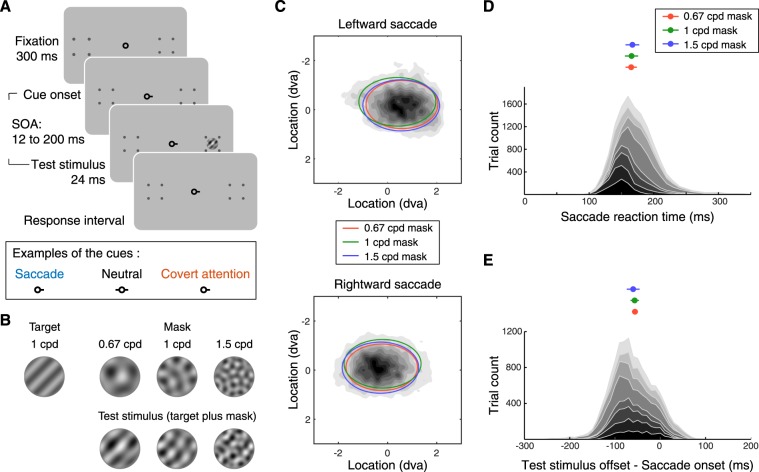
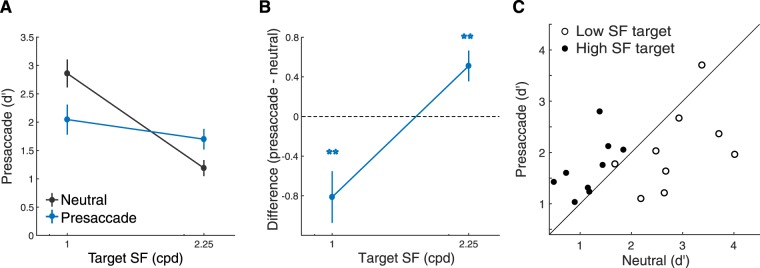
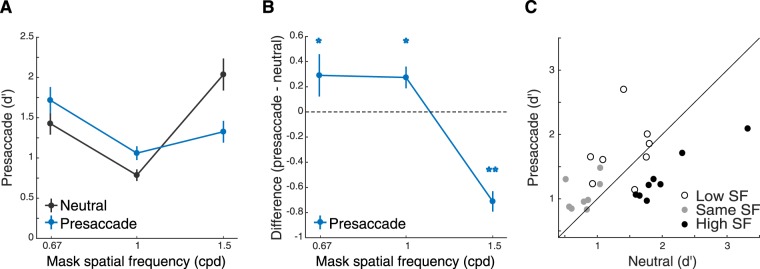
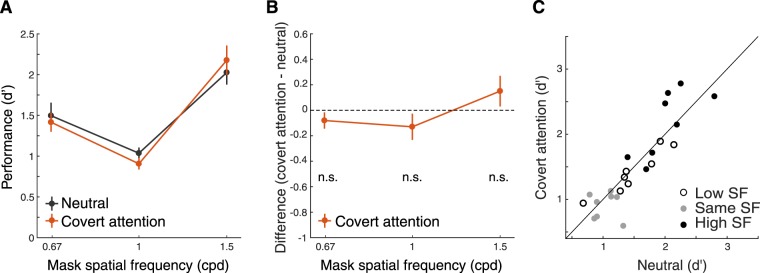
Right before we move our eyes, visual performance and neural responses for the saccade target are enhanced. This effect, presaccadic attention, is considered to prioritize the saccade target and to enhance behavioral performance for the saccade target. Recent evidence has shown that presaccadic attention modulates the processing of feature information. Hitherto, it remains unknown whether presaccadic modulations on feature information are flexible, to improve performance for the task at hand, or automatic, so that they alter the featural representation similarly regardless of the task. Using a masking procedure, here we report that presaccadic attention can either improve or impair performance depending on the spatial frequency content of the visual input. These counterintuitive modulations were significant at a time window right before saccade onset. Furthermore, merely deploying covert attention within the same temporal interval without preparing a saccade did not affect performance. This study reveals that presaccadic attention not only prioritizes the saccade target, but also automatically modifies its featural representation.
在我们移动眼睛之前,扫视目标的视觉表现和神经反应会增强。这种前眼动注意效应被认为优先处理扫视目标,并增强对扫视目标的行为表现。最近的证据表明,前眼动注意调节特征信息的处理。到目前为止,尚不清楚特征信息的前眼动调节是否具有灵活性,以提高手头任务的性能,或者是自动的,因此无论任务如何,它们都会以相似的方式改变特征表示。使用掩蔽程序,我们在这里报告说,前眼动注意可以根据视觉输入的空间频率内容来提高或损害性能。这些违反直觉的调制在眼动开始前的时间窗口内非常显著。此外,仅仅在不准备眼动的相同时间间隔内部署隐蔽注意并不会影响性能。这项研究表明,前眼动注意不仅优先处理扫视目标,而且还自动修改其特征表示。